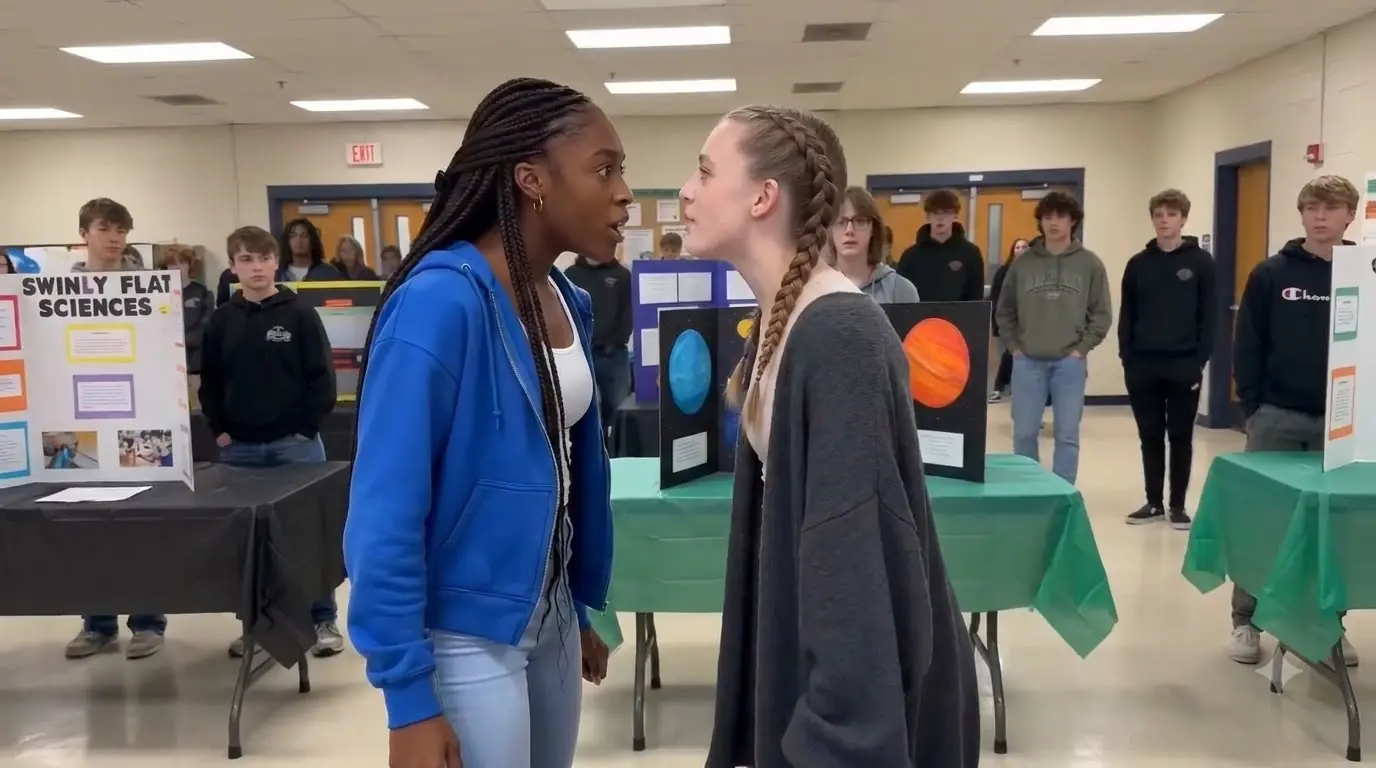
Saturn’s ring would not stay straight. Nia Caldwell had repaired it three times before eight that morning, first with glue, then with a hidden strip of clear tape, and finally by replacing the thin cardboard loop with one cut from the lid of an old oatmeal container. Her mother watched from the kitchen doorway while Nia held the painted planet at eye level and muttered that nobody at a high-school science fair was going to measure Saturn’s angle with NASA equipment. Nia was not convinced.
She was seventeen, Black, tall and slim, with long neat braids that fell past her shoulders and a face that tended to look serious whenever she concentrated. That morning she wore light blue jeans, clean white sneakers, a white tank beneath a royal-blue zip hoodie, and small silver earrings her grandmother had given her for her sixteenth birthday. Her solar-system model sat on a circular cardboard base nearly three feet wide, with hand-painted planets mounted on wooden rods around an orange sun. It had taken her most of six weeks to finish.
Her mother, Denise Caldwell, walked closer and inspected Saturn with exaggerated seriousness. “If anybody rejects this because the ring tilts four degrees left, I’ll personally call the Smithsonian,” she said, and Nia finally laughed. Her father, Anthony Caldwell, entered carrying two travel mugs and announced that he had already loaded a folding crate into the car so the model would survive the drive to school. For ten peaceful minutes, the biggest problem in Nia’s life really was Saturn.
By noon, the entire solar system would be broken across a science-fair table. Jupiter would roll underneath another student’s display, Mars would be crushed beneath a piece of cardboard, and the orange sun would hang sideways from a snapped wooden support. Two students would be on the floor nearby, dozens of phones would be recording, and Nia would stand in the middle of the room breathing hard while teachers ran toward her. But none of that made sense without what had happened during the previous seven months.
Nia had transferred into Evergreen Heights High School at the beginning of junior year after her father accepted a job supervising maintenance systems for the county transit authority. Evergreen sat in one of the wealthiest suburbs outside Baltimore, surrounded by large houses, private tennis clubs, and neighborhoods where most students had known one another since elementary school. The school itself was public, but its advanced STEM academy accepted students through a competitive district application, and Nia had earned one of the open seats after scoring near the top of the entrance assessment. She arrived with a 3.9 GPA, a love of astronomy, and no interest in becoming a symbol of anything.
Her family was comfortably middle class rather than wealthy. Denise managed payroll for a regional hospital, Anthony spent fifteen years working his way from electrical technician to maintenance supervisor, and the Caldwells lived in a brick townhouse twenty minutes from Evergreen. They could afford school supplies, occasional vacations, and the used car Nia hoped to inherit after graduation, but they discussed college costs at the dinner table because numbers still mattered. Nia had never considered any of that unusual until Evergreen students began trying to classify her.
The first person to do it was Claire Whitman, another seventeen-year-old junior who would later become Nia’s most persistent problem. Claire was white, with pale skin, brown hair usually braided tightly behind her head, and a habit of wearing cropped gray cardigans over black tops with dark jeans and white sneakers. Her father owned a commercial landscaping company, her mother was a dental surgeon, and Claire had attended schools in the Evergreen district since kindergarten. She knew nearly everyone who mattered socially before Nia learned where the second-floor bathrooms were.
Claire’s closest friend was Dylan Foster, a white seventeen-year-old boy with sandy-blond hair, a red varsity jacket, blue T-shirt, dark jeans, and the restless confidence of somebody who believed every social situation improved when he entered it. Dylan was not a varsity athlete despite the jacket; his older brother had given it to him after graduation, and Dylan wore it often enough that people associated the red sleeves with him. He liked performing for crowds, disliked being ignored, and laughed hardest when Claire made someone uncomfortable. Together, they functioned less like a couple than two people who reinforced each other’s worst instincts.
Their first interaction with Nia seemed harmless. During orientation, Claire saw the Evergreen STEM Academy card clipped to Nia’s folder and asked whether she had entered through “the diversity transfer program.” Nia corrected her politely and said the academy used districtwide academic applications. Claire smiled and replied, “Same basic idea,” before walking away with Dylan.
Nia mentioned the exchange to Denise that evening while unpacking notebooks. Her mother asked whether Claire had explained what she meant by diversity transfer. Nia said no, then added that she probably meant students from other districts or schools. Denise told her not to assign motives after one strange conversation, advice Nia considered fair. The second conversation made that generosity harder.
Their Advanced Physics teacher, Dr. Samuel Harris, gave students a diagnostic problem involving velocity, gravitational force, and orbital motion. Nia solved it quickly because similar material had been covered at her previous school, and Harris asked her to write the solution on the board. When she finished, Claire whispered loudly enough for two rows to hear, “Guess they really trained the new STEM diversity kid.” Dylan laughed.
Nia turned. “What does diversity have to do with gravity?” she asked, and several students smiled. Claire immediately said she meant diversity of academic backgrounds.
Nia did not continue the argument. She had been at Evergreen for nine school days and wanted friends more than enemies. Still, she wrote the comment down later because something about how quickly Claire changed the explanation bothered her. It would become the first entry in a note eventually containing dozens.
September established the pattern. Nia earned the highest score on a physics quiz, and Claire asked whether transfer students received extra-credit adjustments during their first semester. Nia brought a refurbished laptop to robotics club, and Dylan joked that the STEM academy must hand out good equipment to its “special recruits.” When Nia wore a new pair of sneakers, Claire asked whether they were authentic and immediately called the question harmless when Nia looked annoyed.
The assumptions contradicted one another constantly. Nia was apparently poor enough to require donated electronics but somehow privileged enough to receive easier grades; academically underprepared yet unfairly favored; threatening when she disagreed but arrogant when she ignored people. None of it needed internal logic because the purpose was not to understand Nia. The purpose was to keep her in a position where every accomplishment required explanation.
Nia’s first real friend at Evergreen was Leah Kim, a Korean American girl from robotics who wore enormous glasses, carried three pens in her hair, and possessed no social instinct for pretending obvious things were subtle. After hearing Claire question one of Nia’s physics scores, Leah asked whether she had noticed that Claire never made similar comments about Ryan Walsh, a white student who had also entered through the district STEM application. Nia had noticed. She just had not wanted to make the comparison aloud.
Ryan was not wealthy. His father drove delivery trucks, and his family qualified for reduced lunch, facts several classmates knew because Ryan mentioned them openly. Yet nobody asked whether his computer had been donated, whether his shoes were real, or whether his test scores reflected special treatment. Claire’s fascination with money appeared almost exclusively around Nia.
Leah said what Nia had been reluctant to say. “She thinks Black plus transfer equals charity case, and every fact that doesn’t fit becomes another joke.” Nia told her that sounded dramatic. Leah shrugged and said dramatic did not automatically mean incorrect.
October provided proof in writing. Evergreen posted photographs from a robotics showcase, including one of Nia explaining a small sensor array beside Dr. Harris. Claire shared the photograph in a junior group chat with the caption, Evergreen found its STEM brochure girl.
Dylan replied, Gotta prove the program works somehow, followed by laughing emojis. Another student asked what program he meant because Nia was enrolled through the same academy application as Ryan. Dylan answered, You know what I mean.
Someone sent Nia a screenshot. She stared at it for nearly ten minutes before showing Leah. Then she took it to Assistant Principal Janice Cooper.
Cooper met with Nia first, then Claire and Dylan separately. Both insisted the messages criticized school marketing rather than race, and Claire said Evergreen featured new students heavily because administrators wanted the academy to appear inclusive. Cooper told them that repeated comments connecting one Black student’s achievements to diversity could become discriminatory harassment even without explicit language. Both received formal warnings.
For about three weeks, the jokes stopped. Nia’s shoulders stopped tightening whenever Claire entered a room, and she began enjoying school enough to join the Astronomy Club. Dr. Harris encouraged her to apply for the spring science fair, where juniors could compete for scholarships and a spot at the county STEM expo. The idea excited Nia because astronomy had been the subject she loved before other people started attaching politics to everything she accomplished.
Then she found a photocopied brochure inside her locker. Someone had circled the photograph of a Black student on the cover and written REPRESENTATION MATTERS! in thick black marker with three laughing faces underneath. Cameras did not cover the locker interior, and dozens of students passed through the hallway between classes.
Claire and Dylan denied involvement. Cooper documented the incident but could not assign discipline. Nia told herself she did not care.
At home, however, she ripped the brochure into pieces before throwing it away. Denise saw the paper in the trash and asked what happened. That was when Nia finally explained everything.
Anthony became angry faster than Denise. He wanted a meeting with the school the next morning and repeatedly asked why administrators had not called them after the first group-chat incident. Nia said she had asked the school to handle it without involving parents because she was nearly eighteen. Anthony replied that independence did not mean accepting unlimited mistreatment.
Denise calmed both of them. She suggested Nia begin keeping exact dates, wording, witnesses, and screenshots rather than relying on memory. She also asked an important question: did Claire treat white STEM Academy students the same way?
“No.” Nia answered before Denise finished. Her mother nodded.
“Then keep that comparison.”
November shifted the conflict from jokes into reputation. Evergreen announced applications for a county engineering workshop, and Dr. Harris nominated Nia along with Ryan, Leah, and three other students. Claire had wanted the nomination but did not receive one because her current physics grade was below the program threshold. She told several classmates that Harris had chosen Nia because the county wanted “different faces” at the event.
Leah confronted her directly. “Or maybe she has a ninety-eight in physics.” Claire answered that grades were not everything.
“Apparently they are when you’re mad yours is an eighty-eight,” Leah said. Dylan laughed at first, then stopped when Claire looked at him.
The remark reached Cooper through another student. Claire received detention because it violated the earlier warning. Her mother, Beth Whitman, requested a meeting and argued that the school was turning academic competition into a racial disciplinary case.
Principal Martin Ellis reviewed the documented incidents. He asked Beth why her daughter repeatedly described Nia’s opportunities through diversity while treating Ryan’s success as ordinary. Beth said teenagers were careless with words.
Ellis agreed. Then he said repetition made careless words less accidental. The warning remained.
Claire returned from detention believing Nia had caused it, even though Nia had not filed that particular report. She started describing Nia as someone who “collected complaints” whenever students disagreed with her. Dylan amplified the story because it gave him an audience.
A short video appeared on social media showing Nia arguing with another student during robotics. The caption called her Evergreen’s favorite angry genius. The argument had actually involved two students disagreeing about programming errors, but the clip began after Nia raised her voice and ended before the other student apologized for deleting part of their code.
Dylan had posted it. Nia asked him to take it down. He told her that public conversations were public content.
Nia reported the clip. Evergreen required Dylan to remove it because he had used images recorded during a school activity for targeted ridicule. Dylan removed it and told friends Nia could not handle being seen “as she really was.”
The phrase stuck. Angry. Difficult. Defensive. Aggressive.
Nia started noticing how often adults used softer versions too. When she challenged something confidently, one teacher told her to soften her tone, while Dylan could interrupt classmates repeatedly and be described as enthusiastic. During group work, Claire could become frustrated and be called competitive, while Nia’s frustration turned into attitude.
None of those moments alone proved anything. Together, they made Nia increasingly conscious of how she moved, spoke, and reacted. She began editing herself before other people could.
At dinner one night, Anthony noticed she had become unusually quiet. “You’re doing that thing where you pretend nothing’s wrong until everybody else gets tired of asking,” he said. Nia denied it.
Denise looked at her over the table. “Are you trying not to look angry?”
The question hit too accurately. Nia stared at her plate.
Her mother sighed. “Baby, being calm is useful. Performing calm every second because you’re scared somebody will stereotype you is exhausting.” Nia said she did not know the alternative.
Denise told her the alternative was not rage. It was refusing to take responsibility for other people’s assumptions.
That distinction took months to learn.
December brought the project that would eventually become the science-fair model. Dr. Harris assigned students to propose demonstrations explaining a scientific concept through a physical build, experiment, or simulation. Nia chose a model of the solar system because she wanted to illustrate relative orbital relationships and planetary differences without pretending scale could be represented accurately on a classroom table. She planned to build the entire thing from inexpensive materials.
Claire chose a project involving plant growth under different artificial light conditions. Dylan was not enrolled in Advanced Physics but planned to help the audiovisual club record the fair. When he heard what Nia was building, he said kindergarten classrooms already had solar-system models hanging from ceilings.
Nia told him kindergarten classrooms also had plants. Dylan did not have an answer.