Rhett Callaway did not remember falling asleep. The overnight flight from Denver to New York hummed through thin cloud cover, the business class cabin lights dimming to a low amber glow. And after nearly 40 hours without rest, his body finally surrendered what his mind had been refusing to give. When he opened his eyes, the first thing he registered was expensive fabric, white, structured, immaculate, and the slow, terrible understanding that his head was resting on the shoulder of a woman he had never met. Her assistant, seated one row back, was staring at him with the expression of someone deciding whether to cause a scene.
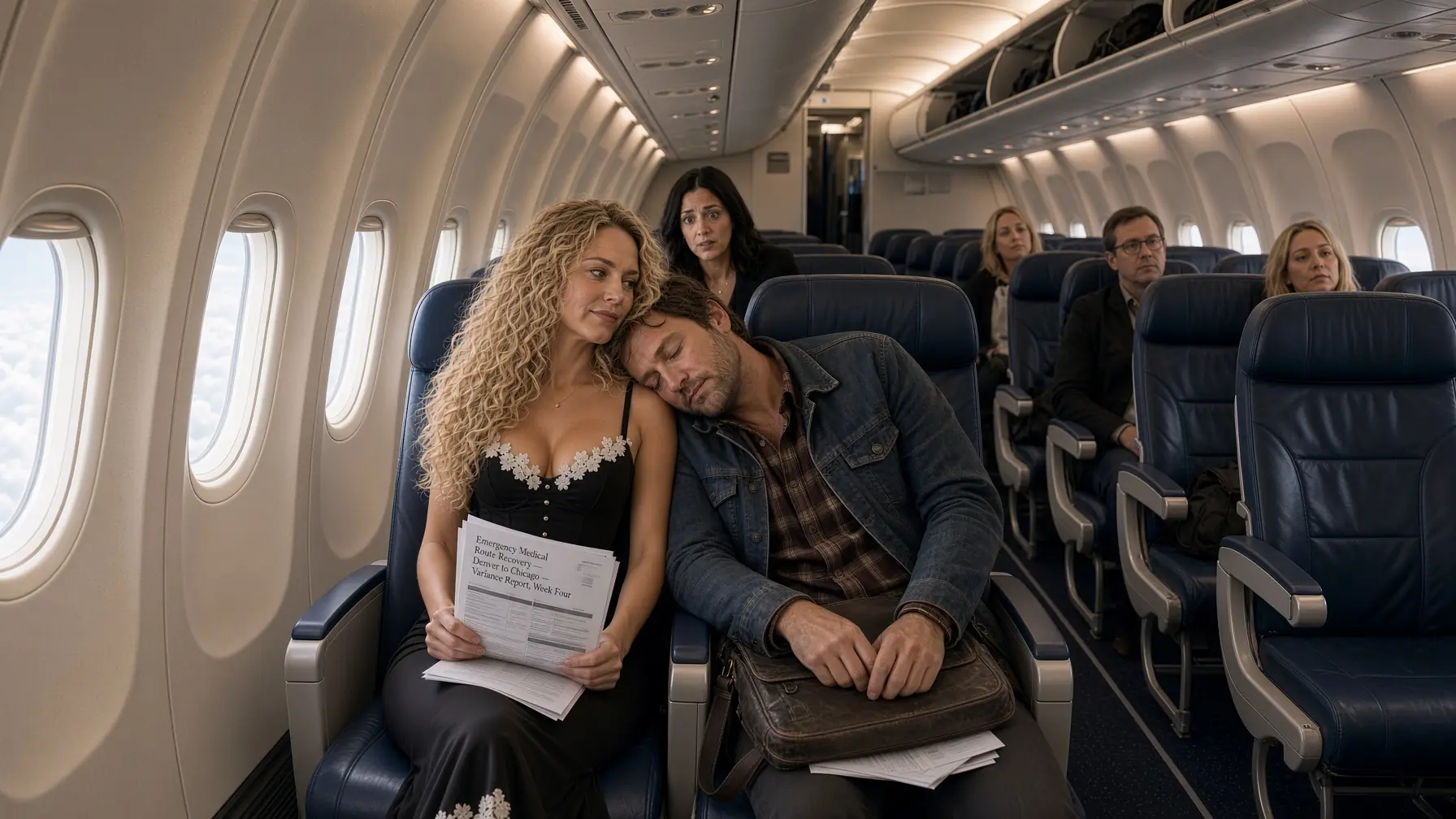
A few passengers had already looked over. Rhett straightened immediately, jaw tight. I'm sorry. I didn't mean to do that. The woman did not flinch, did not reach for a flight attendant, did not make it a moment.
She simply glanced at the papers folded in his hand. The top sheet read, "Emergency medical route recovery, Denver to Chicago, variance report, week four. You work in logistics." Rhett nodded once. The following morning, she called him to the 52nd floor of Von Meridian Systems, not to confront him, to hire him to save her company. Why would a CEO let a stranger sleep on her shoulder and then offer him the keys to her entire operation the very next day?
The seat had not been his by right. Rhett Callaway was a man built for economy class. Not in any way that diminished him, but in the honest sense that business class had never been part of the life he was living now. He wore a dark canvas jacket that had been through better seasons, carried a laptop with a logistics conference sticker peeling at one corner, and kept a battered backpack with a side pouch permanently stretched from holding water bottles for long warehouse walks. The tray table in front of him held a folded paper route map, a halfeaten granola bar, and a phone showing three missed calls from a number saved as Nolan home.
He was not the kind of man who belonged in wide leather seats with warm towels and complimentary wine. But the man who had given him the upgrade had insisted. a client from two years ago, a regional hospital network director named Shephard, who had called Rhett when his refrigerated pharmaceutical shipment stalled outside Pittsburgh in January. Rhett had rerouted it in 11 minutes from his kitchen table on a Sunday night while his son slept upstairs. Shephard had never forgotten. When his company received the seat upgrade and he found himself unable to travel, he had transferred it to Rhett without hesitation, adding a note that said simply, "You saved more than cargo that night."
Rhett had accepted because the alternative was a 6-hour connection through Atlanta, and he had learned not to argue with small kindnesses. Clare vaugh was already in the window seat when he boarded. She was the kind of woman whose stillness announced authority, not loudness, not performance, just the settled certainty of someone accustomed to being the most prepared person in any room. Her suit was pale winter white cut cleanly with the kind of fit that suggested a tailor rather than a rack. She had a leather folder open on the tray table and a tablet propped against the seatback, and she was reading something on both simultaneously, which Rhett recognized as a sign of someone managing a problem that refused to stay in one document.
Her assistant, a sharpeyed woman with dark hair and a slim notebook already open, sat in the row directly behind them. Rhett caught her name during the boarding shuffle, Brooke Ellis, when a flight attendant confirmed her seat number. Clare had not acknowledged Rhett. When he sat down, she offered one brief neutral glance of the kind that says, "I have noticed you exist and have already decided you require no further attention." And then returned to her work. That was fine with Rhett.