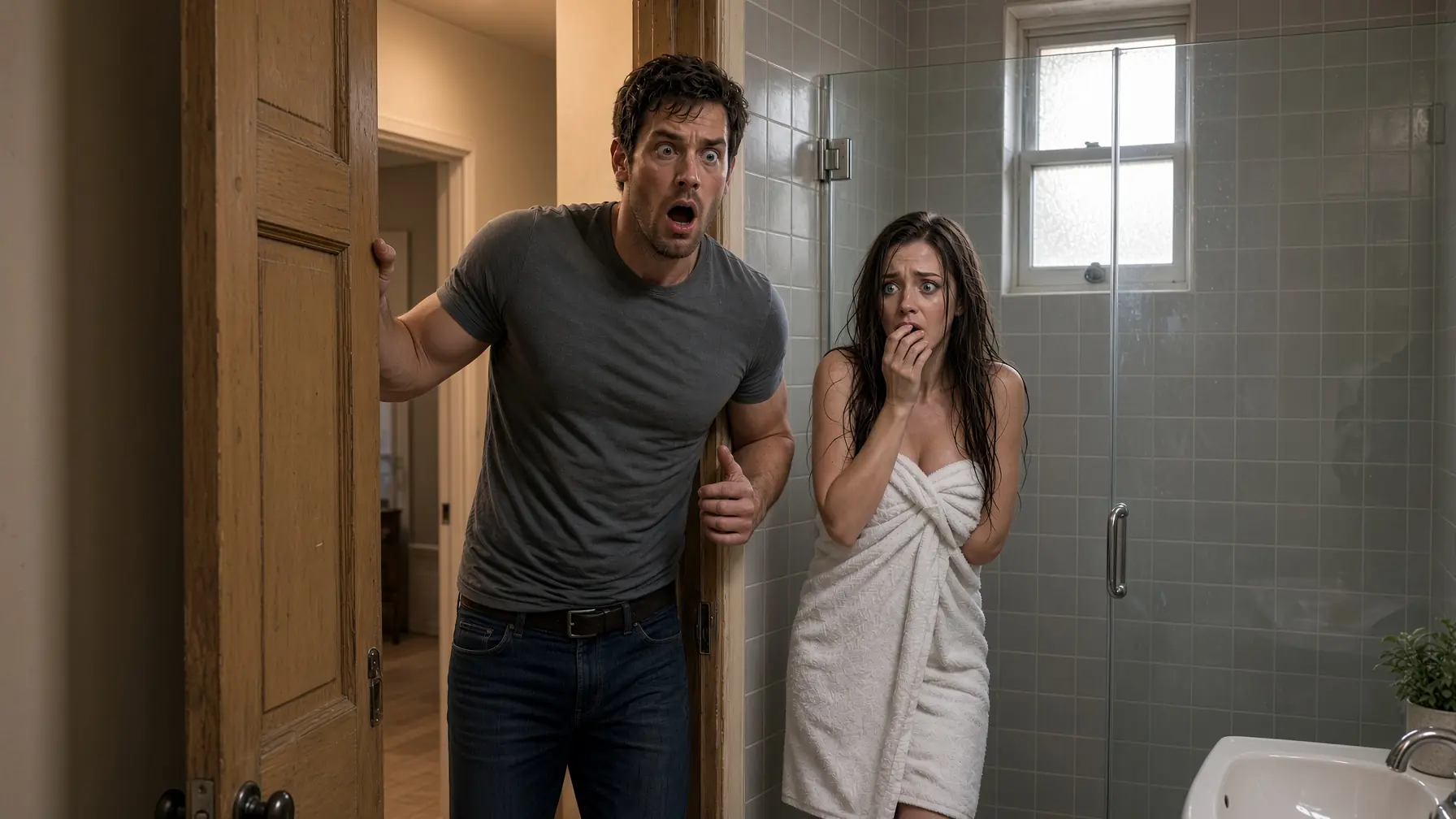
The steam hung thick in the small bathroom when Aaron Miller pushed open the door. He expected nothing more than the quiet routine of a Saturday morning, the familiar hum of old pipes, the flicker of fluorescent light, struggling against decades of grime. What he found instead was a woman pressed against the far wall, wrapped in nothing but a towel, her dark hair dripping, her chest heaving with each ragged breath, her eyes wide and glassy with terror, locked onto his. For a moment, neither of them moved. Then her voice came out in a broken whisper, barely audible above the drip of the faucet.
"Please don't call the police." Aaron's hand froze on the doorframe. His mind raced through a dozen possibilities, none of them good. Behind him, down the narrow hallway of his cramped apartment, he heard the soft padding of small feet. "Daddy," Mia's voice called out, curious and innocent.
Aaron's body shifted instinctively, blocking the doorway, shielding whatever this was from his seven-year-old daughter. The woman's eyes darted toward the sound of the child's voice, and something in her expression shattered even further. Aaron Miller had grown accustomed to hard mornings. The alarm on his phone would sound at 5:30, and he would lie there for exactly 3 seconds, staring at the water stain on the ceiling that had been spreading slowly for the past 2 years. Then he would swing his legs over the side of the bed, his feet finding the cold floor, and begin the ritual of another day.
The apartment was small, a two-bedroom unit on the third floor of a building that had seen better decades. The hallways always smelled faintly of cooking oil and mildew, and the elevator had been broken since before he moved in. But it was theirs, his and Mia's, and he had learned to find warmth in its cramped spaces. Every morning, he would wake Mia, gently brushing the tangled blonde hair from her face, watching her eyes flutter open with that mixture of confusion and joy that only children possess. She would reach for him, wrapping her small arms around his neck.
And in that moment, Aaron would remember why he kept going, why every difficult day was worth enduring, why he had not simply given up when the world had tried to break him. He worked as a plumber now, though the word felt strange in his mouth, even after 3 years. His hands, which had once designed complex electrical systems for commercial buildings, now gripped wrenches and snaked drains. The transition had been brutal, not just economically, but spiritually. He remembered the first time a client had looked at him with that particular expression.
The one that said, "You are beneath me." And he had wanted to explain that he had once worn a suit, had once sat in meetings where his opinion mattered, had once been somebody worth knowing. But he had said nothing. He had fixed the leak, collected his cash, and driven home in his rusted pickup truck with a taste of humiliation thick on his tongue. The hardest part was not the work itself.
Aaron had never been afraid of labor, had never thought himself above getting his hands dirty. The hardest part was the invisibility. When you wore a tool belt instead of a tie, people stopped seeing you as a person. You became a function of service, something to be summoned and dismissed without acknowledgement or thanks. Clients would talk on the phone while he worked, discussing their lives as if he were furniture, as if his presence did not register on any meaningful level.
Three years ago, Aaron Miller had been a rising engineer at Hail Systems, one of the most prestigious tech firms in the Midwest. He had designed the backup protocols for their flagship data center, had been praised in company meetings, had seen his name mentioned in internal newsletters as someone to watch. He had a corner desk by the window. He had colleagues who respected him, who sought his opinion on difficult problems, who invited him to after-work drinks on Friday evenings. He had a future, or so he believed.
Then came the system failure. It happened on a Thursday night. A cascading error brought down the entire Eastern server cluster. Forty-eight hours of downtime, millions in losses, angry clients threatening lawsuits, and someone needed to take the blame. The logs pointed to Aaron's workstation.
The evidence was clear, damning, irrefutable. Timestamps showed modifications made from his login. Code changes traced back to his credentials, a digital fingerprint that could not be denied. He had protested, of course. He had insisted that someone had tampered with the records, that he had not even been in the office during the critical window, that the whole thing was impossible, but no one listened.
The evidence was too clean, too complete, too perfectly constructed to leave room for doubt. Richard Hail, the CEO himself, had stood in the conference room and pronounced judgment with the measured solemnity of a man who believed himself to be fair. Aaron was terminated immediately. His badge was confiscated.
Security escorted him from the building while his former colleagues watched in uncomfortable silence. Within weeks, his name had been blacklisted across the industry. Every application was rejected, every contact suddenly unavailable. The engineering career he had spent a decade building evaporated in a single afternoon, and no amount of protest could bring it back.
Elena Parker had never known what it meant to want. She had grown up in a house with 12 rooms, and a staff of seven, attended private schools where the daughters of senators sat beside her in calculus class, had spent summers in Europe, learning languages she would never need. Her childhood had been a carefully curated experience designed to produce a certain kind of woman, polished and pleasant and perfectly prepared for a life of comfortable irrelevance. Her father had built his fortune in pharmaceuticals and when he died of a heart attack at 62, he left behind a legacy of wealth and obligation. Elena was expected to marry well to continue the family's social standing, to be beautiful and silent and grateful for the gilded cage that surrounded her.
Richard Hail had seemed at first like a reasonable choice. He was powerful, respected, connected to all the right people, and invited to all the right events. He was 15 years her senior, but still handsome in that sharp, calculating way that certain powerful men cultivate. Their courtship had been brief and efficient, more merger than romance. Richard had courted her the way he acquired companies, with strategic precision and careful attention to value.