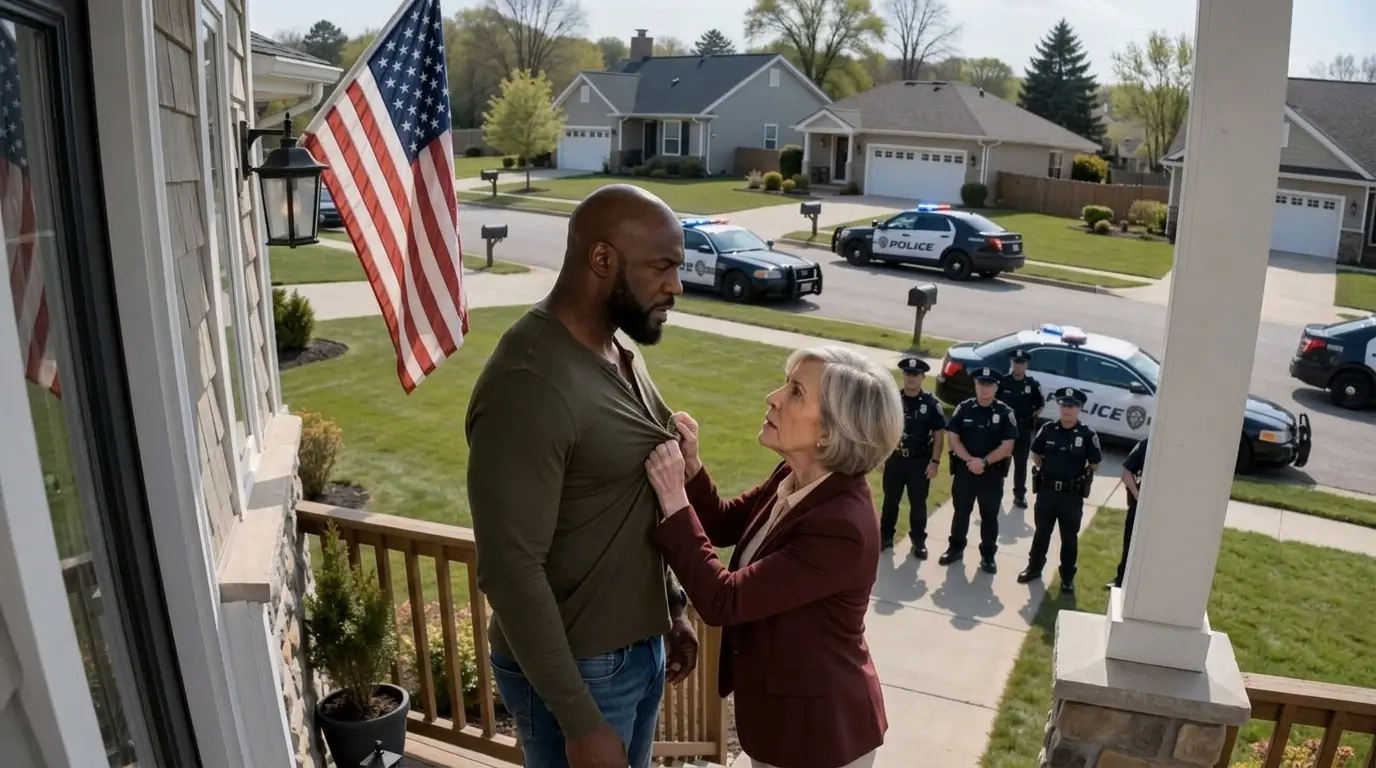
At 4:37 on a bright Saturday afternoon, Marcus Reed stood on the front porch of his own house while five police officers watched from the walkway below. Marcus was forty-two, Black, broad-shouldered, with a trimmed beard, wearing faded jeans, brown work boots, and a dark olive long-sleeve shirt he had thrown on after spending most of the morning repairing shelves in the garage. Standing inches from him was Patricia Langley, a sixty-three-year-old white woman with short silver-blonde hair, cream slacks, low heels, and the burgundy blazer she wore whenever she wanted people in the neighborhood to know she represented the homeowners association. Patricia had one hand near Marcus’s collar and the other pointed toward his face as if she were the person with authority on his porch.
“Stop touching me,” Marcus said for the third time. Patricia released part of his shirt but did not step away, instead turning toward the officers and insisting that Marcus had been “aggressive from the beginning.” Sergeant David Miller, who stood nearest the steps, told both of them to keep their hands to themselves while two other officers watched the driveway and another pair remained closer to the sidewalk. Marcus stared at the small crowd of uniforms and wondered how a Saturday spent assembling bookshelves had somehow become this.
Patricia jabbed a finger toward the open front door. “The homeowner is military,” she said, loud enough for the officers and three watching neighbors to hear. “This man will not even tell us why he’s inside.” Marcus looked at her with an exhaustion that had replaced anger twenty minutes earlier. “Because I live here,” he said.
Patricia laughed. It was not a nervous laugh or an embarrassed one, but the dismissive sound of someone hearing an explanation she had already decided was absurd. She told Sergeant Miller that the actual homeowner was “a decorated Army officer” and that everyone on Hawthorne Court knew it. Marcus nodded slowly. “You are right about that part.”
The video that would later reach millions of viewers began around then. It came from the doorbell camera mounted above Marcus’s shoulder, giving the scene a wide view of the porch, the American flag moving beside one column, the patrol vehicles on the street, and the line of officers standing below. The footage showed Patricia reaching toward Marcus again, grabbing fabric near the front of his shirt before he pulled away. It also showed the front door opening behind them almost eleven seconds later.
A Black woman in Army dress blues stepped onto the porch. She was forty-one, tall, composed, with her dark hair secured in a regulation bun and rows of ribbons arranged precisely across her uniform. Silver eagles sat on her shoulders, identifying her as a colonel. Colonel Renee Reed looked first at the officers, then at Patricia, then at her husband.
“What is going on?” she asked. Nobody answered immediately. Marcus pointed toward Patricia without looking away from her. “Apparently I don’t live here.”
Patricia’s face changed. Sergeant Miller turned toward Renee, and two of the officers farther down the walkway straightened almost instinctively after noticing the rank insignia. Renee looked at Marcus, then back toward the group. “He doesn’t just live here,” she said. “His name is on the deed with mine.”
For the internet, that was the twist. A white HOA woman had called police on a Black man she assumed did not belong in an expensive neighborhood, only for a decorated Black Army colonel to emerge from the house and identify him as her husband. It was short, visual, and emotionally satisfying enough to fit perfectly inside a viral caption. For Marcus and Renee, however, the story had started almost a year earlier.
They had moved to Kingsley Preserve, a planned community outside Fayetteville, North Carolina, after Renee received orders assigning her to Fort Liberty. The neighborhood was less than thirty minutes from base and filled with a mix of active-duty families, retired military officers, physicians, contractors, federal employees, and people who simply wanted large yards without moving completely into the countryside. Most homes had brick or stone fronts, two-car garages, carefully maintained lawns, and flags hanging near the entryways. The Reeds chose a four-bedroom house at the end of Hawthorne Court because it had a workshop space for Marcus and a downstairs bedroom where Renee’s mother could stay when visiting.
Marcus worked remotely as a cybersecurity consultant for a defense contractor headquartered in Northern Virginia. He had served eight years in the Air Force when he was younger, earned his computer-science degree afterward, and eventually built a career that allowed him to work from almost anywhere with a secure connection. He rarely talked about money, rank, or military history because none of those things seemed especially interesting to him anymore. Neighbors usually saw a Black man in jeans walking a dog, fixing something in his garage, or collecting packages at strange hours between client calls.
Renee’s career was easier for strangers to recognize. She had spent nineteen years in the Army, served overseas several times, and was now a colonel working in medical logistics. When she left home in uniform, nobody needed an explanation for why she lived in Kingsley Preserve. The insignia, ribbons, and government plates on one vehicle seemed to communicate status before she said a word.
Patricia Langley introduced herself on moving day. She lived four houses down and served as president of the Kingsley Preserve Residential Association, a position that technically involved landscaping contracts, architectural approvals, pool rules, and budgets. Patricia treated it like elected office. She arrived carrying a welcome folder thick enough to qualify as a small textbook.
She spent nearly twenty minutes explaining trash schedules, acceptable mailbox colors, parking rules, and which contractor had permission to pressure-wash sidewalks. Marcus listened politely while unpacking dishes. Renee came downstairs halfway through the conversation wearing her uniform after returning from an afternoon briefing. Patricia’s entire demeanor changed.
“Oh, Colonel,” she said, suddenly warmer. Renee smiled and explained that they had just arrived from Virginia. Patricia immediately began asking questions about Fort Liberty, deployments, and whether Renee planned to attend the neighborhood’s military-appreciation dinner. Marcus stood beside them holding two coffee mugs and noticed Patricia never asked what he did.
That alone meant nothing. People were curious about uniforms, especially in a community near one of the country’s largest military installations. Marcus understood that and forgot about it. A week later, however, Patricia knocked on the garage door while he was assembling a workbench.
“Can I help you?” Marcus asked. Patricia looked past him toward the shelves. “Is Colonel Reed home?”
“No.” Marcus waited. Patricia explained that an association form needed a homeowner signature before a backyard fence could be approved. Marcus held out his hand.
“I can sign it.” Patricia hesitated. “It needs a homeowner.” Marcus looked at her. “Yes.”
The pause lasted only a second, but it said more than the words. Patricia finally handed him the paper after Marcus explained that his name was also on the house. She apologized lightly and said she had assumed the property belonged to Renee because the association records listed her first. Marcus signed the form and returned to his workbench.
That evening, he mentioned the exchange over dinner. Renee shook her head but did not seem surprised. “She probably saw my name first because the closing paperwork was submitted through my relocation office.” Marcus nodded. “Probably.”
Neither wanted a conflict with the HOA president during their first month. They had moved enough times to know that neighbors could turn small disagreements into years of discomfort. Marcus decided to assume the best. Patricia made that decision increasingly difficult.
The next incident involved a package. Marcus received a large computer monitor that required a signature, and the delivery driver left it temporarily inside the open garage while Marcus finished a client call upstairs. Patricia was walking her dog when she saw a delivery worker entering the garage. She called the neighborhood security line.
The security patrol arrived five minutes later. Marcus came downstairs and found a uniformed contractor speaking with the delivery driver beside his garage. Patricia stood across the street holding her dog’s leash. She told Marcus she was only being cautious because “the colonel travels.”
Marcus stared at her. “So do I.” Patricia smiled as though he had missed the point. “You know how things are now.”
He did not know what that meant. He asked. Patricia told him there had been package thefts in a nearby subdivision.
Marcus glanced at the monitor box. “A delivery driver carried a package into my garage.” Patricia said she had no way of knowing he was a real delivery driver. Marcus looked at the company truck parked directly behind them. Patricia changed the subject.
Renee became less willing to dismiss the pattern after that. “She sees me as the homeowner and you as somebody attached to me.” Marcus laughed. “That would technically describe a husband.”
Renee did not laugh. “You know what I mean.” Marcus did.
Still, they tried to keep things peaceful. Kingsley Preserve had been good to them otherwise. Their neighbors Tom and Elise Walker invited them to cookouts, a retired Marine named Carlos Mendoza helped Marcus repair a lawn mower, and the couple across the street brought homemade cookies when Renee left for a two-week exercise.
Most residents treated the Reeds exactly as they treated anyone else. That made Patricia’s behavior easier to isolate. She was not the entire neighborhood. She was one person with enough confidence in her assumptions to make those assumptions other people’s problem.
During Renee’s training exercise, Marcus had a contractor install extra electrical outlets in the garage. Patricia drove past, stopped, backed up, and asked whether the workers had architectural approval. Marcus told her interior electrical work required no association approval. Patricia said she would check.
“Feel free,” Marcus answered. She did.
The association manager later emailed Marcus apologizing for the unnecessary inquiry. Interior work was outside the HOA’s authority unless it affected exterior structures. Marcus forwarded the message to Renee with one sentence. Your mayor is at it again.
Renee replied with a laughing emoji. Then she wrote, Save everything.
That advice became important.
Over the next several months, Marcus kept a small folder containing association emails, camera clips, and screenshots. He did not collect them because he expected litigation. He collected them because Patricia had developed a habit of remembering encounters differently after someone challenged her.
In May, Marcus parked a rented pickup in the driveway while helping Tom move a heavy patio table. Patricia reported an unauthorized commercial vehicle. In June, Marcus’s younger cousin Darius stayed for three nights while attending a conference in Fayetteville, and Patricia asked two neighbors whether the Reeds had taken in a tenant. In July, she complained that Marcus was using the garage for “commercial activity” because she saw him receiving computer equipment.
Every complaint disappeared once the association office checked the facts. None resulted in penalties. That allowed Patricia to describe herself as merely cautious rather than repeatedly wrong.
The racial element became harder to ignore during the annual neighborhood cookout. Marcus and Renee were talking with several families when Patricia approached with a new resident named Beth Morgan. Patricia introduced Renee first. “This is Colonel Reed, one of our military homeowners.”
Then she gestured toward Marcus. “And this is Marcus.” She stopped there.
Marcus smiled. “Her husband.” Beth laughed because she assumed Patricia had simply forgotten. Patricia laughed too.
Later that afternoon, Beth asked Marcus whether he worked from home while Renee was stationed nearby. Marcus said yes and explained his cybersecurity role. Beth looked impressed. Patricia, standing beside her, said, “He’s very lucky her career lets them live in such great places.”
Marcus stared at her. Renee heard it from several feet away. “His career pays for half of those places,” she said.
Patricia immediately claimed she had meant military benefits made relocation easier. Renee did not argue. She simply looked at her until Patricia walked away.
That evening, Marcus said what they had both avoided saying. “She has a picture in her head.” Renee nodded.
“In that picture, you’re the decorated officer who belongs here.” Marcus opened the refrigerator. “And I’m what?”
Renee hesitated. Marcus answered for her. “Temporary.”
The word fit. Patricia did not treat him like a burglar every day. She treated him like somebody whose presence needed an explanation whenever Renee was not visible.
Marcus began noticing when the same standard was not applied elsewhere. White contractors walked into garages without anyone calling security. Teenagers visited homes without being questioned. Friends borrowed vehicles.
Patricia did not patrol every unfamiliar person. She reacted selectively. The pattern became especially obvious when the unfamiliar person was Black or Latino.
Carlos Mendoza had noticed too. He told Marcus that Patricia once questioned his adult son for sitting in a car outside the Mendoza house after midnight. “She asked him who he was waiting for,” Carlos said. Marcus asked whether Patricia knew Carlos’s son.
“She met him at Christmas.” Carlos shook his head. “Some people only remember you when you fit the role they assigned you.”