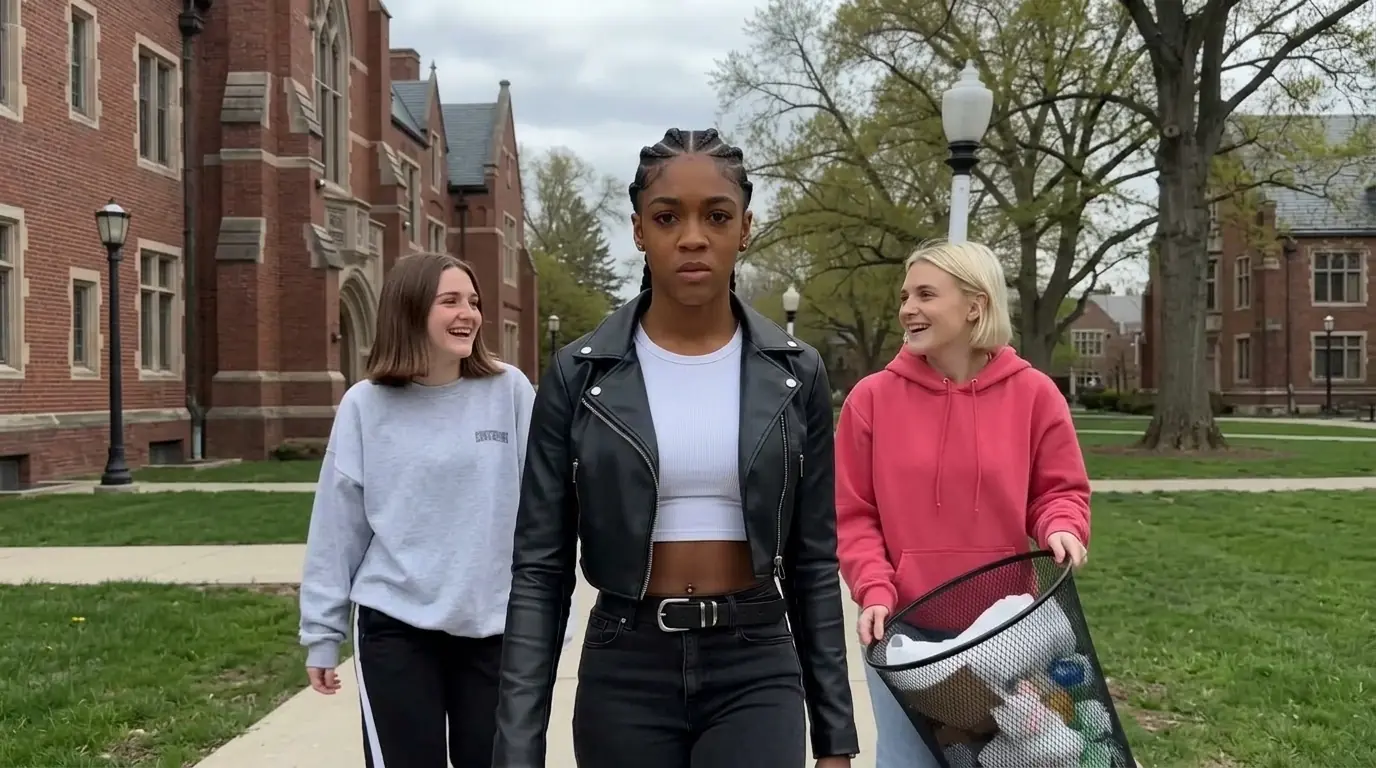
The first thing that struck Jordan Avery was not the paper cup that bounced from her shoulder. It was the smell. Old coffee, ketchup, damp napkins, something sweet and sour from a half-finished smoothie, and the unmistakable odor of campus trash slid over the back of her black denim jacket while students stopped in the middle of the brick walkway to stare.
Jordan did not turn around immediately. A white foam food container caught in the braids near the back of her head, a plastic bottle rolled between her boots, and fast-food wrappers settled around her feet like somebody had emptied a kitchen drawer over her. Behind her, two women were laughing. Jordan knew both voices before she looked.
Savannah Grant stood beside the overturned trash barrel with both hands covering her mouth as though she could not believe how funny the moment had become. Next to her, Brooke Whitman was bent slightly at the waist, laughing hard enough that her long brown hair had fallen across her face. Neither seemed to notice how many students had stopped walking. Neither noticed the first phones coming out.
Jordan reached slowly into her braids and removed the takeout container. She set it on the ground. Then she brushed two napkins from her shoulder, turned around, and looked directly at Savannah.
“You finished?”
Savannah straightened.
“Relax.”
Jordan looked at the trash spread across the walkway. “You dumped an entire trash can on me.”
“It tipped.”
Brooke laughed again.
Jordan nodded once.
“Okay.”
Then she turned and started walking away.
That was the part almost nobody understood when the video later reached millions of views. People watched Jordan standing motionless beneath the falling garbage and decided she must have been calculating what she would do next. They called the pause cold, dangerous, intimidating, even cinematic.
The truth was less dramatic.
Jordan was trying not to cry.
Six months earlier, she had arrived at Crescent Valley University with two suitcases, a used laptop, and enough anxiety to make the campus feel twice its actual size. She was twenty-one, entering her junior year after earning an associate degree from a community college outside Norfolk, Virginia, where she had spent two years taking classes during the day and working almost thirty hours a week at a rehabilitation-equipment warehouse at night. Crescent Valley was the first place she had ever lived where almost everybody around her seemed to assume college was the natural next step rather than something the family budget had to survive.
The campus stretched across rolling green lawns outside Charlottesville, with old red-brick buildings, newer glass classrooms, residence halls arranged around courtyards, and a student center that never seemed to close. Jordan got lost twice during orientation and once ended up in a music-practice building while looking for introductory public finance. Nobody knew her. She liked that.
Her mother, Marlene Avery, had raised Jordan and her younger sister in a small townhouse after Jordan’s father died from a stroke when she was thirteen. Money had never been absent, but it was never invisible either. Jordan understood what electricity cost, how long a set of tires could safely last, and why her mother sometimes said she was not hungry when dinner portions looked too small.
Transferring to Crescent Valley took financial aid, a state grant, summer savings, and a campus job. Jordan planned to study public policy and eventually work in municipal administration because she had spent enough of childhood watching small government decisions shape bus routes, school programs, rent assistance, and neighborhood resources without anybody she knew understanding who made those decisions. She almost never explained that dream to other students. Ambitions felt safer before strangers could judge them.
Jordan first met Savannah Grant during transfer orientation.
Savannah was also a junior, although she had been at Crescent Valley since freshman year. She was blond, polished, socially effortless, and one of those people who seemed to know the name of every resident assistant, club president, bartender, athletic trainer, and student-government officer within a mile of campus. Brooke Whitman was usually beside her, brunette, slightly quieter, and capable of turning almost anything Savannah said into something funnier simply by laughing before the sentence ended.
Their first interaction barely qualified as one.
Jordan stood beside a map outside Hampton Hall trying to locate a policy classroom when Savannah walked past and said, “Government building is completely the other direction.”
Jordan turned.
“Oh. Thanks.”
Savannah gave her a bright smile. “You’re welcome.”
Something about the tone made Brooke laugh.
Jordan assumed she had missed an inside joke and walked away.
The second time they met, Jordan was wearing a university facilities polo.
Her campus job was with the Student Union Operations Office. Most evenings she arranged tables, unlocked conference rooms, checked event reservations, moved portable signs, monitored closing procedures, and reminded student organizations that a building employee was not automatically their personal cleanup crew.
The work paid modestly but came with a supervisor who respected class schedules.
His name was Harold Jenkins.
Harold was sixty-four, Black, broad through the shoulders, and had worked at Crescent Valley for almost three decades. He knew which stairwell lights failed every winter, which ballroom thermostat lied by four degrees, which student organizations always overstayed reservations, and which vending machine returned dollar bills only if someone slapped the side panel.
He treated Jordan like an employee.
Not a scholarship student.
Not temporary help.
Not a kid.
She appreciated that.
By the end of September, Harold trusted her to close the east wing alone.
Savannah spent plenty of time inside the union because she served on the Student Programming Board. The board organized concerts, welcome-week activities, comedy nights, homecoming events, campus charity drives, and spring festivals. Members received radios, event credentials, early building access, and permission to enter several rooms ordinary students needed reservations to use.
Savannah loved all of it.
She carried the radio clipped to her jeans even when nothing was happening. She walked through staff-only doors with the confidence of someone who believed proximity to authority counted as authority itself. Brooke was not officially on the board, but she was around often enough that most facilities employees assumed she might be.
For the first month, Jordan and Savannah remained polite.
“Ballroom B open?”
“Your reservation starts at six.”
“Can you let us in at five-thirty?”
“I can do five-forty-five.”
“Perfect.”
Nothing unusual.
The first real problem happened during Homecoming Week.
Crescent Valley scheduled student events almost every night, and by Friday the union staff looked exhausted. Jordan worked a late alumni mixer that ended shortly after eleven. When she entered the west corridor afterward, she found paper decorations taped to walls, drink cups under chairs, pizza boxes stacked beside trash cans, plastic banners across the floor, and pieces of a giant cardboard photo wall scattered from one end of the hallway to the other.
Savannah and Brooke stood near the elevators taking photographs.
Jordan looked at the mess.
Then at them.
“Is your board coming back for this?”
Savannah lowered her phone. “For what?”
“The decorations.”
Savannah glanced around.
“Facilities handles cleanup.”
“Facilities handles building maintenance.”
Jordan pointed toward the event agreement attached to a clipboard.
“Your organization clears personal decorations and loose trash.”
Brooke laughed.
“You’re serious?”
“Yes.”
Savannah folded her arms.
“We have literally never done that.”
Jordan shrugged. “Then somebody has been cleaning up after you.”
Savannah stared at her.
A cart squeaked around the corner.
Harold Jenkins appeared carrying trash liners and a broom.
Savannah smiled instantly.
“There.”
She pointed toward him.