“Come out with your hands up. Walk out.”
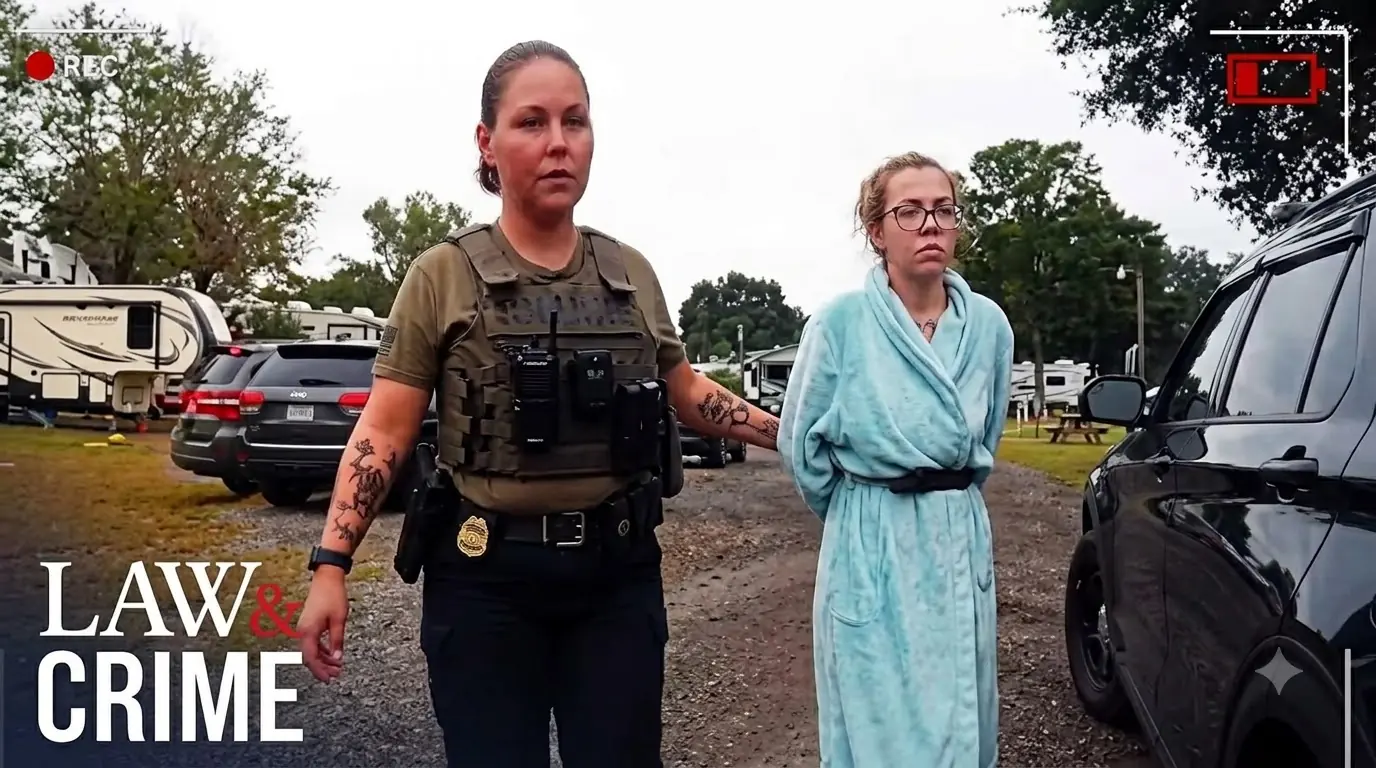
The commands cut through the quiet outside a trailer in Santa Rosa County, Florida. A 24-year-old woman named Valyn Harab stepped outside wearing a bathrobe, clearly confused as deputies moved her away from the entrance and placed her in handcuffs. She repeatedly asked what was happening, but the officers told her that detectives would explain once the scene was secure. Before anything else, they wanted to know whether anyone else was inside and whether the dogs in the trailer were safe to approach.
Harab said she lived there with her fiance and seven dogs. The number caught one officer by surprise, but the immediate concern was safety rather than the animals themselves. Harab insisted the dogs did not bite, and deputies moved her toward a patrol vehicle while another officer prepared to search her. One officer warned her about an ant hill beside the car and explained that a female officer would conduct the search because he did not have gloves on. Harab kept asking the same question: what was happening? Only then did someone finally tell her the basic reason for the police presence: they were executing a search warrant.
“For what?” Harab asked.
The officers did not explain in detail. They told her a detective would speak with her shortly, and for the moment she needed to cooperate while the warrant was carried out. According to the source, the investigation had begun after a cybertip connected an online account to suspected child sexual abuse material, commonly referred to as CSAM. The tip ultimately led investigators to Harab’s residence and to the digital devices they believed might contain evidence.
When asked whether she knew what the detective was talking about, Harab said yes. She began explaining that she had discovered an adult website where users could communicate with one another. According to her account, people she met online later sent her illegal material without her asking for it. She said some of those contacts added her on Snapchat and sent files there as well.
Harab told detectives that when she received material involving minors, she blocked the senders. She described the website as an adult-content site she had found while browsing and said the interactions eventually became too disturbing for her, so she stopped using it. She could not identify most of the people who had allegedly sent her material, saying they used screen names and were strangers to her.
The detective listened, but made it clear that investigators were not relying only on Harab’s explanation. Digital investigations, she said, often preserve detailed records of account activity, files, IP information, and platform data. She told Harab that investigators already had evidence to compare against whatever account she chose to give them.
“There are two sides to every story,” the detective said in substance. She explained that she had interviewed many people in similar investigations and had heard explanations ranging from accidental exposure to compulsive pornography use to people openly acknowledging illegal interests. The purpose of the interview, she said, was to give Harab a chance to explain her side without trying to deceive investigators about evidence they could independently verify.
Harab said she had no reason to lie.
The detective’s approach was deliberate. Rather than immediately accuse Harab of knowingly collecting illegal material, she described patterns she had heard in hundreds of internet-crimes-against-children interviews. Some people, she said, blamed an escalating pornography habit. Others admitted they had developed illegal interests. Still others claimed files arrived unexpectedly and were never intentionally kept. What mattered was whether Harab’s version could survive comparison with the digital record.
Harab continued to emphasize that people had contacted her rather than the other way around. She said random users from the adult website had added her on Snapchat and then sent material she did not want. She described blocking them once the conversations became too much and said she had stayed away from the site afterward. Detectives did not openly accept or reject that explanation at first; instead, they kept narrowing the questions toward specific platform actions that could be independently verified.
The conversation then shifted to a specific file detectives said had been linked to her Snapchat account. Rather than describe the image, the source states that investigators classified it as CSAM involving an infant. The detective asked Harab whether she remembered where it had come from. Harab said she honestly did not remember and mentioned that she used marijuana, which she said helped with anxiety, sleep, and nightmares following an accident the previous year.
The detective then explained why the question mattered. According to her, Snapchat had reported that on March 2, 2025, the file had been saved to the account’s Memories. That detail challenged Harab’s earlier suggestion that illegal files had simply appeared in messages and were immediately rejected. The source notes that part of Harab’s response to this point was redacted by law enforcement.
The distinction between receiving and saving became central. Detectives explained that if a file had been preserved in Memories, it suggested more than a fleeting view inside a disappearing message. They wanted Harab to explain how something she said she did not want to see had allegedly ended up stored in a part of the account designed to retain content. Harab suggested it may have come through Snapchat rather than directly from the adult website, but her explanation remained uncertain.
The investigators also referred to the National Center for Missing and Exploited Children, explaining that platforms send detailed reports when they detect suspected CSAM. Those reports can include account identifiers and information about how a file was handled. The source does not reproduce every technical detail, but the detectives repeatedly emphasized that this case was built on records that could be checked independently of Harab’s memory.
Harab said she had considered therapy. When the detective suggested that some offenders describe a progression from legal adult pornography into increasingly troubling material, Harab rejected the idea that she had a fixed illegal preference. She characterized what had happened as pornography use that had gone wrong and said she had encountered content while browsing that she did not know how to process.
She also connected some of her recent behavior to anxiety following an accident the previous April. Harab told the detectives that marijuana helped her sleep and reduced nightmares, and she used that when explaining why some details were difficult for her to remember. Investigators listened but continued returning to timestamps and saved files, treating those records as a way to test claims that memory could not resolve.
The source’s narrator emphasizes that investigators believed the files were too serious to dismiss as something merely seen and ignored online. Rather than repeating the report’s graphic descriptions, it is enough to say the case materials allegedly documented multiple files investigators classified as CSAM. Detectives also referenced online conversations they believed were connected to Harab and were trying to determine whether she had merely received illegal material or had knowingly retained, discussed, or redistributed it.
Harab continued to say that she had blocked people and assumed the issue would disappear once those conversations ended. The detectives returned to the saved file and asked whether it might still exist on her phone. Harab said she did not expect investigators to find additional illegal pornography and repeatedly insisted she was sure about that.
One detective warned her not to make absolute statements unless she was certain. If investigators later found more files, he said, those statements could damage her credibility. Harab responded that she understood. She also said she had watched law-enforcement programs before and knew that digital evidence could expose contradictions.
The detectives then asked about other communication platforms. Harab said she had deleted Telegram from her phone two or three months earlier. They asked when she had last seen anything she believed involved someone under 18, whether similar files would still be present on her phone, and whether other pornography would be discovered during the forensic review. Harab repeatedly answered that investigators would not find more illegal material. The detectives reminded her that they did not need to rely on memory alone because platform records, account histories, and device examinations could be compared against her statements. The questioning remained focused on when she had last encountered material involving minors, how files had moved between websites and Snapchat, and whether the forensic examination of her devices would support her account.
Then the interview took a separate and equally serious turn. Detectives began asking about conversations involving animals.
Harab said one man had introduced her to sexual material involving animals and described this as another point where her online activity had gone in a direction she now recognized as wrong. The detective asked whether she remembered sending videos to a particular online contact. Harab denied recognizing the username investigators mentioned, although detectives said they had chat records associated with that account.
The questioning moved into Harab’s household and the dogs living there. She identified several animals by name, including Ezu, Whiskey, Freyer, Ryden, and Uki, and explained that additional puppies had not been planned. She described Uki as the smallest dog, around 25 pounds, and said the family had quietly kept more animals than they were supposed to have at the residence. When a detective remarked that seven huskies would be difficult to hide, Harab replied that many of them looked similar enough that outsiders might not realize how many were there. She said two of the younger dogs had bonded and that she had struggled to find anyone willing to take them together. The detectives then asked about a man named Patrick Smith, whom Harab said she knew through friends in the Apalachicola or Tallahassee area and whom she associated with some of the troubling conversations.
The detective pressed her about whether an online discussion had progressed from fantasy into real conduct. Harab’s response in the source is fragmented, but investigators later relied heavily on what they said they had already recovered digitally. According to court records cited by the source, law enforcement found 20 files on Harab’s devices that they categorized as depicting sexual activity involving animals. Investigators further alleged that four files showed Harab herself engaging in illegal conduct with a dog.
The investigators made clear that this part of the case was not based only on a vague conversation with an unknown internet user. They said they had chats in which the number and sex of the dogs had been discussed, along with media tied to Harab’s account. Harab disputed knowing at least one username they referenced and differentiated that contact from Patrick, the man she did remember. The detectives continued to present the issue as something the forensic review of her phone and Snapchat account would either corroborate or contradict.
The detective asked Harab whether she believed the dogs had been harmed. Court records summarized by the source state that Harab allegedly told investigators she did not think she had hurt the animal. Because the underlying conduct is sexual and abusive, the cleaned account does not reproduce the explicit details of those files or of the alleged acts.
Harab then asked the question that had been hanging over the entire conversation: what happens next? By then, the tone of the interview had changed noticeably. At the beginning, she had been asking why officers were at her home at all. Now she was asking about the consequences of evidence detectives said they had already seen and the evidence still being collected from her devices.
Detectives explained that the search warrant authorized them to seize electronic devices for forensic analysis. They told her that if illegal material was found, possession or production-related charges could follow depending on the evidence. They also made clear that they could not promise what sentence, bond conditions, or court outcome might result. Their role was to investigate and present the evidence; charging decisions and later punishment would move through prosecutors and the court system.
Harab asked whether the case would become public. The detectives explained that their agency was not planning to post the matter on its own Facebook page, but that criminal records, arrest reports, and mug shots can become public records. They said news organizations sometimes check jail databases regularly and could decide to publish a story once charges appeared. Harab seemed particularly worried about social media exposure. The detectives stressed that they could not control what outside news organizations did with publicly available information and that they were trying to prepare her for that possibility rather than promise it would happen.
The interview then returned to the dogs. Detectives said animal control was on the way because investigators had reviewed multiple videos on Harab’s Snapchat account involving her dogs. Harab asked whether animal control would take one dog or all of them.
The removal of the animals appeared to hit Harab differently from the earlier discussion about electronics. She immediately wanted to know whether authorities intended to seize a single dog connected to the allegation or every animal in the trailer. Detectives said the decision applied to all seven because the warrant investigation had raised broader welfare concerns and because they said they had seen more than one relevant video connected to her account.
“All of them are getting taken,” a detective told her.
Harab said her fiance was nearby and would be angry. The detectives nevertheless told her that, given the circumstances, the animals would be removed that day. By that point the search warrant had expanded from a digital-evidence investigation into a case involving alleged crimes against both children and animals.
Harab asked whether she was going to jail that day. The detectives did not give her a simple prediction about sentencing or long-term outcomes. One said the criminal-justice system could be inconsistent and that they could not know what a judge might ultimately do. Another clarified that investigators would finish gathering evidence, forward the case through prosecutors, and allow the court process to determine what followed. The source then transitions from the interview to the charging information available in court records.
According to the source, Harab was taken into custody and was facing a large number of charges at the time the report was produced. The narration states that online court records showed 26 counts overall and separately describes charges involving sexual contact with an animal, possession of material charged under child-pornography laws, and filming or possessing images or videos of sexual activity with animals. Because the numerical breakdown given in the source does not add up cleanly to the stated total, the exact count breakdown is left unreconciled rather than guessed. These are allegations and charges, not convictions, and the source does not report that a trial had yet occurred.
The report also states that Harab initially posted bond on March 24. Prosecutors then alleged that she violated her bond conditions the following day by accessing various social-media accounts. According to the source, she was subsequently held in the Santa Rosa County Jail in Florida.
At the time of the source’s publication, no trial date had been set. The investigation therefore remained unresolved in court, and the evidence described in the interview had not yet been tested through a completed criminal trial. What the footage captures is the beginning of that legal process: a woman pulled from her home during a search warrant, an interview built around digital records she initially tried to explain as unsolicited material, and detectives gradually revealing that the case they believed they had was broader than a single cybertip.
The final significance of the encounter is not a verdict, because the source does not provide one. It is the way the interview evolves. Harab begins by repeatedly asking what is happening and describing herself as someone who received disturbing material from strangers. Detectives respond by pointing to saved files, account data, chats, and other digital evidence that, in their view, told a more complicated story.
By the end of the interview, investigators are no longer discussing only one Snapchat file. They are seizing devices, arranging for animal control to remove seven dogs, and preparing a case involving multiple felony allegations. Harab’s questions shift from why police are there to what charges may come next, whether the case will become public, and whether she is going to jail.
For investigators, the search warrant was only the start. The real case would depend on forensic analysis of the electronics, the integrity of the cybertip records, the authenticity and context of the chats and saved files, and the ability of prosecutors to prove the charged conduct in court. Until that process is complete, the allegations remain allegations. But the footage shows the moment a digital investigation crossed the threshold from an online tip into a physical search, an interview, the seizure of devices and animals, and a criminal case that was still pending when the source ended.