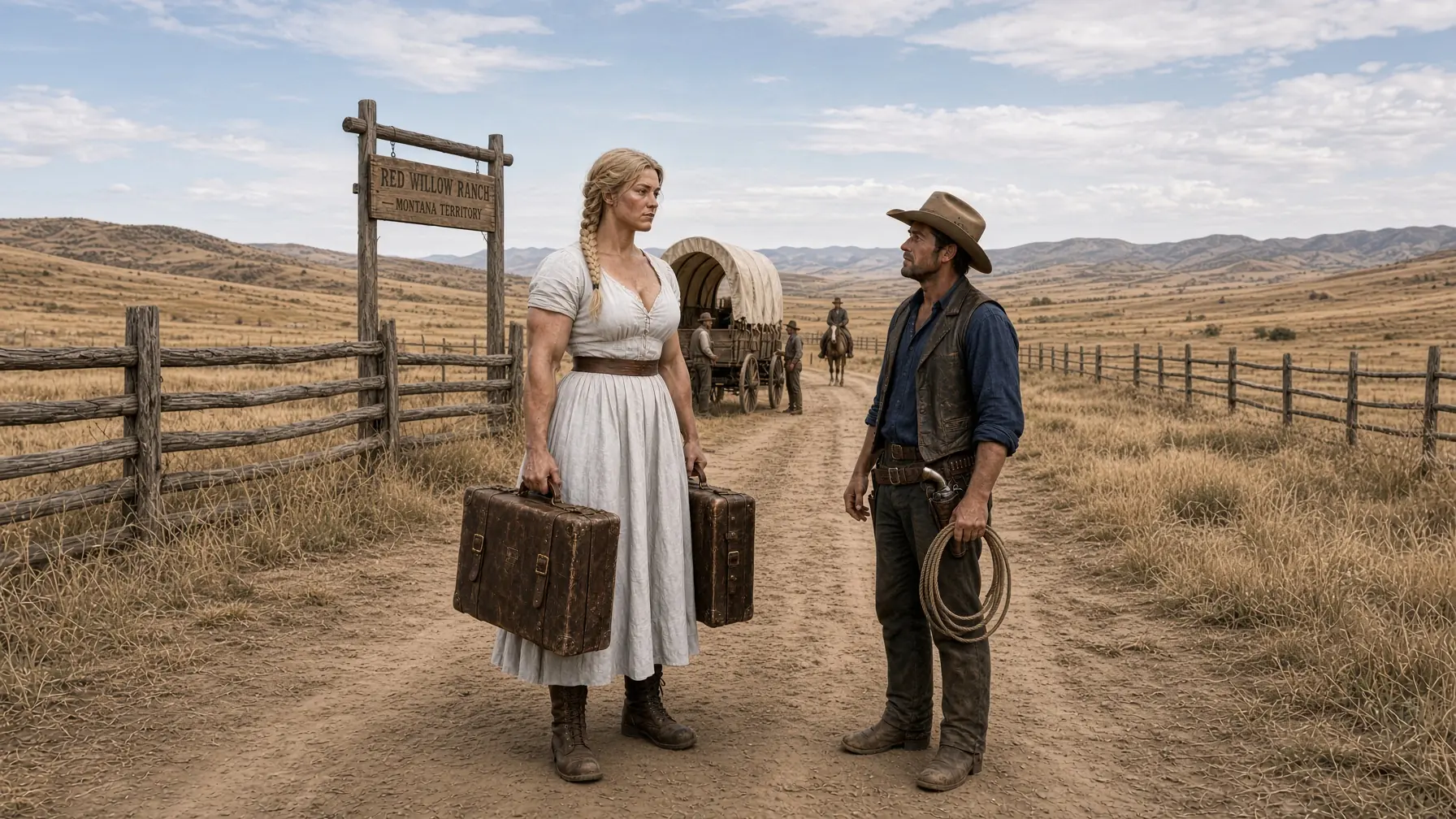
The wind came down from the Montana hills before sunrise and rattled the loose shutter beside Elias Mercer's bed. He lay awake beneath two wool blankets, listening to the old cabin complain against the cold, and remembered that sometime before noon a woman he had never met was supposed to become his wife. The thought still sounded ridiculous inside his own head. A wife belonged to another kind of man's life.
Red Willow Ranch had never been built for softness. The kitchen table carried knife marks from three generations of Mercers, the roof leaked above the pantry when rain came from the west, and mud collected near the door no matter how many times Elias swept it away. A rifle hung over the stone fireplace, a cracked coffee pot sat permanently near the stove, and seven years of living alone had reduced conversation to whatever he said to horses. Most days that suited him.
He was thirty-eight, broad through the shoulders, stubborn by reputation, and better with livestock than people. His father had died six years earlier, his mother before that, and his younger brother had gone east after deciding ranch life offered too much work for too little certainty. Elias stayed because somebody had to. Over time, staying became the thing he was best at.
The marriage notice had not been his idea. Beatrice Hale, who ran the Silver Creek post office and considered other people's business a public responsibility, had slid a matrimonial newspaper across the counter one afternoon and told him his silence was becoming unhealthy. Elias had said what he needed was a better winter and cheaper feed. Beatrice replied that she had no influence over God or cattle prices, but she could at least improve his supper table.
When she asked what sort of woman he wanted, Elias thought for a long time. Finally, he wrote, Someone who can endure hard weather. Beatrice read the sentence, looked over her spectacles, and told him it sounded like he was ordering a workhorse. Elias told her at least a workhorse description would be honest.
She rewrote the notice herself.
Montana Territory rancher, steady and sober, owns land and livestock, seeks practical woman willing to build a household in the West. No promise of comfort, but honest work and a permanent home. Elias objected to the word practical only because it sounded too hopeful. Beatrice mailed it anyway.
Three months later, a letter arrived from Nebraska.
Her name was Mara Whitfield.
She did not write the way Elias imagined women wrote to strange men. There were no flowers in the margins, no mentions of sunsets, and no shy language about hoping he might find her agreeable. She wrote that she was thirty-one, could cook, keep accounts, handle horses, mend harness, repair fence, and work beside a man without waiting for praise.
Then came the sentence Elias remembered most.
I am taller than many women and stronger than most men prefer their wives to be. If you are looking for something decorative to place beside a stove, you should answer somebody else.
Elias read the letter three times.
He told himself he appreciated her honesty. Still, without admitting it, his imagination softened her. He pictured someone tall but narrow, strong in the acceptable frontier way, sturdy enough to carry water but still delicate enough that nobody in Silver Creek would stare when she entered church.
That picture survived until the day she arrived.
Elias was supposed to meet the noon train. Instead, a section of fencing near the southern pasture collapsed just after dawn, and his bad-tempered bull found the opening before Elias could finish breakfast. By the time the fence was patched and the bull driven back, the train whistle had already echoed across the valley.
He cursed the bull.
Then himself.
Then the entire institution of marriage.
At one o'clock, Beatrice Hale's wagon appeared on the road.
Elias stood beside the ranch gate with his hat in both hands as the wagon rolled closer. Beatrice sat stiff-backed on the driver's bench with an expression suggesting she had already prepared a lecture. Beside her sat a woman who made the wagon look unexpectedly small.
Mara Whitfield was nearly as tall as Elias.
She had broad shoulders beneath a brown wool traveling coat, strong hands reddened by cold, and a face that was neither delicate nor severe. Her features were plain at first glance, but there was something steady in her gray-green eyes that made looking away feel like surrendering first. Two large leather valises sat at her feet.
Before Elias could offer help, Mara climbed down and lifted both bags herself.
Beatrice watched his face.
“Elias Mercer,” she said, “this is Mara Whitfield.”
Mara looked at him.
“You missed the train.”
Elias cleared his throat.
“Fence went down.”
Her gaze moved beyond him toward the southern pasture.
“Livestock?”
“Bull.”
“Mean?”
“Mostly clever.”
Mara examined the fresh rails from fifty yards away.
“Clever animals discover where people got lazy.”
Beatrice coughed into her glove to hide a laugh.
Elias looked at Mara.
“You know fencing?”
“I know what happens when people pretend rotten wood is still good because replacing it is inconvenient.”
That answer stayed with him.
So did the laughter from the road.
Wesley Dunn, who owned half the feed store and all of his own opinions, had slowed his horse near the outer fence with another ranch hand beside him. He leaned over his saddle and spoke loudly enough for everyone to hear.
“That your bride, Mercer?”
Elias said nothing.
Wesley grinned.
“Looks like the railroad delivered you another hired man and put him in a woman's coat.”
The other rider laughed.
Mara heard every word.
Her expression changed only slightly, but Elias recognized something in it that made his stomach tighten. It was not shock. It was the tired recognition of a person who had heard the same cruelty wearing different clothes before.
She picked up both suitcases.
“Where do these go?”
Elias pointed toward the cabin.
“I can take one.”
“I've carried them this far.”
She walked past him without looking back.
Beatrice waited until the cabin door closed.
“Well?”
Elias stared after Mara.
“Well what?”
“Are you embarrassed?”
“By Wesley?”
“By yourself.”
That landed harder.
Elias frowned.
“I didn't say anything.”
“No.”
Beatrice climbed down from the wagon.