Mary Turner was eighteen and newly in charge of a service wing no one else in the county would set foot in. She had a bundle of letters, a single sovereign sewn into the hem of her dress, and a duke's careless instruction to make what she could of the servants no other house would take. What nobody at Ashwell Court yet understood—not the Duke, not the housekeeper who had left in disgust, not the villagers who whispered about the castoffs arriving one by one on the carrier's cart—was that among those disgraced women and quiet men were hands that had cooked for earls and a history the great houses had forgotten on purpose.
Mary had been born in a village called Nether Ashwell, two miles down the lane from the estate she would one day be given the running of. Her earliest memories were of her mother's kitchen, a low room with a scoured deal table, a black range that smoked in west winds, and shelves of stoneware jars labeled in her mother's careful hand. Her father, Thomas Turner, had been undergardener at Ashwell for twenty-two years and had died of a chill caught digging a drainage trench in February when Mary was eleven. After him, her mother had taken in laundry from the vicarage and taught Mary the plain, useful things: how to render lard, how to bank a fire, how to salt a side of bacon so it kept through a wet summer, and how to speak civilly to people who thought themselves your betters without ever quite bowing your head.
Her mother had died the winter Mary turned fifteen, and Mary had been taken into Ashwell Court itself as an under-housemaid on the strength of her father's long service and the vicar's letter. It was there she had met the woman who shaped her. Mrs. Harriet Peele had been housekeeper at Ashwell for thirty-one years by then, a widow of a country schoolmaster, sixty-four years old, thin as a hedge stake, with hands that could iron a linen tablecloth to the smoothness of glass and a way of standing in a doorway that could quiet a whole servants' hall. Mrs. Peele had taken one long look at Mary on her first morning—Mary in a borrowed apron two sizes too large, still red-eyed from the funeral.
"You'll do," she had said only. "Come with me, and don't chatter."
For three years Mary had followed her through stillrooms and linen presses and dairy sheds, through the accounting of tallow and beeswax and blue, through the folding of counterpanes and the mixing of furniture wax from turpentine and beeswax, through the quiet science of running a house of forty rooms on the shoestring the estate agent allowed. Mrs. Peele did not praise. Mrs. Peele explained a thing once, watched you do it, and if you did it well, she said nothing, which was the highest form of praise she had. She had taught Mary that a household was a body of many small parts, and that a good housekeeper thought a week ahead, a month ahead, a season ahead, and never let herself be surprised by Christmas, by mutton going off in August, or by a chimney sweep failing to come on the day appointed.
She had taught her, too, to look at people. Really to look, and to know within a quarter of an hour whether a new girl was lazy or only frightened, or clever and being hidden by fear. When Mrs. Peele had at last taken ill in the spring of Mary's eighteenth year and knew she would not rise from her bed again, she had asked Mary to sit with her one afternoon. She put into Mary's hands a small object wrapped in a piece of blue flannel: a brass housekeeper's chatelaine on a short chain, worn smooth by thirty-one years of use, with its little scissors, thimble case, and pencil sheath still hanging from it, and a tiny key that opened the stillroom press.
"It kept me on my feet," Mrs. Peele had said, her voice already thin. "It will keep you on yours. Don't let them see you tired."
Mary had worn it inside her apron pocket ever since, where its small weight against her hip felt like a hand steadying her. When Mrs. Peele was buried in the churchyard at Nether Ashwell in the last week of April, Mary walked back to the great house alone in the rain. She knew without anyone telling her that everything now was going to be different and probably harder, and that the woman who had promised to guide her through her first years of real responsibility was gone.
Ashwell Court in that spring of 1858 belonged to the young Duke of Marabe, who was twenty-nine years old and had inherited three estates and a house in town. He visited Ashwell perhaps twice a year, in autumn for the shooting and in early summer to sign what his agent put before him. He was not cruel, but he was inattentive, and the servants' hall had suffered accordingly. A succession of cooks had come and gone, the last one dismissed for drunkenness at Michaelmas, and the kitchen had been running for six months on the labor of a scullery maid and a village woman brought in by the day.
When Mrs. Peele died, the Duke's agent, Mr. Hollis, wrote to His Grace in London to say that a new housekeeper must be found. The Duke could not be troubled with interviews, and he had heard from someone at his club that a young woman lately trained under old Mrs. Peele at Ashwell was said to be capable. He wrote back a single line: "Give the Turner girl the keys and be done with it."
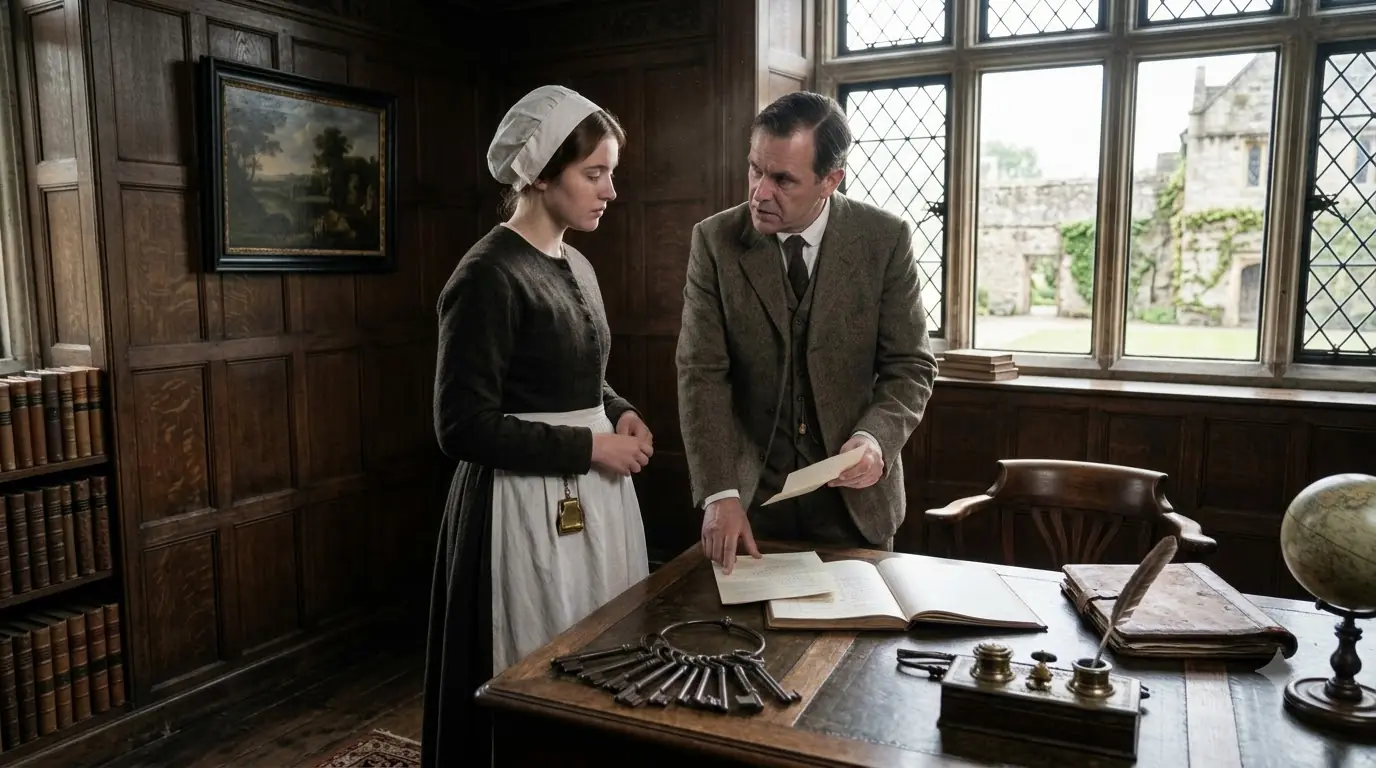
And so, on the second morning of May, Mr Hollis called Mary into the estate office, laid Mrs Peele's ring of keys on the desk between them, and told her she was housekeeper of Ashwell Court from that hour onward at £22 a year. The servants' hall, the kitchens, the stillroom, the linen presses, the wine cellar, and the whole damp, neglected service wing of a house of forty rooms were now hers to manage as best she could.
Mary took the keys without letting her hand shake, thanked Mr Hollis in the same low, steady voice her mother had taught her to use with men who held ledgers, and walked out of the estate office into the stone passage with the ring heavy in her palm and Mrs Peele's chatelaine warm in her apron pocket. She understood that she had not been given a promotion so much as she had been handed a room no one else in the county wished to enter.