The Donor’s Daughter Locked a Black Scholarship Student in the Gym Storage Room — Then Three Black SUVs Rolled Through the Academy Gates
Chapter 1: Behind the Metal Door
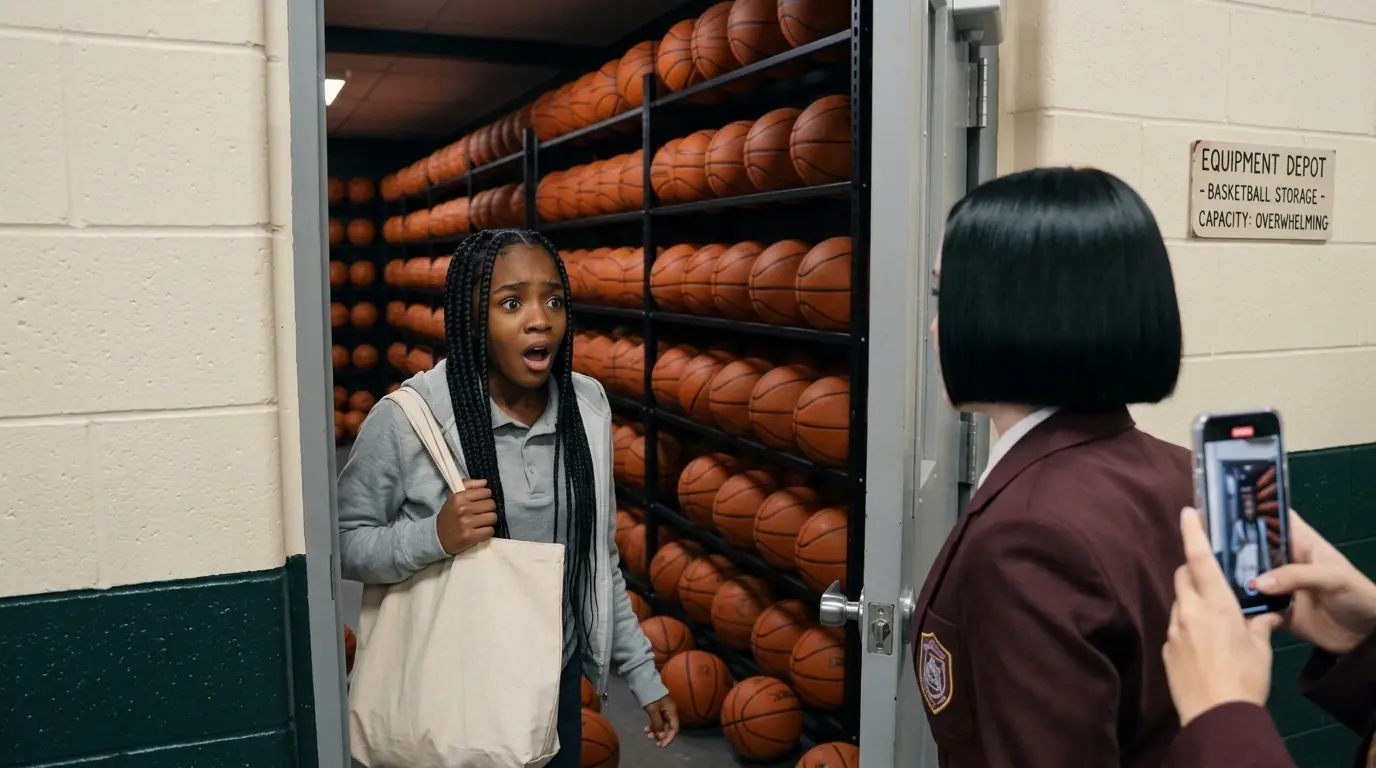
Avery Coleman hit the concrete floor hard enough to knock the air from her lungs. Her faded canvas backpack skidded beneath a rack of basketballs while the metal storage-room door slammed behind her, followed by the scrape of something heavy being forced through the outside handle. For several seconds she stayed on one hand and one knee, trying to understand what had happened before the laughter outside made understanding unnecessary. Brooke Whitmore had finally gone further than anyone at St. Catherine Preparatory Academy believed she would.
“Go ahead and scream,” Brooke called through the door, her voice bright with the excitement of having an audience. “Nobody’s going to hear you over the gym, and nobody important is coming for you anyway.” Two girls beside her laughed while one kept her phone aimed at the locked door, recording whatever sound came from the other side. Brooke leaned against the wall as though she had just pulled a harmless prank between classes.
The gym was unusually crowded because Saturday was Founders Weekend, the largest donor event of the school year. Parents sat in folding chairs along one side of the basketball court while student athletes practiced short demonstrations for alumni and foundation guests. Faculty members floated between the donor tables, smiling harder than usual, and school administrators wore name badges with colored ribbons identifying who had given what. St. Catherine was always careful about appearances, but on donor weekends the place seemed polished down to the air.
Avery got to her feet slowly and grabbed the handle. It did not move because Brooke had wedged a wooden mop handle through the pull bar and the metal shelving beside it, creating a crude lock from the outside. Avery pulled harder, then stopped when pain shot through her shoulder. She could hear girls laughing ten feet away.
“Brooke,” Avery called. “Open the door.”
No answer came immediately.
Then Brooke knocked twice on the metal. “Maybe call financial aid.”
The laughter was louder this time.
Avery closed her eyes.
She had spent fourteen months at St. Catherine learning which insults were designed to make her react and which were designed to make everyone else believe she was too sensitive. Brooke had mastered that distinction better than anyone. She rarely said anything cruel enough in front of a teacher to become punishable, but she understood how to turn money, clothes, lunch choices, transportation, and family background into reminders that Avery was living in a world Brooke considered borrowed.
Avery was seventeen and a junior. She had arrived at St. Catherine on the school’s prestigious Langford Scholars Award after finishing first in her class at a public middle school and spending two years at North Fulton Magnet. The scholarship covered tuition, books, transportation, uniforms, and most activity fees, but it did not make her life resemble the lives of girls whose families treated forty-thousand-dollar tuition like another household bill.
Her mother, Renee Coleman, managed the evening shift at a rehabilitation center outside Atlanta. Avery worked Saturdays at the Eastwood Community Center tutoring younger students in math and reading whenever her school schedule allowed. Her sneakers were clean but old, her phone was three models behind everyone else’s, and the canvas backpack lying under the basketball rack had already been repaired twice by her mother.
Brooke noticed everything.
Brooke Whitmore was also seventeen, blonde, polished, captain of the junior varsity cheer squad, and the only daughter of Grant and Melissa Whitmore. The Whitmore name appeared across St. Catherine more often than the school mascot. There was the Whitmore Science Pavilion, the Whitmore Leadership Terrace, the Whitmore Athletic Endowment, and a bronze donor wall where the family name occupied a line by itself.
Grant Whitmore owned a commercial-development company that had transformed warehouse districts across Georgia into luxury offices, apartments, and retail centers. His donations to St. Catherine over twelve years exceeded eleven million dollars, though no administrator ever said the number aloud where students could hear it. They did not need to.
Everyone understood.
Brooke understood best.
Coach Evan Mercer stood twenty feet from the hallway when Brooke shoved Avery through the storage-room doorway. He had seen the argument begin after Brooke accused Avery of moving a donor gift bag from one table to another. He had also seen Brooke seize Avery’s backpack, throw it into the storage room, and tell her to go fetch it.
Then Brooke pushed.
Coach Mercer took one step toward them.
He stopped when Grant Whitmore’s executive assistant looked up from the donor table.
It lasted less than two seconds.
That was enough.
Brooke saw him hesitate.
She smiled.
That was the moment she understood no adult in the hallway intended to stop her.
Inside the storage room, Avery beat both palms against the door. “Coach Mercer!”
He heard her.
His face tightened.
Another coach beside him whispered, “Evan.”
Mercer looked toward the donor tables again.
Grant Whitmore was not in the gym yet, but his wife sat in the front row speaking with the head of school. His assistant, Daniel Pruitt, was standing beside the refreshment station with his phone in one hand.
Mercer did nothing.
Brooke bent toward the door. “Maybe yell louder.”
Avery hit it again.
“Please let me out.”
One of Brooke’s friends, Kelsey Monroe, stopped smiling.
“This is enough, Brooke.”
Brooke looked at her.
“You worried?”
“She could get hurt.”
“She’s in a room full of basketballs.”
Kelsey glanced toward the mop handle.
“Just open it.”
Brooke stepped closer to her.
“You can leave if you’re scared.”
Kelsey went quiet.
That was how Brooke maintained loyalty.
Nobody was forced.
They were simply taught that hesitation had social consequences.
The hallway slowly emptied as the next athletic demonstration began. Students returned to the court, parents shifted their chairs, and music rose through the gym speakers. Avery kept pounding until her hands hurt.
Then she stopped.
Not because she gave up.
Because she remembered the small emergency alert button inside her smartwatch.
It had been a gift from someone she rarely mentioned at school.
Avery held the side button for five seconds.
The screen vibrated.
A silent emergency message went out.
Then she sat against the wall and waited.
Outside, Brooke pulled out her phone to check the video her friend had recorded.
Seven minutes later, the laughter disappeared.
The first black SUV came through St. Catherine’s main gate without stopping at the visitor lane.
The second followed six feet behind.
Then a third.
All three had dark windows.
All three turned toward the athletic complex.
And every administrator who saw them knew immediately that they were not part of the Whitmore family’s arrival.
Chapter 2: The Girl on Scholarship
To understand why those vehicles mattered, you had to understand what Avery never told anyone at St. Catherine.
Her scholarship was real.
She had earned it.
Her grades were real, her placement exams were real, and the interview panel that selected her had not been pressured by anyone.
But the Coleman name was only half of Avery’s family.
Her mother had never hidden the other half.
She simply refused to build Avery’s identity around it.
Renee Coleman had grown up as Renee Harrington, the youngest daughter of Theodore Harrington, founder of Harrington Logistics Group. What began with six freight trucks outside Savannah became one of the largest privately held logistics and infrastructure companies in the Southeast. By the time Theodore turned seventy, Harrington companies operated ports, warehouses, freight terminals, data facilities, and disaster-response contracts across eleven states.
The Harrington name opened doors.