Squatter Refuses to Leave on Court Order for Stalking...Taser Changes Her Mind
In Escambia County, Florida, what began as the service of a temporary court order turned into a long argument at a front door, an arrest, and a use-of-force review. The dispute involved a homeowner who had obtained a temporary injunction against a woman who had been staying at the property. By the time deputies arrived, the homeowner said police had already been called to the address repeatedly and that tensions had been building for some time. The central issue that day, however, was narrower: a judge had signed an order requiring the woman to stay away from the petitioner and remain at least 500 feet from the address.
The homeowner told deputies that he had become concerned enough about the situation that his brother escorted him whenever he returned to the property. He described the woman as someone he feared might accuse him of striking her and said deputies had been called to the home two or three times a week over different problems. He also pointed to writing and damage around the property and claimed she had spray-painted the driveway, his vehicle, and parts of the house. Those allegations came from him on camera; the footage itself did not resolve every one of those claims.
He also said the conflict had worsened whenever new legal papers were served. According to him, each new court action was followed by some form of retaliation or property damage. He said other people familiar with the dispute had seen video of some of the behavior and that he had already moved his RV from the property. His explanation was that he no longer felt safe remaining there while the case worked its way through court.
The homeowner was particularly worried that the woman would retaliate after learning another order had been entered. He told deputies that he had video of her spray-painting portions of the property and said he had previously complained about damage inside the home as well. He also said that whenever he came back after service of the injunction, his brother accompanied him because he was afraid of being alone with her. Nothing in the body-camera sequence independently decided those allegations, but they formed the background the deputy was hearing before he spoke with her.
When the deputy reviewed the paperwork with the woman, there was some initial confusion over which copy of the order had been served. The woman said she had not received a handwritten version. The deputy explained that judges sometimes issue handwritten language before the order is entered into the computer and then focused on the terms that were already in effect. A court date was set for the 8th, but until then, he told her, the temporary injunction controlled what she could and could not do.
She pointed toward the driveway and referred to the place where the petitioner's RV had previously been parked. From her perspective, the fact that he had moved the RV mattered because she had apparently expected that space or vehicle to be part of how the living arrangement would be handled. The deputy told her he could not resolve that property dispute. His immediate concern was that the judge had ordered the parties apart and had specifically tied the restriction to the address where they were standing.
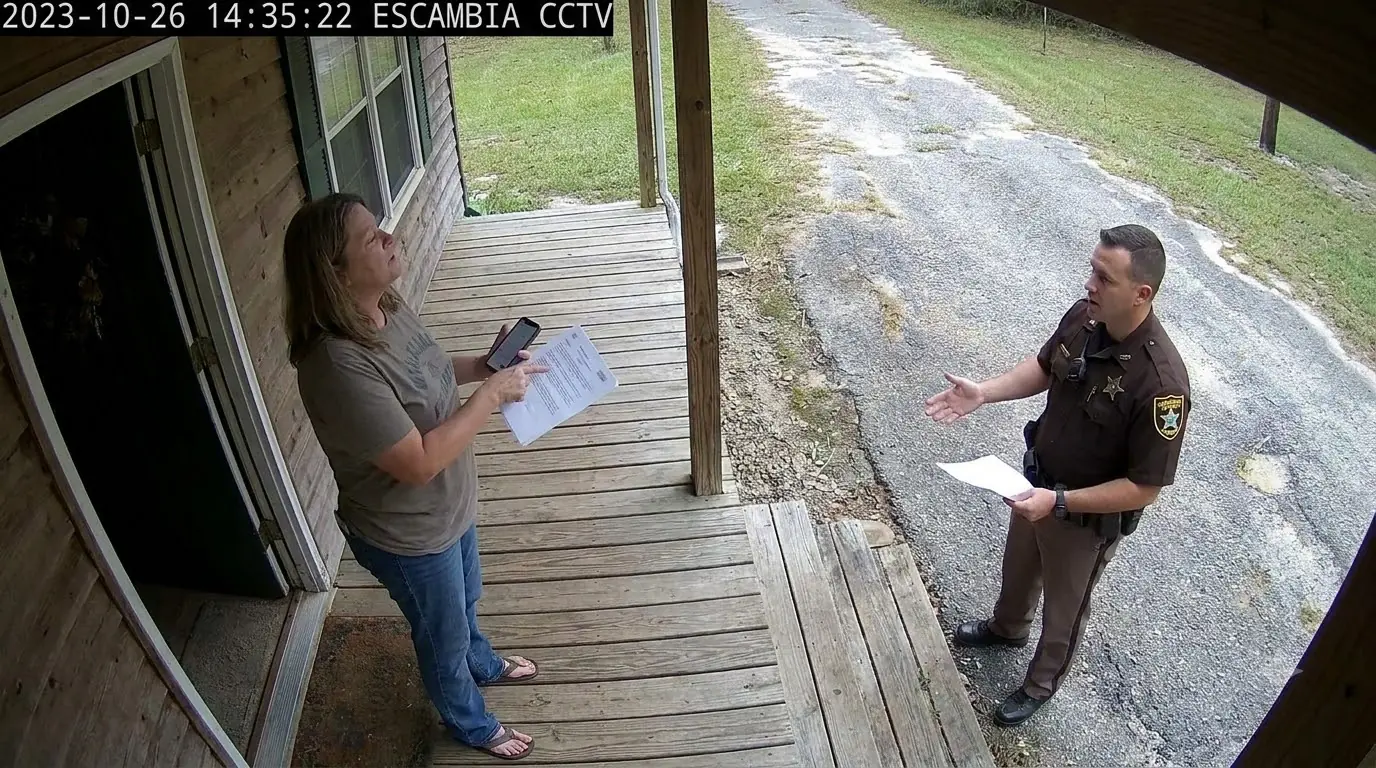
The deputy separated the restraining order from the eviction process. He told her that an eviction would be a different proceeding and might determine longer-term possession of the residence, but the injunction was a separate order that had immediate effect. In his explanation, the fact that an eviction was not yet complete did not override a judge's instruction that the two parties remain apart. He repeatedly returned to the same point: whatever questions she had about ownership, tenancy, or fairness could be addressed in court, but for the moment she had to comply with the injunction.
The woman asked whether the order was only temporary. The deputy said yes, at least until the scheduled court date, but emphasized that temporary did not mean optional. She wanted him to show her exactly where the paperwork stated that she had to leave immediately. He pointed to the language indicating the order had been signed and entered and again referred to the 500-foot restriction.
She then asked whether there was a deadline, such as 5:00 p.m., or some other specific time by which she had to vacate. The deputy said there was no separate grace period written into the order. In his understanding, once she had been served, compliance was required. He told her that technically she was already within the prohibited area while standing at the property.
The woman kept returning to the wording on the paper. "Show me where it says right now," she said in substance, asking whether the absence of a clock time created some kind of notice period. The deputy answered that the operative moment was service itself: once she had been served, the restriction was in effect. She asked whether that meant she should receive twenty-four hours, and he told her no. He said he was not trying to be unnecessarily harsh, but by remaining there she was already violating the terms as he understood them.
At the same time, the deputy tried to distinguish between allowing her to move an entire household and allowing her to gather enough belongings to get through the next several days. He told her he was not expecting her to remove dressers, furniture, and everything she owned at that moment. Instead, he was willing to let her go inside, gather clothing and other necessities, and then leave. The larger property dispute could be sorted out later.
The woman said the situation was unrealistic and estimated that it could take her about three hours to fully get out. She also said she needed to make phone calls because she was not willing to simply get into her car and start driving without knowing where she would go. The deputy answered that she could pack while making calls and that he was trying to give her a reasonable opportunity to gather essentials before enforcing the order more strictly.
For a moment, it appeared they had a workable arrangement. The deputy suggested they step inside so she could begin packing. She responded that she would rather remain outside and make phone calls first so she could figure out where she was going. That became the point where the conversation started circling instead of moving forward.
"Let's step inside and pack your stuff," the deputy told her, making clear that he was trying to combine the two things she wanted to do. She could call someone while gathering clothes and necessities, but she could not simply remain at the address while deciding whether she accepted the order. She answered that she wanted to make the phone calls first. He warned that if she chose not to use the opportunity he was giving her, he did not have to keep extending access to the house.
The deputy told her that he was not there to wait while she created a long-term plan. His responsibility, as he described it, was to enforce the judge's order. If she wanted to use the limited opportunity he was offering to collect necessary belongings, she needed to do that now. If she chose instead to remain at the address and continue debating, he warned, the encounter could become an arrest.
The woman insisted that she was not refusing to leave forever. She said she simply wanted to know where she would sleep and how she would move her belongings before walking away from the only place she currently had. She asked whether he had resources or any suggestion for where she should go. The deputy told her that finding housing was not the issue he had been sent to solve and that the court order did not depend on whether she already had another destination arranged.
She said she did not have much more than clothing and a couple of dressers, but she still wanted a destination before pulling away from the property. The deputy repeated that this was not a full move-out under an eviction order. He was telling her to take enough to sustain herself until the hearing and leave the prohibited area. Whatever remained inside could be dealt with through the civil process and future arrangements rather than by refusing to comply that afternoon.
The exchange became increasingly tense. The deputy again gave her two options as he saw them: go inside under his supervision, gather what she needed, and leave, or continue refusing and face jail. The woman argued that he was making a point rather than helping her. He replied that she could call it whatever she wanted, but he was not going to keep debating a signed order at the doorway.
"Get your stuff and get out of the house, or you go to jail," he told her, reducing the dispute to the choice he believed the order left him. She said she understood the order was temporary and wanted to verify what it actually required. He answered that she could challenge or research it, but not while continuing to stay at an address the judge had ordered her to avoid. The longer the discussion continued, the less willing he became to treat it as confusion rather than noncompliance.
She pulled out her phone and said she was looking things up because she did not believe the situation was as definite as he was presenting it. He acknowledged that the order was temporary, but again explained that temporary meant it remained in force until the hearing. He told her she was free to research the issue later, but he was not going to stand there indefinitely while she did so instead of leaving.
The woman again asked whether he expected her to sleep on the street. She said she was trying to make a plan, not trying to stay at the residence forever. The deputy responded bluntly that where she went next was not his problem; his assignment was to enforce the order already signed by the judge. He said he had tried to work with her by allowing time to gather belongings, but that accommodation did not mean she could delay compliance until she found housing she considered acceptable.
The woman returned to the same practical problem. She said he knew she had nowhere arranged to go and asked again whether he had any plan for her. The deputy answered that he did not. His only role, he said, was to tell her that the judge required her to leave the residence and to give her an opportunity to take necessary belongings with her.
She asked once more if she could make a phone call first. The deputy said no and directed her to move. What happened immediately afterward moved quickly and was partly obscured in the source by the way the body-camera footage was presented. The next clear commands are the deputy ordering her to roll over and put her hands behind her back.
"Put your hands behind your back. Now," he ordered.
The woman protested that she was trying to get up for him. The deputy told her she was not getting up and again directed her to place her hands behind her back. She asked whether the level of force was really necessary, while the deputy repeatedly told her to stop and comply.
The struggle moved inside the house. In the deputy's later account to another officer, he said he had spent roughly ten minutes debating the order with her after service, had tried to let her gather property, and had finally concluded that she was not going to leave. He said they then struggled inside and that he deployed his Taser. Afterward, he reported that she had two Taser probe marks but no other injury that he was aware of.
Once she was secured, the deputy summarized the situation over the radio and to responding personnel. He said there had initially been confusion over the paperwork, but that the temporary restraining order had ultimately been located and served. According to his account, the woman kept insisting she needed to make a plan before leaving, while he kept telling her that the order required her to be out of the residence immediately.
He told another officer that he had repeatedly offered to let her go inside and take necessary property. Instead, he said, she wanted to remain there, make calls, and decide what she would do before leaving. He estimated that the argument at the doorway lasted about ten minutes before he finally moved to arrest her. In his summary, the physical confrontation occurred after he entered the residence to take her into custody, not during the earlier discussion about the paperwork.
He also explained that he had been trying to give her the opportunity to collect belongings rather than simply arresting her at the outset. In his view, the problem was not that she wanted her property; it was that she continued to remain at the prohibited address while arguing over the order instead of gathering essentials and leaving. By the time the confrontation became physical, he said, the issue had moved from a civil housing dispute into alleged violations of the injunction and resistance to arrest.
The petitioner remained nearby. Another officer confirmed that he was the homeowner and the person who had requested the injunction. The homeowner said he had already moved away from the property temporarily while waiting for the court date. He again complained about previous calls for service and claimed the woman had damaged the property, though those allegations remained separate from the immediate arrest.
Because a Taser had been used, a supervisor came to speak with the woman and assess what had happened. He asked whether she needed medical attention. She immediately focused on the fact that she had been tased and then gave her version of the sequence that led to the arrest.
The supervisor's interview was important because it captured the dispute after the immediate struggle was over. He did not simply accept the first deputy's version without asking her to explain what she believed had happened. She told him the central issue was never that she planned to ignore the court forever. Her complaint was that she wanted to make arrangements before leaving and felt the deputy treated that request as refusal.
She told the supervisor that two days earlier she had received paperwork for a court hearing connected to a stalking allegation filed by her roommate. Then, on the day of the arrest, the deputy arrived at the same time as the roommate and told her a judge had entered a temporary injunction. She said she understood she was being told to leave, but she wanted time to make arrangements before driving away with no destination.
The supervisor asked who the petitioner was to her. The homeowner described her as a friend he had helped in the past who later began paying rent. He said their relationship deteriorated and that he had started talking about evicting her. The injunction, however, had moved ahead separately from that eviction discussion.
The woman said that when the deputy told her to leave immediately, she tried to use her phone to make arrangements. In her version, the deputy then pushed his way inside and tried to arrest her. The supervisor asked whether, once the arrest began, she turned around and allowed herself to be handcuffed. She said she asked him not to arrest her.
The supervisor pressed that point. He wanted to know what she physically did when the deputy announced the arrest, not simply whether she disagreed with it. Her answer centered on asking the deputy not to proceed, while the officers' account was that she resisted the attempt to place her in handcuffs and that a struggle followed. The footage's closing discussion therefore framed the second charge around the arrest itself rather than around her earlier questions about the injunction.
The supervisor explained the charges being considered. He told her the underlying issue was violation of the injunction because, once she had been served, she was required to vacate the property. He also said she was being accused of resisting because the arrest did not proceed quietly and peacefully. He described those charges to her as misdemeanors.
During that discussion, someone at the scene also stated that she had another felony matter pending involving an alleged assault or battery on her stepfather. That was an on-camera claim made during the encounter, not a matter resolved by this footage. The officers discussed the possibility that a new arrest could affect any existing bond in that other case, while acknowledging they did not know what another court would ultimately do.
The woman asked again whether she could still make a plan for somewhere to go. The supervisor told her that she was now going to jail because the encounter had progressed beyond the point where she could simply collect belongings and leave. She questioned how she had fought the deputy.
He answered that, from the deputy's account, she did not follow the instruction to gather her belongings and leave after service of the injunction. Then, when the deputy tried to arrest her, she resisted rather than allowing the handcuffing to proceed. The supervisor told her that the injunction required her to vacate immediately and that arguing about the order at the house was not the proper way to challenge it.
She pushed back, saying the same deputy who served the paperwork was also the one who arrested her and that she had not been given a meaningful opportunity to make arrangements. The supervisor said the opportunity she had been given was to collect necessary property and go. In his view, the extended debate and phone use were the reasons the situation escalated.
The supervisor told her that photographs would be taken of the Taser marks as part of the use-of-force documentation. The deputy reported that she did not appear to have other injuries and that the probes were the main medical issue requiring documentation. The encounter then moved toward transport and booking.
According to the source's closing account, the woman was charged with violating a court-ordered injunction against stalking, resisting an officer, obstruction without violence, and misuse of 911. The source characterized the listed offenses as misdemeanors and said bond was set at $2,000. The footage did not include the later court resolution of those charges.
The homeowner's earlier allegations about spray paint, damaged property, and repeated calls for service remained his allegations in the body-camera footage. They helped explain the background of the injunction and why he said he feared further retaliation, but the recording itself did not establish the outcome of any separate property-damage investigation. Likewise, the woman's arguments about tenancy and the pending eviction were not resolved at the door.
What the footage did show was a collision between two different questions. The woman kept asking where she was supposed to go and how she could make arrangements before leaving. The deputy kept answering a different question: what did the signed court order require her to do right now? Once neither side moved away from those positions, the encounter escalated from a temporary injunction being served to an arrest that would have to be explained later in court.