The photograph had been hanging in Hawthorne Academy’s main building for almost six years, yet Madison Price had never bothered reading the name beneath it. The man in the portrait was Black, middle-aged, wearing a dark suit, standing beside a brass plaque that credited the Reeves Future Fund with financing the school’s renovated science wing, technology lab, and nearly half of Hawthorne’s need-based scholarships. Madison had walked past his face hundreds of times without a second thought. Three days after she dumped an entire trash can over a Black classmate’s head, that same man walked into the headmaster’s office, opened his arms, and said, “Naomi, come here, sweetheart.”
Madison stopped breathing for a moment. The Black girl sitting beside the window—the one Madison had spent months calling “charity case,” “scholarship project,” and “somebody Hawthorne rescued”—stood and hugged the man from the donor wall. Headmaster Richard Palmer looked from Madison to the visitor and introduced him formally as Dr. Malcolm Reeves, founder of Reeves Medical Technologies and chairman of the foundation that had helped Hawthorne expand access for students from across the county. Then he added the part Madison had never imagined: “Dr. Reeves is Naomi’s father.”
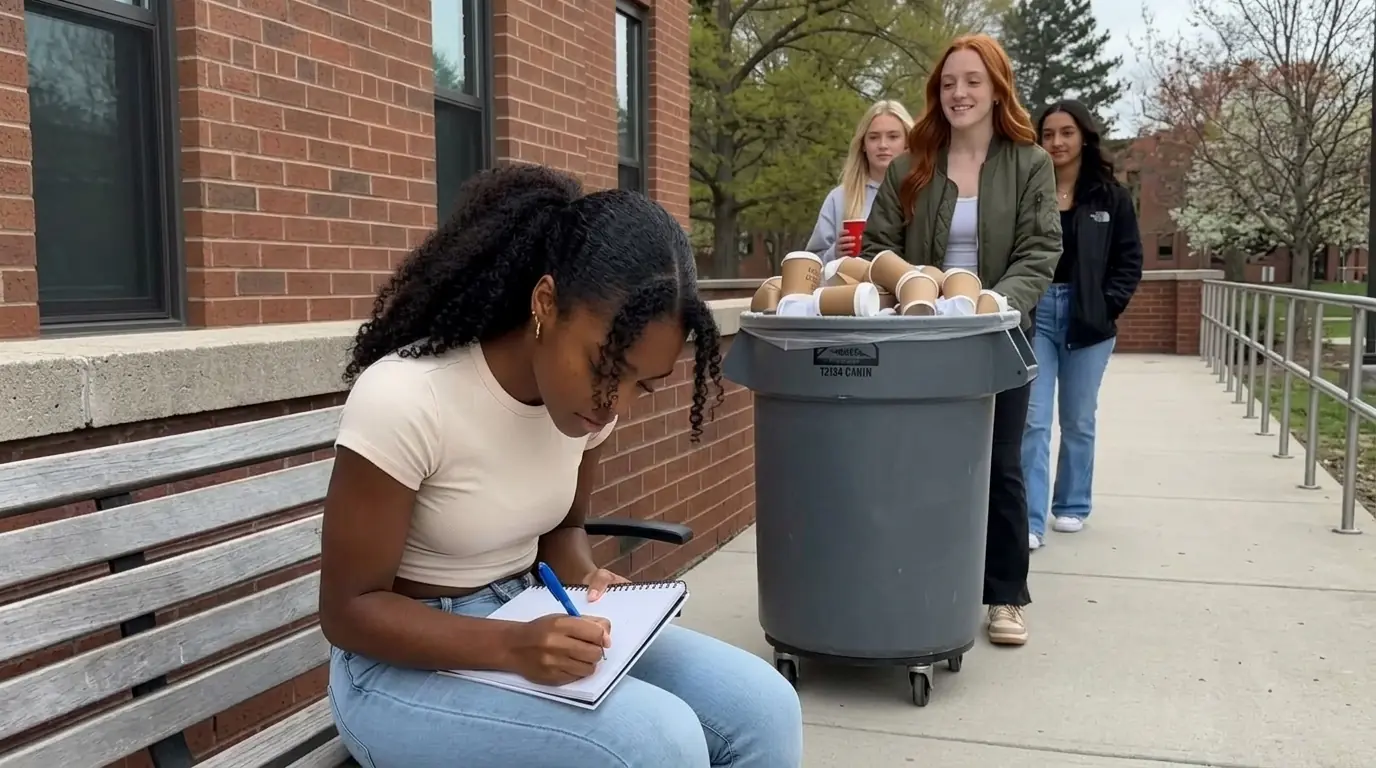
Nobody in the room laughed. Madison’s mother slowly lowered the phone she had been gripping since arriving. Naomi’s torn notebook sat on the table beside several photographs of crushed paper cups, food wrappers, and stained worksheets gathered from the courtyard after Friday’s incident. The humiliation Madison had designed around a girl she believed was poor had exposed something much uglier than a mistake about money.
But Dr. Reeves had not come to Hawthorne to announce that his daughter was rich. In fact, wealth was the least important thing he planned to discuss. He had come because months of complaints showed that several students had repeatedly connected Naomi’s Blackness, scholarship status, clothing, and right to belong at Hawthorne without knowing almost anything about her. The fact that those assumptions happened to be financially wrong only made their confidence easier to see.
To understand why nobody at school knew who Naomi’s father was, you had to go back to August. Naomi Ellis arrived at Hawthorne Academy for senior year using the same surname she had used since kindergarten—her mother’s. She was eighteen, Black, with warm brown skin, dark natural curls usually gathered into a loose high puff, small gold earrings, and the kind of quiet expression that made people assume she was shy until she decided she had something worth saying. She preferred fitted neutral-colored T-shirts, light denim jeans, clean white sneakers, and notebooks covered in handwritten tabs.
Her mother, Danielle Ellis, was an architect who had kept her surname after marrying Malcolm Reeves. Naomi used Ellis partly because that was the name on all her childhood records and partly because her parents believed children of successful people deserved a chance to enter rooms without their family histories walking in first. Malcolm had become wealthy after founding a medical-device company that designed monitoring systems used in hospitals throughout the country. At home, however, he remained the father who forgot where he left his glasses and embarrassed Naomi by singing old R&B songs while cooking breakfast.
The Reeves family had donated generously to education for more than a decade, but Malcolm avoided putting his children in publicity materials. He believed philanthropy became less meaningful when every donation required a photograph. Hawthorne knew him well because his foundation had funded major programs, yet only Headmaster Palmer, the finance office, and a few longtime trustees knew Naomi was his daughter. She entered Hawthorne through the academic transfer process on her own record and earned a Hawthorne Merit Fellowship because her grades and writing portfolio qualified her.
The fellowship reduced senior-year tuition, though Naomi’s parents obviously did not need the money. Malcolm had initially suggested declining the financial component, but the foundation governing the fellowship insisted all recipients receive the same award. The Reeves family quietly redirected the tuition savings into another scholarship fund without attaching Naomi’s name. To her classmates, however, one fact was visible: Naomi was a Black transfer student with the word Fellow printed beside her name in the orientation directory.
That was enough for Madison Price to invent everything else. Madison was eighteen, white, with long copper-red hair, pale skin, green eyes, and the effortless confidence of someone who had attended Hawthorne since seventh grade. She wore fashionable jackets over cropped tops, expensive boots that looked intentionally worn, and carried herself like every hallway already belonged to people she knew. Her father owned a successful real-estate brokerage, while her mother ran several fundraising events for the school.
Madison’s closest friends were Brooke Wallace, a blonde senior who rarely disagreed with her, and Sienna Cole, a dark-haired student who had built a modest social-media following from posting school humor. Neither girl was as openly confrontational as Madison. Their role was usually to watch, laugh, validate, and sometimes record.
Naomi first met them outside AP Government. Madison noticed the Merit Fellows folder beneath Naomi’s arm and asked whether she was “one of the new scholarship girls.” Naomi answered that she was a Merit Fellow. Madison looked her up and down and said Hawthorne had become “really generous lately.”
Naomi did not understand what she meant. “Generous with what?” she asked. Madison smiled and said, “Opportunities,” then walked into class with Brooke and Sienna laughing behind her.
The second comment arrived three days later. Naomi answered a difficult question about voting-rights litigation, and teacher Mrs. Candace Miller complimented her explanation. Madison whispered loudly enough for the students around her to hear that transfer programs clearly prepared students for their first week. When Naomi looked back, Madison smiled as though the remark had been praise.
Those moments were small, but they formed a pattern quickly. When Naomi bought coffee before school, Brooke asked whether Hawthorne gave Fellows meal cards. When Naomi brought a new tablet to journalism club, Sienna joked that scholarship programs had better technology budgets than regular students. Madison once asked whether the designer tote Naomi carried was real.
The bag had belonged to Danielle for seven years. Naomi stared at Madison and said, “It carries books either way.” Madison laughed and told her she did not need to be defensive.
That word became useful whenever Naomi challenged them. If she corrected an assumption, she was defensive. If she ignored them, she thought she was better than everyone. If she showed irritation, Madison said Naomi had “an attitude.”
Race rarely appeared through direct language. Instead, Madison talked about “girls from programs like hers,” “kids Hawthorne wanted to help,” and “students who made the school look inclusive.” Naomi noticed that white Merit Fellow Andrew Collins, whose father was an accountant and whose family actually relied on the tuition assistance, never received the same comments. Nobody asked whether his shoes were donated or his laptop belonged to Hawthorne.
Naomi mentioned the difference to Jasmine Patel, a senior editor on the school newspaper who became her first close friend. Jasmine had known Madison since middle school and understood how she controlled social situations. “She decides what a person is,” Jasmine said, “then everybody around her starts treating the label like evidence.” Naomi said she only needed to survive one year.
“Graduation is ten months away.” Jasmine looked at her. “That is a long time to let somebody practice on you.”
Naomi laughed, but the phrase stayed with her. Madison was practicing. Each comment tested how much she could say without consequence.
October produced the first screenshot. Hawthorne posted a photograph of Naomi interviewing students during a volunteer fair, and Madison shared it inside a senior group chat with the caption, Hawthorne making sure the scholarship brochure stays diverse. Brooke responded with laughing emojis, while Sienna added, They’re getting their money’s worth.
Another student sent Naomi the exchange. She stared at the screenshot for several minutes before taking it to Dean of Students Rebecca Grant. Grant interviewed Madison, who insisted she had been criticizing school advertising rather than Naomi herself.
Grant asked why Naomi’s scholarship mattered to a photograph about journalism. Madison answered that everyone knew schools highlighted certain stories for publicity. When Grant asked what “certain stories” meant, Madison became less specific.
She received a written warning. Brooke and Sienna were formally cautioned as well. Grant told all three girls to stop making comments about Naomi’s race, fellowship, family finances, or admissions status.
For almost two weeks, nothing happened. Naomi began believing the problem might actually be finished. She ate lunch outside again, joined Hawthorne’s investigative-journalism team, and stopped opening social media expecting someone else’s screenshot.
Then she found three crumpled dollar bills inside her locker. A sticky note read, FOR WHEN THE SCHOLARSHIP RUNS OUT. The hallway camera showed too many students passing to identify who had placed them there.
Madison denied involvement. Naomi did not accuse her without evidence. The school documented the incident and moved on.
Danielle learned about everything that evening. Naomi had avoided telling her parents because she knew her father’s relationship with Hawthorne would immediately change how administrators responded. She did not want special treatment and hated the idea that classmates might later claim every consequence happened because Malcolm Reeves made a phone call.
Danielle listened without interrupting. Then she asked whether Naomi wanted them involved. Naomi said no, at least not yet.
Malcolm was less comfortable. He sat at the kitchen island reading screenshots silently before asking one question. “Why haven’t you told them who we are?”
Naomi looked at him. “Because that shouldn’t be the reason she stops.”