You stole my phone. I'm sure you stole my earbuds, too. Dad, search her bag. It must be in there. Steal anything.
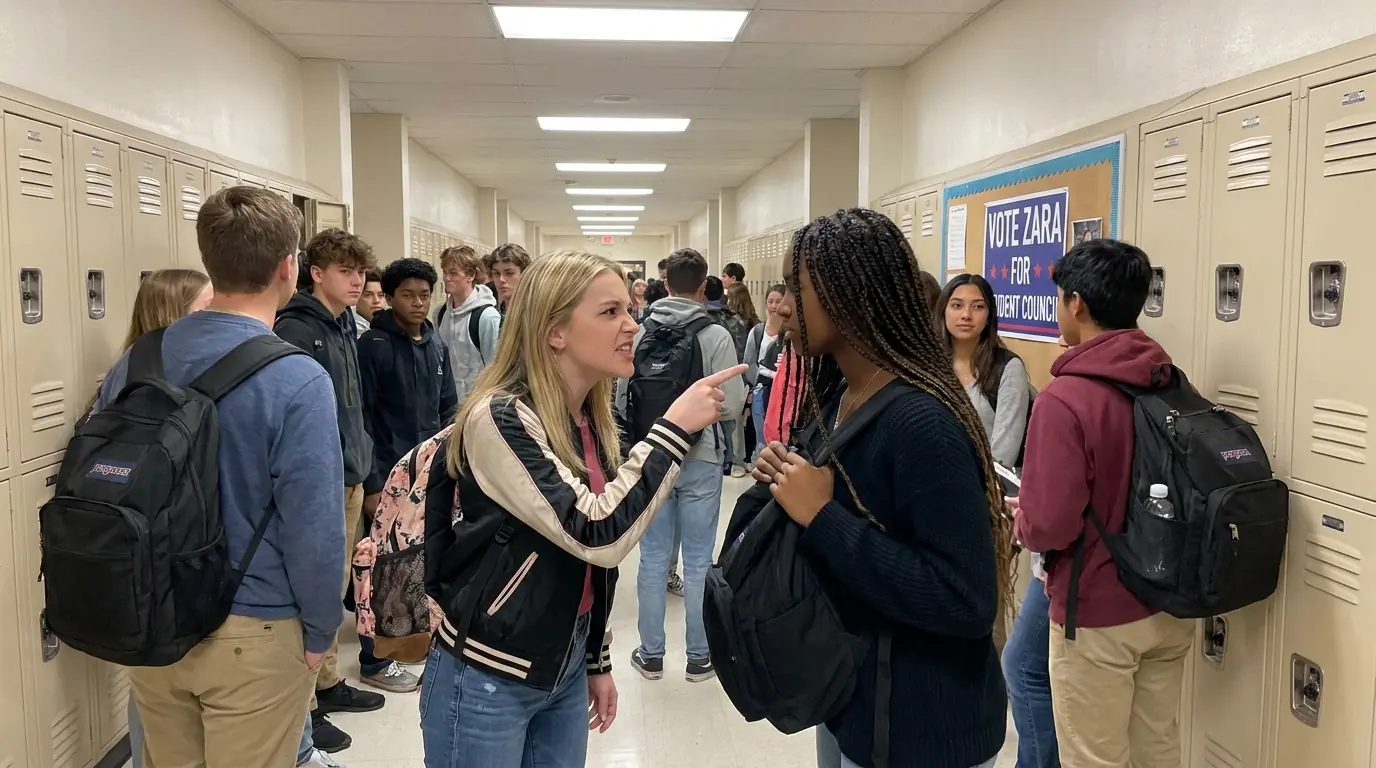
There has to be some kind of mistake. Young lady, give me that bag right now. If you're innocent, there's nothing you should be afraid of. When Zara Mitchell, a black student who was quietly popular at Lincoln High, decided to run for student body president, her white classmate Emily Patterson couldn't accept competing against her. For months, Emily bullied Zara with racist insults while privately threatening to make her life miserable if she didn't drop out of the election and leave the school entirely.
When those threats failed to break Zara's resolve, Emily secretly planted her expensive iPhone and wireless earbuds deep inside Zara's backpack during lunch to frame her for theft. Everything went exactly as Emily had planned. She reported the items as stolen, called her police officer father, and watched as he arrested Zara in front of students and teachers. But what Emily Patterson didn't know, what she was about to discover, was that every step of her plan had been captured in crystal clear 4K by the school's security cameras. And before the day was over, she would be the one leaving in handcuffs.
Zara Mitchell walked through the hallways of Lincoln High School on a regular Tuesday morning in late September, carrying her backpack and heading to her first period class. She was 17 years old, a junior, intelligent, and articulate. The kind of student who was respected by teachers and liked by a diverse group of her peers. Her mother was a judge in the state court system, and that had shaped the way Zara thought about fairness, justice, and speaking up for what was right. Three weeks ago, she had made a decision that would change the dynamics of her entire school.
She had decided to run for student body president. The announcement had been met with surprise and support from many students. Zara had always been involved in school activities, respected by her classmates, and known for actually caring about student issues. The campaign seemed natural, something that made sense. But it had also triggered something unexpected in one of her classmates.
Emily Patterson had been in Lincoln High for 2 years. She came from a family with a strong law enforcement background. Her father, Marcus Patterson, was a police officer with 20 years on the force. Emily had run for student body president once before, 2 years ago, and had won easily. She had expected to win again this year without any real opposition.
She had expected the position to be hers by default. When Zara announced her candidacy, Emily's first reaction had been dismissive. But as the weeks went on and Emily noticed that students were actually supporting Zara, that her campaign was gaining traction, something shifted. Emily's dismissiveness turned into something darker. It turned into anger.
It turned into racism. Emily began making comments in the hallways. Comments about whether Zara was really qualified for the position. Comments questioning whether the school was ready for that kind of change. Comments that became increasingly focused on Zara's race rather than her actual ideas or qualifications.
Students began telling Zara about things Emily had said when Zara wasn't around. Jokes about her appearance. Suggestions that she didn't belong in a leadership position. But Emily didn't stop there. In private moments when no one else was around, Emily approached Zara directly.