No charge for repairs, just marry me. Reed said it the moment Tessa asked what she owed him. She laughed. He turned back to the workbench before she could see that he wasn’t entirely joking. For eight days, she lived in the guest room off his kitchen, used his coffee maker every morning, and filled the silence of a house that had been quiet for too long.
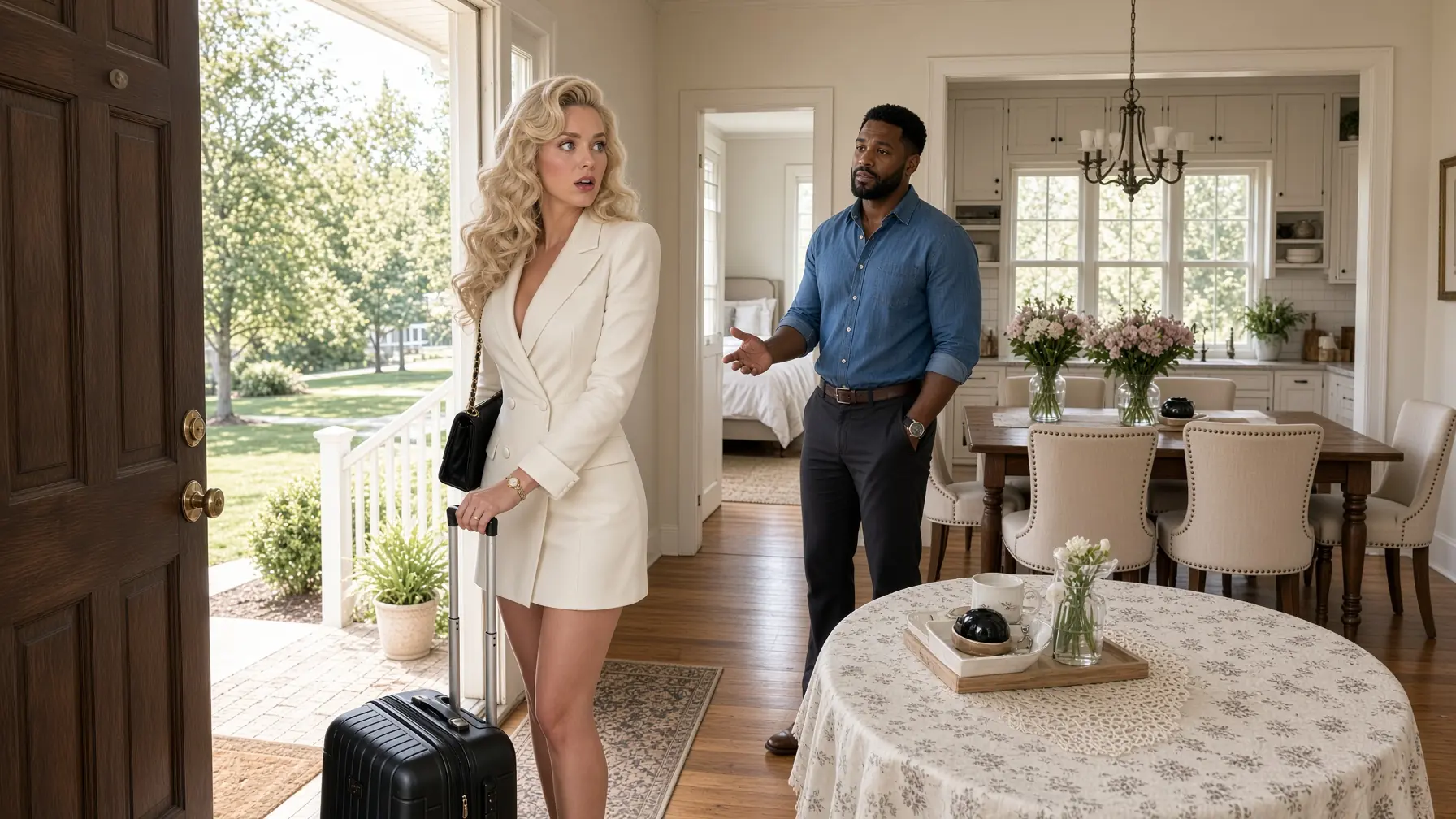
They shared a table, argued over grocery lists, and somewhere between a wrong part shipment and a meal she cooked without being asked, something shifted between them. Then the car was fixed. He watched her set her suitcase by the door the night before she left. He had the words. He knew exactly what he wanted to say. But Reed Callahan had spent his whole adult life making himself useful to people on their way somewhere else, and he didn’t know how to ask someone to stay when they no longer needed him to.
Tessa Monroe had a system. When you grew up in a family that moved 11 times before you turned 18, you learned to keep your life in a format that could be packed in under two hours: one large duffel, one rolling suitcase, a box of kitchen items she’d had since college, apartment leases in 12-month increments, a savings account she treated like a fire extinguisher, only to be touched in genuine emergencies. She was 32 years old, and she had never once let herself need someone more than she could afford to.
The job in Springfield had come through on a Tuesday. By Thursday, she’d signed the lease on a one-bedroom, put down the deposit, and given notice at the staffing agency she’d worked through since her previous employer shut its doors. Coordinator position at a midsize distribution company, steady hours, benefits after 90 days, room to move up if she stayed focused. It wasn’t the job she’d imagined at 22, but it was real, and it was hers, and no one had done her any favors to get it.
She’d loaded her car on a Saturday morning, told her best friend Simone the address of the new apartment, and pointed herself south on I-44. The car made it to Brier Creek, Missouri before it gave up. She heard the noise first, a high rhythmic whine from somewhere under the hood that hadn’t been there an hour ago. Then the charge warning light came on, orange and unhurried, as if it had been waiting for the right moment. Then the temperature gauge climbed.
Tessa took the next exit, pulled into the gravel lot of a feed store on the county road, and shut off the engine before anything worse could happen. She sat in the sudden silence and did the math. She had enough in her account to cover the first month’s rent, groceries for six weeks, and a security buffer she was not willing to touch. A rental car for 10 days would take a third of the buffer. A motel for the same period would take the rest. Both at once was not an option.
She called Simone. “Don’t panic,” Simone said. “I’m not panicking.” “You have the voice.” “What voice?” “The one where you’re already three steps into a contingency plan and angry that you need one.” Tessa exhaled through her nose. “The car died.” “How dead?” “The kind that needs a mechanic, not a YouTube video.” Simone told her to find the nearest shop and call her back.
The man behind the counter at the feed store, older, unhurried, a name tag that said Gus, didn’t look up from his inventory sheet when Tessa came in, but he listened. And then he said there was one shop in Brier Creek worth calling. Reed Callahan, straight shot down County Road 7, left at the water tower. Look for the green sign. “He’s good,” Gus said. “And he won’t sell you something you don’t need.” Tessa wrote down the number.
Reed Callahan picked up on the second ring. He arrived 20 minutes later in a white truck with rust along the wheel wells and a magnetic sign on the door that said Callahan Auto in plain block letters. He was tall, a little lean, with grease worked into the creases of his hands in the way that didn’t fully wash out anymore. He didn’t ask her how she was doing or make the face people made when they saw a woman standing alone next to a broken-down car on a county road, the face that was either pity or opportunity. He just crouched beside the front tire and listened.
“Walk me through what you heard,” he said. She described it: the whine, the light, the temperature gauge. He nodded once, opened the hood, looked for about 45 seconds, and then said, “Don’t start it again.” He had the car on his flatbed in 20 minutes. At the shop, a converted garage behind a small house at the edge of town, tidy in the specific way of someone who worked alone and had strong opinions about where things belonged, he put the car on the lift and showed her exactly what had failed.
The idler pulley had seized. The friction had shredded the serpentine belt, and someone at some point had repaired a bracket with a method that had probably seemed fine at the time and was now not fine at all. He set the pulley on the workbench in front of her. She looked at it. The bearing had collapsed inward on one side. “How long could I have driven on it?” she asked. “You didn’t. That’s what matters.” “But if I had?” He considered this. “Another 20 miles, maybe. Then the belt lets go completely. You lose the alternator and the water pump at the same time, and the engine overheats. Could have warped the head.”