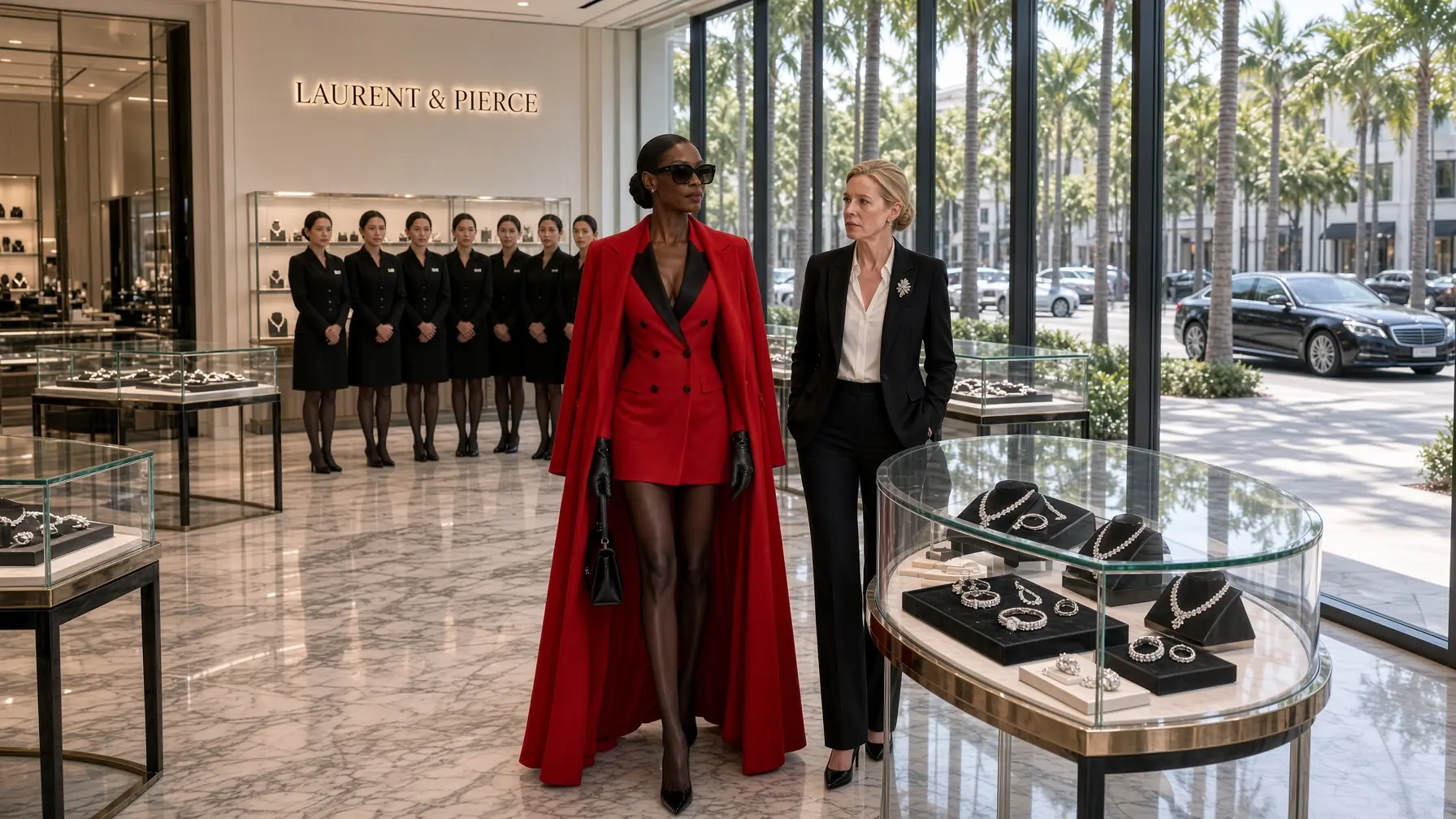
The first thing Regina Caldwell noticed when she stepped inside Laurent & Pierce Jewelers was not the diamonds. It was the silence that followed her through the door. Three sales associates looked up, decided something within seconds, then returned to arranging velvet trays as though she had wandered into the wrong building. Near the center of the showroom, store manager Meredith Sloan glanced at Regina’s jeans, flat shoes, and plain wool coat before turning back toward a white couple she had been greeting with champagne.
Regina stopped just inside the entrance and waited. No welcome. No offer to take her coat. No polished line about the Laurent experience that appeared in every employee-training manual she had reviewed before signing the acquisition papers that morning.
She almost laughed. Twelve hours earlier, attorneys had slid the final documents across a conference-room table on the thirty-second floor of Caldwell Holdings, giving Regina controlling ownership of Laurent & Pierce, a ninety-year-old luxury jewelry company with seventeen boutiques across the United States. The acquisition had taken fourteen months, hundreds of hours of negotiations, and enough money to make business reporters speculate for weeks about what Regina planned to do with the struggling heritage brand. The public announcement was scheduled for Monday morning.
Nobody inside the flagship store knew yet.
That was intentional.
Regina had spent most of her career buying companies whose spreadsheets revealed obvious problems while their leadership insisted the culture was healthy. Laurent’s numbers showed shrinking repeat customers, rising turnover, three settled discrimination claims, and a disturbing gap between online traffic and in-store conversion. Executives blamed changing consumer habits, younger buyers, and the decline of formal luxury retail. Regina suspected customers were not the only thing changing.
She wanted to see the floor before anyone knew she owned it.
So she traded her tailored business suit for dark jeans, a cream sweater, flat boots, and a simple coat from the back of her closet. She left her usual diamond studs at the office, let her natural curls fall around her shoulders, and had her driver drop her three blocks away. Nothing about the clothes was cheap. They simply did not advertise money to people trained to recognize labels from across a room.
That distinction was apparently enough.
Laurent & Pierce occupied a limestone building on Chicago’s North Michigan Avenue, with brass-framed windows and a doorman who had been removed during cost reductions six months earlier. Inside, crystal fixtures reflected across glass cases displaying watches, rings, necklaces, and loose stones under carefully engineered white light. The company liked to describe the flagship as timeless. Regina’s acquisition team had described it privately as expensive-looking and emotionally frozen.
She moved toward a case holding bracelets.
One piece immediately caught her attention. It was an articulated platinum bracelet set with sapphires and small diamonds, elegant without being ostentatious. Regina had seen it in inventory reports because Laurent had carried three versions of the design for almost fourteen months without selling one.
A small card listed the price at $28,500.
Regina waited.
Behind another counter, a sales associate named Kyle Bennett watched her for several seconds before leaning toward a coworker. They whispered something. The coworker smiled.
Regina looked directly at them.
Both suddenly found paperwork interesting.
After almost five minutes, she approached Meredith Sloan.
“Excuse me.”
Meredith turned slowly.
She was forty-five, immaculately dressed in a charcoal skirt suit, with blond hair pulled into a smooth bun and a diamond brooch positioned perfectly beneath one shoulder. Her professional smile appeared late, after her eyes had already completed another inspection of Regina’s clothes. That delay told Regina more than the smile ever could.
“How may I help you?”
“I’d like to see the sapphire bracelet in the center case.”
Meredith looked toward it.
“The Celestine.”
“Yes.”
Meredith’s smile tightened slightly.
“That piece is twenty-eight thousand five hundred dollars.”
Regina nodded.
“I saw the card.”
For half a second, something flickered across Meredith’s face. Annoyance, perhaps, that the price itself had failed to redirect the conversation. She placed one hand against the glass case but did not reach for the key.
“Pieces in that collection are generally viewed by appointment.”
Regina looked around.
The store was not busy.
The white couple Meredith had been helping were now speaking privately near the bridal section, and two sales associates were standing without customers. Regina could see no appointment book, no waiting clients, and no practical reason the bracelet could not be shown.
“I’m here now.”
Meredith gave a small sympathetic smile.
“We try to preserve a certain level of service for serious buyers.”
Regina tilted her head.
“What makes someone serious?”
Meredith seemed to hear the trap only after stepping into it.
“I simply mean clients who have already gone through a consultation.”
“I haven’t.”
“Exactly.”
Regina looked at the bracelet again.
“So I would need a consultation before I can decide whether I want to buy something.”
“For high-value pieces, yes.”
The answer sounded official.
Regina already knew it was false.
She had read the operating manual.
Any salesperson could open the case for a customer after confirming basic handling procedures, regardless of appointment status. Appointments were encouraged for custom pieces and private collections, but the Celestine bracelet was standard floor inventory. Meredith was not applying a policy.
She was inventing one.
Regina nodded.
“Could I schedule the consultation now?”
Meredith looked toward the entrance as a white man in a navy overcoat walked in.
Her entire posture changed.
“Mr. Hollister.”
She smiled broadly.
“How wonderful to see you.”
Then she looked back at Regina.
“Someone at the front desk can assist you.”
She walked away.
Regina remained beside the case.
The man Meredith greeted did not have an appointment.
Regina knew because she had spent the previous week reviewing high-value customer lists and recognized Charles Hollister as a client who had purchased watches twice in five years. Meredith unlocked a case for him within ninety seconds. No consultation.
No qualification.
No question about seriousness.
Regina felt an old familiar pressure settle behind her ribs.
It was not surprise.
That bothered her more.
At thirty-nine, she had built Caldwell Holdings from a small luxury-accessories startup into a private investment group with interests in retail, hospitality, and consumer design. Magazines described her as self-made, which always ignored the twenty years her mother spent operating a salon and the twelve-hour days her father worked as an electrician. Regina had never believed building wealth would erase the moment when somebody looked at her and decided she probably could not afford the room.
Money changed many things.
It did not travel ahead of you unless you displayed it.
Sometimes Regina deliberately did not.
A few minutes later, a young employee approached carrying a small tray with bottled water and glasses.
“Would you like some water?”
Regina looked at her name tag.