“Hey, poor man. Clean my shoes quickly. I don’t have all day.”
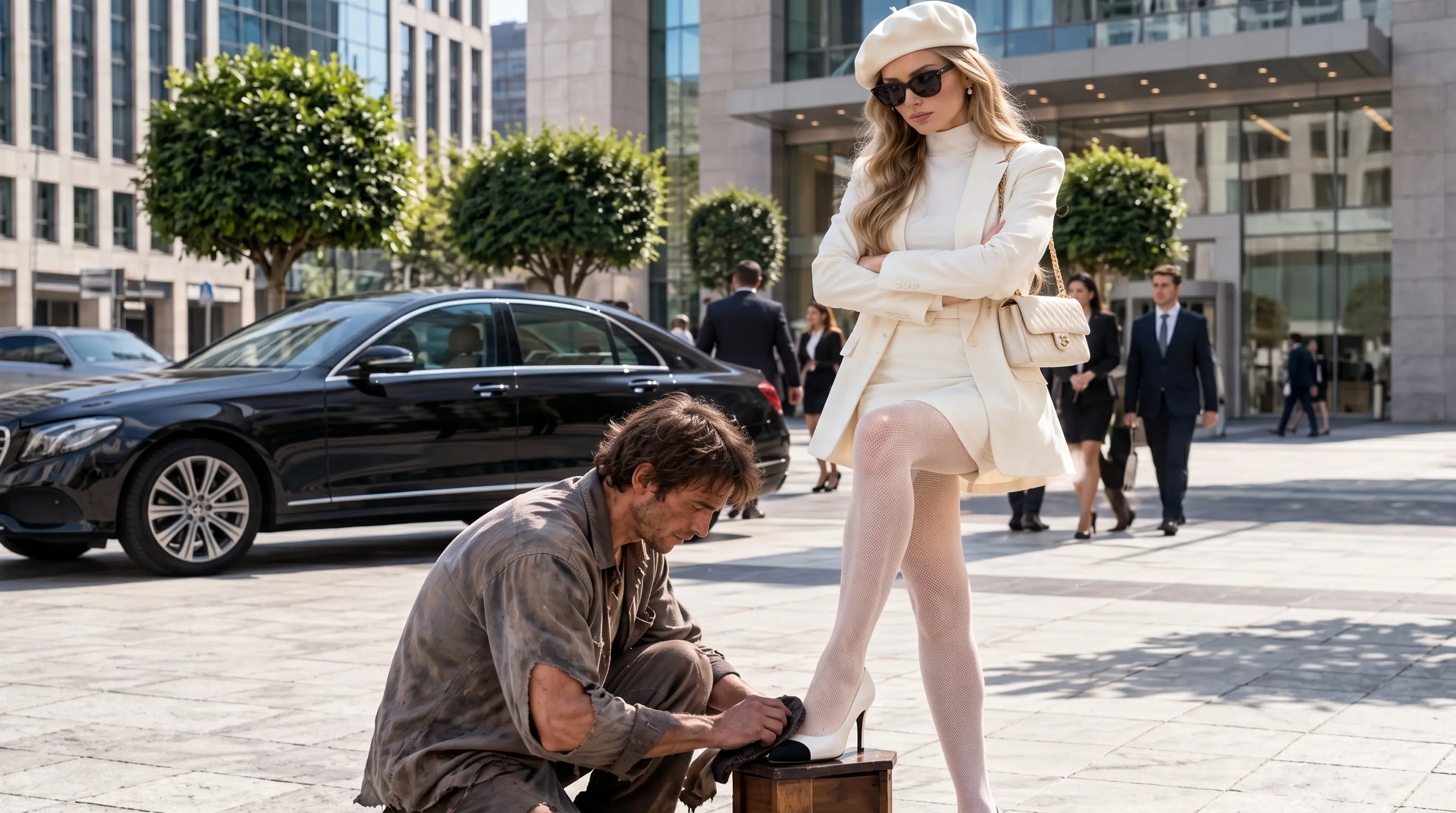
The woman didn’t ask so much as issue an order. She stopped directly in front of Daniel’s small wooden shoe stand, lifted one expensive heel, and dropped it against the edge hard enough to send a streak of dirty rainwater across his shirt. Around them, employees streamed through the glass entrance of the forty-story office building without slowing down. Daniel looked at the shoe, then at the woman wearing it, and lowered his eyes.
“Yes, ma’am.”
Her name was Victoria Lane, and Daniel already knew exactly who she was.
She was the company’s senior vice president of client relations, one of the most visible executives in the building and one of the names Daniel’s mother had mentioned repeatedly whenever they discussed leadership succession. On paper, Victoria was exceptional: profitable accounts, polished presentations, impressive retention numbers, and glowing feedback from wealthy clients. Yet over the previous six months, something strange had begun appearing beneath those numbers. Junior employees transferred out of her division at twice the company average, temporary workers rarely lasted more than a few weeks, and several service vendors had quietly requested that their contracts exclude direct contact with her team.
Nobody had accused Victoria of anything serious enough to trigger an investigation. The complaints were always softer than that. “Dismissive.” “Humiliating.” “Treats support workers differently.” “Makes people feel small.” One facilities employee had written only seven words before resigning: “You learn quickly whose dignity matters here.”
Daniel had read that sentence three times.
His mother had built the company nearly thirty years earlier from a rented office above a hardware store. She had begun with four employees, secondhand desks, and a rule she repeated so often that Daniel had known it before he understood what a corporation was: nobody became less human because of the work they performed. The company had grown far beyond those beginnings. Thousands of people now worked under its name, and the headquarters lobby had polished stone floors, private elevators, security gates, art that cost more than Daniel’s childhood home, and employees who sometimes forgot what the company had once been.
Daniel had spent most of his adult life trying not to become one of them.
He was thirty-six now, old enough that newspapers occasionally called him the founder’s son, although he hated the phrase. He had started in the warehouse at nineteen, worked customer support, spent two years in procurement, and later managed one of the company’s smaller regional offices without publicly using his family connection. His mother had insisted on it. If he was ever going to help lead the company, she said, he needed to know how people behaved when they thought he had no power over them.
That lesson stayed with him.
So when Daniel returned to headquarters after six years away and began preparing to take a larger role in the business, he did not start with financial reports. He started with resignation letters. He read anonymous workplace surveys, vendor complaints, security logs, HR summaries, and exit interviews. What bothered him most wasn’t that the company had problems; every large organization did. What bothered him was how many people seemed to believe those problems were simply part of working there.
One employee described executives walking past janitors without acknowledging them. Another said security guards treated delivery drivers like suspects while greeting senior managers by name. A cafeteria worker reported that a director had snapped her fingers instead of speaking to her. A temporary receptionist wrote that after three weeks she had learned more about hierarchy from the way people treated the cleaning staff than from the organizational chart.
Daniel brought the reports to his mother one evening.
She read them in silence from behind the desk in her home office. Age had softened her voice but not her attention. When she finished the last page, she removed her glasses and looked at him.
“What are you thinking?”
“I want to know whether this is a collection of bad experiences or a culture.”
“We have people whose job is to investigate that.”
“They know when they’re being investigated.”
His mother leaned back.
“And you have another idea.”
Daniel had already purchased the old shoe-shine stand.
He explained it carefully. For one week, he wanted to sit outside the headquarters entrance dressed as a struggling street shoe cleaner. The building sat beside a public plaza, so he wouldn’t technically be inside company property. He would charge five dollars, stay out of the walkway, and observe how employees behaved toward someone they believed had no connection to them and no ability to affect their careers.
His mother stared at him as though waiting for the part where he admitted it was a joke.
“Daniel, you don’t have to do this.”
“I know.”
“Let me send someone else.”
“No, Mom. I need to see the truth myself.”
“You could be recognized.”
“I’ve been gone six years. Half the headquarters staff have never met me, and the executives who have only know me from formal photographs.”
She still looked unconvinced.
Daniel leaned forward.
“If I walk in there as your son, everyone will show me their best behavior. I don’t want their best behavior.”
“What do you want?”
“The behavior they think doesn’t matter.”
That answer changed her expression.
Finally, she nodded.
“All right. You have my permission, but no one can know who you are.”
Daniel smiled faintly.
“That’s the point.”
He began the following Monday.
He grew his beard for two weeks beforehand, wore an old coat, faded trousers, worn gloves, and a knit cap pulled low over his forehead. He borrowed scuffed boots from a warehouse employee he trusted and rubbed dark polish beneath his fingernails. When he looked at himself in the mirror before leaving home, he didn’t see the man who had spent the previous month in board meetings.
He saw someone most people would forget five seconds after walking past.
That first morning taught him more than some executives had in years.
Hundreds of employees entered the building between seven and nine. Most ignored him entirely, which Daniel had expected. Some glanced at the sign offering shoe shines for five dollars and continued walking. A few smiled or said good morning.
One man stopped.
“How much for a shine, sir?”
Daniel looked up.
“Five dollars, sir. I’ll have them shining in no time.”
The customer was an older accountant Daniel vaguely recognized from the company directory. He sat, chatted about the weather, paid five dollars, and added another five as a tip.
“Good morning,” the man said as he stood. “Hope you have a good day out here.”
It was ordinary.
That was exactly why Daniel remembered it.
Kindness didn’t always arrive as sacrifice. Sometimes it was simply the refusal to act as though another person were invisible.
Victoria arrived at 8:17.
Daniel recognized her before she reached the plaza because people seemed to reorganize themselves around her. An assistant hurried at her side carrying coffee and a tablet. A junior employee held the door before Victoria was anywhere near it. She walked quickly, speaking into a wireless headset, her red-soled shoes clicking against the pavement.
Then she noticed Daniel.
Her eyes moved from his stand to his clothes, then back toward the building.
She slowed.
“You.”
Daniel looked up.
“Yes, ma’am?”
“Clean these.”
She placed one shoe on the stand.