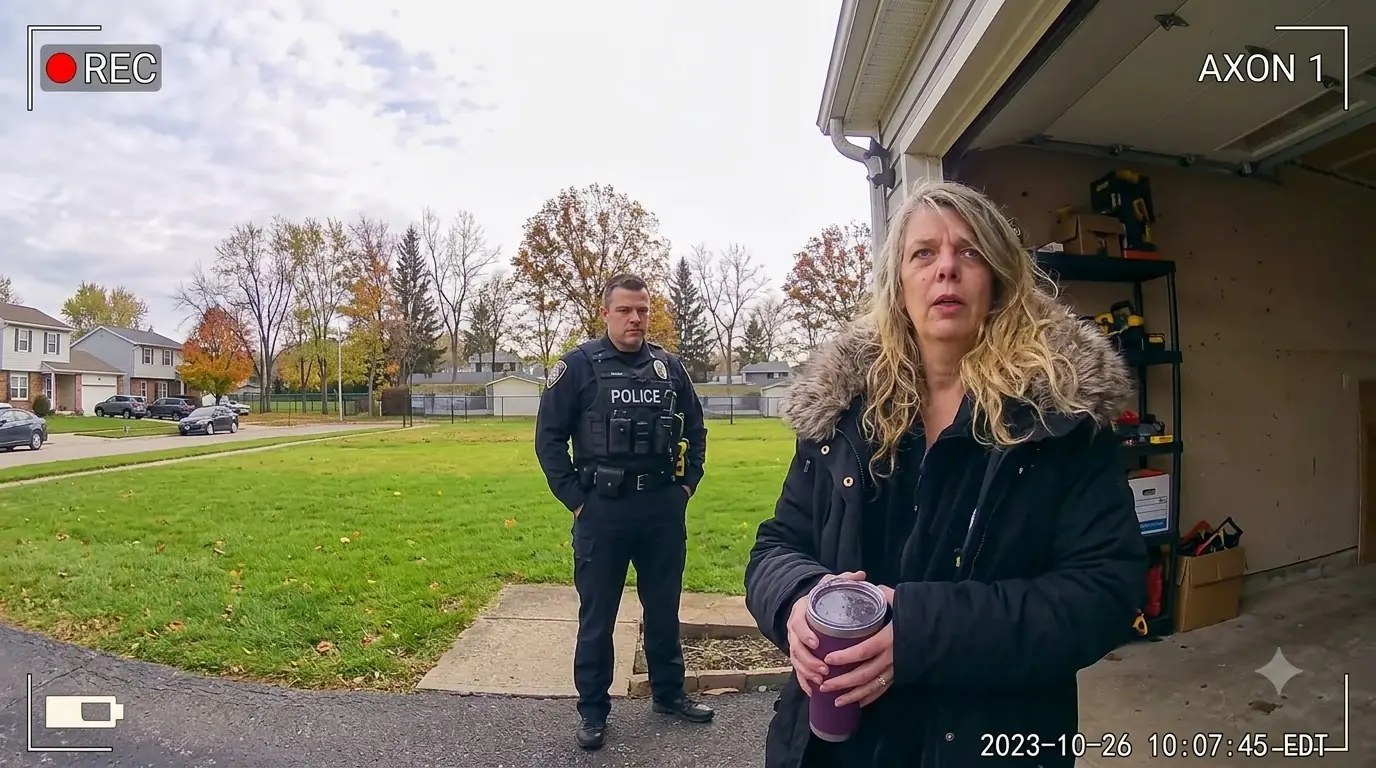
“How you doing, ma’am?” an officer asked as a woman approached the scene. “What’s your name?”
“Anna.”
“Anna. Can I speak to Anna for a second?”
The woman was Edward Lewis’s sister. Only moments earlier, police had found her brother dead inside his own home. At that point, officers knew they were dealing with a homicide, but they did not yet understand how much of Edward’s final months had been shaped by people he trusted, how many warnings had surfaced before his death, or how long it would take to turn suspicion into a case strong enough for court.
The investigation began on November 2, 2023, at about 10:28 a.m., when the Youngstown Police Department received a report from an older neighbor who had gone inside Edward’s house and found him unresponsive on the floor. A patrol officer was sent to check the residence. From the dispatch information, it initially sounded like a death investigation, not necessarily a murder scene.
When the officer arrived, the neighbor met him outside and directed him toward the garage. “You got to go in the garage,” the man explained. “Into the kitchen and turn left.”
The officer told him to remain outside while he entered alone. Within moments, the tone changed. Inside the kitchen area, the officer found 53-year-old Edward Lewis with multiple gunshot injuries and signs that he had been there for some time. He immediately requested a supervisor and additional officers to secure the property.
Investigators would later document one gunshot wound to Edward’s head that was identified as fatal, two additional wounds to his torso, another wound to his thigh, and a grazing injury to his thumb. Four spent shell casings and a deformed bullet were recovered near his body. Early decomposition suggested that Edward had been dead for days rather than hours.
What investigators did not see mattered almost as much as what they did. There was no obvious evidence of a prolonged struggle. Furniture was not scattered in a way that suggested a fight, and there were no signs that Edward had been desperately trying to defend himself before the shots were fired. The scene suggested that the attack had been sudden.
There were also no obvious signs of forced entry. The doors and locks were intact, and no broken window offered an easy explanation for how the shooter had entered. That immediately pushed detectives toward a disturbing possibility: Edward may have opened the door voluntarily to someone he knew, or at least to someone he did not consider an immediate threat.
With the house secured, detectives began with the person who had found him. Edward’s next-door neighbor explained that Edward’s car had remained outside for about two days, something he found unusual. The day before the body was discovered, the neighbor had also noticed a white pickup truck parked farther down the street near Salt Springs.
The truck drew his attention because people occasionally came into the area to dump things. The neighbor said that when he went down the road to see what was happening, the truck backed away and disappeared from his view. When he returned, he noticed Edward’s garage door open.
At first, he did not enter. The situation simply felt wrong. He told his wife that something was not adding up and suggested they contact Edward’s sister, Anna. By the following morning, concern had grown enough that he went into the house, called out for Edward, and found him just around the kitchen area.
The neighbor’s timeline helped police narrow the likely period of the killing. He had last seen Edward around Halloween, and no one recalled seeing him outside after October 31. The condition of the body was generally consistent with Edward having been dead for roughly two days when officers arrived on November 2.
Then the neighbor remembered something else. On either the night of October 30 or October 31, at roughly 12:30 a.m., he had seen a man outside Edward’s residence. The man had his hood drawn tightly around his face. The neighbor could not identify him, but he remembered the stranger knocking at the front door and repeatedly calling, “Ed. Ed. Ed.”
When Edward did not answer, the man moved toward the back of the property. The neighbor did not report hearing gunshots, and he could not say whether the late-night visitor was connected to the murder. But the detail mattered because the person clearly knew Edward’s name and appeared comfortable enough to approach the residence and call for him directly.
The investigation now had fragments rather than answers: an apparently trusted entry, a late-night visitor, a suspicious white pickup seen later, no weapon at the scene, no obvious forced entry, and very little physical evidence pointing to a specific suspect. Detectives needed to understand Edward’s relationships.
The neighbor walked investigators through the sequence again because the timing mattered. He had noticed Edward's vehicle sitting in the same place, then saw the white pickup farther down the road. When the pickup backed away, he briefly followed the direction it went, lost sight of it, and came back toward Edward's property. That was when the open garage became impossible to ignore.
He emphasized that he had not gone inside the first time he noticed the garage. Instead, he went home and told his wife something felt wrong. The next day, with Edward still nowhere to be seen, he returned, entered through the garage, and called Edward's name as he moved into the kitchen. He did not search the entire house. He found Edward almost immediately.
Detectives also asked whether he had heard gunfire during the previous nights. He had not. That absence did not rule out a shooting, but it meant investigators could not rely on a neighbor who remembered a clear volley of shots at a specific time. The neighborhood had not been alerted by a dramatic disturbance.
The hooded visitor was therefore unusually important. The neighbor remembered the man appearing around midnight or shortly after, calling for Edward at the front of the house and then moving toward the rear when there was no response. The visitor's face was largely obscured by the hood, leaving the neighbor unable to make an identification. Still, the repeated use of Edward's nickname made it clear the visitor was not randomly testing doors.
The account also complicated the white-pickup sighting. Detectives could not establish from the neighbor's testimony alone whether the pickup was connected to the murder, whether the late-night visitor and the pickup driver were the same person, or whether either event occurred before or after Edward died. Each detail was a lead, not a conclusion.
That was when Anna arrived.
Edward’s sister was devastated, but she began giving officers names. She said her brother had spent time with two women, Ashley Coulton and Paris Jones. According to Anna, the women were sisters and were both in their thirties. Ashley had been in prison, Anna said, while Edward had continued spending time with Paris.
Anna was not able to identify the hooded man the neighbor had seen, and she could not hand detectives a simple explanation for why Edward would have been killed. But she confirmed that she had heard about someone appearing at the house late at night. She also described relationships around Edward that investigators now needed to untangle.
The initial forensic work did not immediately give them the breakthrough they wanted. Investigators did not recover a clean fingerprint or DNA profile that instantly identified the shooter. Nearby homes did not provide useful video showing the killing, and no murder weapon was found inside the house. The shell casings established that a firearm had been used, but they did not tell detectives who had pulled the trigger.
Anna's first interview did not immediately identify Glenn, and detectives treated her information cautiously. She mentioned Ashley Coulton and Paris Jones because both names were connected to Edward's recent social circle. Anna said Ashley had previously been incarcerated and that Edward had more recently been spending time with Paris. She also recalled enough about Paris to make investigators want to understand whether money, drugs, family problems, or another relationship had created tension around Edward.
Anna could not personally say who had been outside the house at 12:30 a.m., and she did not claim to have witnessed any threat herself. Her value at that stage was different: she gave detectives a map of Edward's relationships. That map led them toward Paris, then toward Stacy, and eventually toward the man Paris was reluctant to name.
The absence of immediate forensic identification made those relationship interviews essential. Four shell casings could be measured and compared, but without the firearm they could not name the shooter. The lack of forced entry suggested familiarity, but it could not identify which familiar person had been allowed inside. Every statement therefore had to be separated into what a witness actually saw, what Edward had told that witness, and what investigators were only beginning to suspect.
Shortly after the initial interviews, Anna provided another important name: Stacy, a woman Edward had met only a few months earlier. Stacy was in jail on an unrelated matter when detectives sought her out, but she had spent enough time with Edward to know what had been troubling him before he died.
When detectives asked how she knew him, Stacy said they had met three or four months earlier at Jordan’s Market. Both were coming out of difficult relationships. Edward had spoken to her as she was leaving the store, asked for her number, and the two began talking. They went to dinner a few times, visited each other’s homes, and gradually began sharing details about their lives.
During those conversations, Edward told Stacy about another woman in his life. Stacy said she never focused on the woman’s name because she became angry simply hearing how Edward described the relationship. According to Edward, the woman regularly took his money and depended heavily on him. He had known her for years and had even become involved in helping her with a child-services matter.
Stacy told detectives that Edward said he had assisted the woman in getting her children back after they had been removed. Detectives later connected that description to Paris Jones. Investigators learned that Paris had seven children from multiple relationships and had experienced custody problems involving several of them. Edward had stepped in to help in a way that went far beyond casual friendship.
According to the investigation, Edward signed paperwork connected to the children and helped create circumstances in which they could again be with Paris. Whether every detail of that arrangement had been understood correctly at the time was less important to detectives than what it revealed about Edward’s role in Paris’s life. He was not a distant acquaintance. He was someone she repeatedly relied on.
Stacy said Edward described Paris as someone who had been taking large portions of his pay. She believed he knew he was being used but continued helping anyway. The relationship became even more complicated when a man connected to Paris was released from prison in September 2023.
Edward told Stacy that after the man returned, the man assaulted him, took money from his pocket, and became angry during a dispute over a job interview. Edward had apparently been expected to drive him to the interview, but after being punched and robbed, Edward refused.
According to Stacy, Edward then told her the man had threatened to kill him.
That statement changed the direction of the conversation immediately. Stacy had recently lost a nephew to gun violence, and the threat alarmed her. She told Edward that when someone explicitly says they are going to kill you, the safest response is to take it seriously and distance yourself.
“Leave her alone,” Stacy remembered telling him, referring to Paris and the turmoil surrounding her life.
Stacy also could not understand why Paris, after knowing Edward for years and accepting so much help from him, had apparently done little when the man assaulted and robbed him. To Stacy, that was a warning sign in itself. If someone had treated Edward that way in front of her, she said, she would have defended him even though they had known each other only a short time.
She also remembered Edward saying that people at his job thought he was foolish for continuing to give Paris so much money. His boss, according to Edward, had warned him about the situation. Stacy believed Paris sometimes came to or near Edward’s workplace to get money from him, and she contrasted that with her own approach to the friendship. If Edward bought dinner one night, she said, she wanted to pay the next time. She did not want him to feel that she was another person expecting him to finance her life.