"My mama keeps hitting me, bro. Please take her. Please take her."
On January 12, 2024, officers with the Riviera Beach Police Department were dispatched to an apartment on Avenue E after an anonymous neighbor reported an unknown disturbance next door. When they arrived, they encountered a visibly upset 13-year-old girl outside the residence. She said her mother had been physical with her and repeatedly begged officers to take one of them away because she did not want to leave with her mother.
Inside, the girl's mother, Monica Hightower, gave officers a very different account. "My daughter thinks she can beat me," Monica said. "She put her hands on me."
An officer asked what had happened and whether the argument was simply about the girl refusing to go to school. Monica said it was more complicated. She explained that she had told her daughter to get up and get ready for school, and that the morning had already become frustrating after the girl had an accident on a friend's sofa. Monica said she cleaned the couch, told her daughter to shower, and then instructed her to gather what she needed so they could leave.
According to Monica, her daughter took too long getting ready. Monica said she went into the room, became angry, and ordered her to hurry. She described the exchange as disrespectful and said the girl challenged her authority while Monica was telling her to gather her things. Monica acknowledged using harsh language during the argument, but she maintained that the teenager was the one who made the confrontation physical first. She told the officer the girl began swinging at her and insisted that she had not initiated the fight. "She thinks she can beat me, so I showed her," Monica said.
The officer continued trying to clarify exactly what Monica meant. He asked whether the girl had pushed her, taken a swing, or done something else first. Monica answered that her daughter had been swinging at her and emphasized that the girl was 13 years old. When asked her first name, she identified herself as Monica.
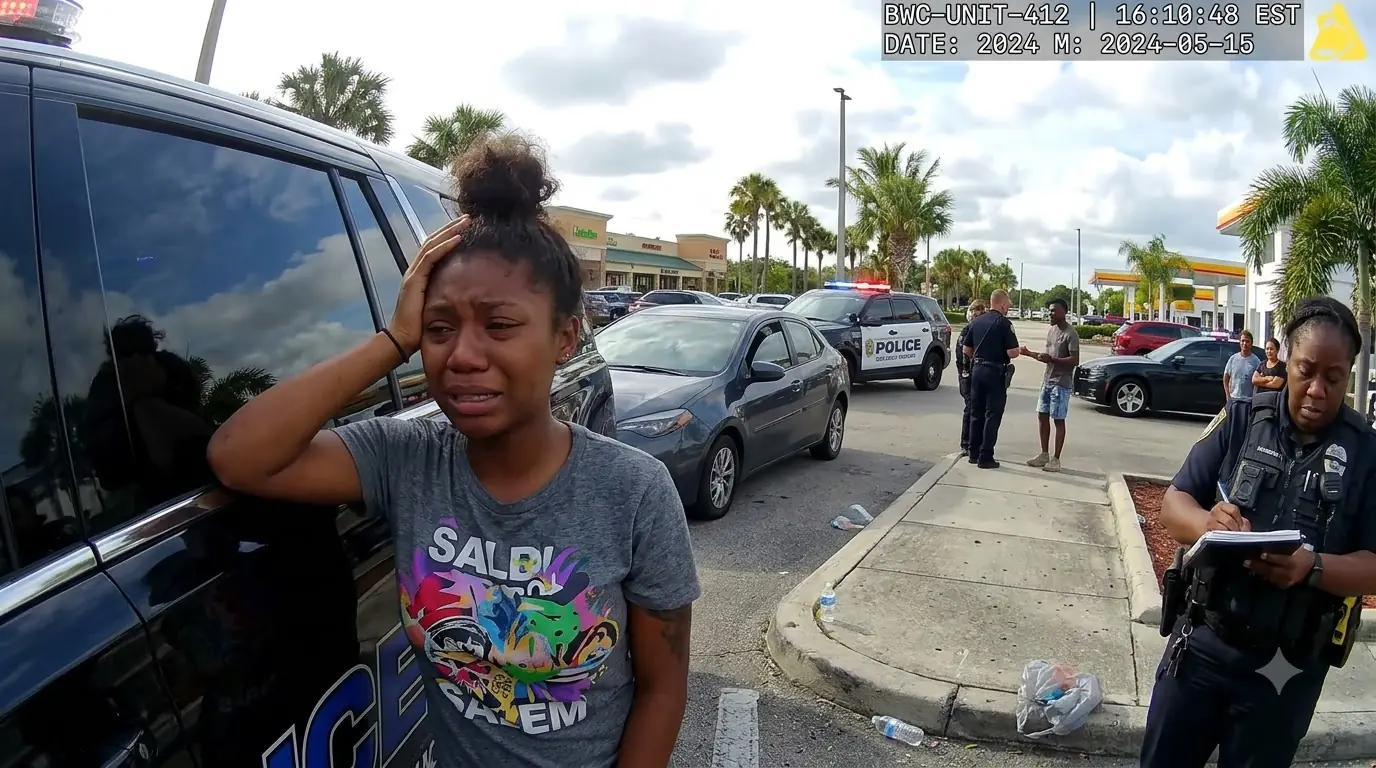
The scene already suggested that tensions inside the apartment had been running high before police arrived. Monica portrayed herself as a parent trying to maintain control over a disrespectful child. Her daughter, meanwhile, appeared deeply distressed and said the confrontation had started very differently. Officers separated the two so they could hear each version without interruption.
Monica continued explaining that this was not the first time she had problems with her daughter's behavior. She said her daughter needed to respect her and could not simply do whatever she wanted. An officer noticed what appeared to be the girl's name tattooed on Monica and commented on it. Monica referred to her daughter affectionately in one breath, then complained that the teenager constantly tried to get slick with her and ignore rules.
The officer then walked away from Monica and spoke privately with the girl. He asked what had happened that morning. The teenager said she had been taking a shower and later went into a room to get lotion and ask what her mother planned to do with one of her shirts. According to the girl, Monica came into the room already angry and confronted her.
The girl said her mother hit her in the face. She asked, "What did I do to you?" She said Monica then grabbed at her hair. The teenager told officers that she said, "Bro, I hate you," tried to walk away, and was pulled back by her hair. She had been wearing her hair in a ponytail and said the pulling caused part of it to come loose.
According to the daughter, Monica continued hitting her. The teenager said she tried to tell her mother to get back and eventually hit back while trying to defend herself. She said her aunt intervened and told her to stop, so she stopped fighting. The girl claimed Monica continued striking her while she sat there repeating, "I don't care. I don't care."
One of the officers remembered hearing the girl repeatedly saying that phrase before he fully entered the situation. The teenager confirmed that was what she had been saying. She then made her position clear: she did not want to go anywhere with Monica. "Y'all are going to have to take one of us, because I'm not going," she told them.
The officers also learned that the family situation was unstable. The girl said they did not actually live at the apartment and had come there largely to shower and get ready. There was discussion that Monica and her daughter had been staying with friends and did not have stable housing. The teenager referenced another place near Northlake Shore Court, while an officer summarized the situation by saying they appeared to be moving between friends' homes. Some of the exact address information in the body-camera audio was unclear, so officers focused on the immediate safety issue rather than trying to resolve the family's housing situation at that moment.
The conversation also returned to the embarrassing accident that had happened earlier in the morning. Officers understood that the girl had urinated on a couch and that Monica had cleaned it. The daughter indicated that the situation embarrassed her and that she did not want other people in the residence discussing it. Officers heard enough to understand that this humiliation had added another layer of tension before the argument moved into the bedroom and became physical.
An officer explained to the teenager that Monica's story was different. Monica had said she told the girl to gather her clothes, finish getting ready, and leave. According to Monica, the daughter became confrontational and started swinging first. The teenager immediately rejected that version and said her mother was lying.
As officers looked more closely, the physical condition of the two became increasingly important. The girl had an injured lip and visible marks on her face, neck, and arms. Her hair had also been pulled loose. Monica, by contrast, did not appear to have comparable visible injuries.
That contrast changed the direction of the investigation. The teenager's account was no longer standing alone as one person's word against another. Officers could see signs that she had been involved in a significant physical confrontation, and they began looking for anyone else who might have witnessed what happened.
The girl told officers that her aunt, Britney, had been present. Police located Britney and asked whether she had seen the incident. Britney said she had.
The body-camera discussion with Britney was partially fragmented, but the key point was clear. When officers asked who initiated the physical contact, Britney indicated that Monica had started it. She said Monica grabbed the girl and confirmed that she had grabbed her by the hair. Britney's account lined up with the daughter's central claim that Monica made the first physical move.
The officer asked several follow-up questions because he wanted to be certain he was not simply hearing a relative repeat the teenager's version. Britney said she had been present and saw enough of the encounter to identify who initiated it. Other people in the apartment apparently had not seen the entire confrontation, which made Britney particularly important to the officers' decision. The officers also remembered Britney from earlier police contacts at the same general location, though those unrelated incidents had nothing to do with the immediate case.
That statement mattered because it directly contradicted Monica's claim that the teenager had attacked her first. Officers also discussed how much more visibly injured the daughter appeared compared with Monica. One officer remarked that the mother looked substantially better than the daughter and that the teenager appeared to have taken the brunt of whatever had happened.
The officers then spoke among themselves about what they had observed and what they believed they were required to do. One considered calling a sergeant because the call sat at the uncomfortable line between parental discipline and alleged abuse. They discussed Florida's allowance for parental discipline but distinguished ordinary corporal punishment from conduct that, in their view, crossed into battery or abuse. Their concern centered on the girl's injured lip, facial marks, scratches, and the allegation that Monica had pulled her hair and struck her in the face.
One officer explained that if he had arrived and seen only temporary redness consistent with a spanking, he might have evaluated the case differently. What troubled him was the location and extent of the injuries: the girl's face, neck, arms, and lip all showed signs of the struggle, and her hair had been pulled. Another officer emphasized that an adult striking a child in the face hard enough to leave visible injuries was fundamentally different from reasonable physical discipline. The officers were careful to separate the teenager's possible disrespect from the question of whether Monica's response had been lawful.
One officer explained that he would view the teenager as having been battered if the evidence showed Monica initiated the physical contact and left those injuries. Another officer agreed that the girl's age was central to the decision. Whatever disrespectful behavior might have occurred, they said, did not justify punching a 13-year-old in the face or dragging her by the hair.
They also compared the case with other domestic calls involving parents and runaway teenagers, trying to separate reasonable efforts to control a child from excessive force. The officers repeatedly returned to the same point: the visible marks were on the daughter. Her lip was injured, her face and neck showed marks, and her hair appeared to have been pulled.
When officers returned to Monica, they confronted her more directly. They told her the girl said Monica had dragged her by the hair, pulled hair out, struck her in the face, and left multiple marks. They also told her that Britney had said Monica initiated the physical contact. Monica did not fully accept the officers' interpretation of what had happened, but her own explanation began to shift.
Monica continued insisting that her daughter had put hands on her, but she also began acknowledging more of her own physical actions. The discussion moved from her original portrayal of simple self-defense toward admissions that she had hit the girl and physically restrained her. That change mattered because officers were no longer relying solely on the teenager's account and Britney's observation; Monica herself was now conceding conduct consistent with parts of what they had already seen on the girl's body.
One officer told her there was a difference between disciplining a child and physically assaulting someone. Monica acknowledged that she had hit the girl "one or two times" but said much of what she had done involved holding the teenager down with her knee. She continued to argue that the girl had also put her hands on her.
The officer told Monica he understood that parenting a defiant teenager could be frustrating, but reminded her that she was the adult in the situation and the girl was 13. He explained that if he simply left after seeing the teenager's injured lip, pulled hair, and scratches, the body-camera footage itself would raise serious questions about why no action had been taken.
He also explained that because the incident involved a parent and child, it was being treated as a domestic matter rather than an ordinary dispute between unrelated people. The officer told Monica that he could not simply write a report and leave after documenting the girl's condition. He said that anyone later reviewing the body-camera footage would see the injured lip and other marks and would immediately question why officers had taken no enforcement action. The officers said child protective authorities would also need to become involved because of the girl's age and the nature of the allegations.
Monica eventually asked the question that made the outcome clear. "So I'm going to jail?"
"Yes," an officer answered.
He tried to explain that the terminology sounded severe but that, from their perspective, the visible evidence and witness account left them without a reasonable alternative. Monica asked questions about the charge and the arrest process. Officers then began preparing to transport her.
During the final exchange, police asked whether this was Monica's first arrest. She indicated that it was not. An officer tried to clarify whether a previous arrest had also involved a domestic incident and whether it involved a boyfriend, but the body-camera exchange became fragmented and never established the earlier case clearly. Officers then focused on transport, what personal property Monica could bring with her, and notifying the jail.
Monica Hightower was arrested and, according to the source, charged with child abuse with great bodily harm. She was transported to the Palm Beach County Jail and booked without bond. The 13-year-old girl, who had begun the call begging police not to leave her with her mother, was separated from Monica as child-protection procedures moved forward.
The source further states that Monica had another law-enforcement encounter in 2025 and was arrested on a separate domestic battery charge. That later arrest was a different case, and the source does not provide enough detail to establish its final disposition. What the January 2024 body-camera footage does document is a domestic call that began with two competing stories and ended with officers relying on visible injuries, a witness statement, and Monica's own partial admissions to decide that the confrontation had crossed the line from parental discipline into alleged child abuse.