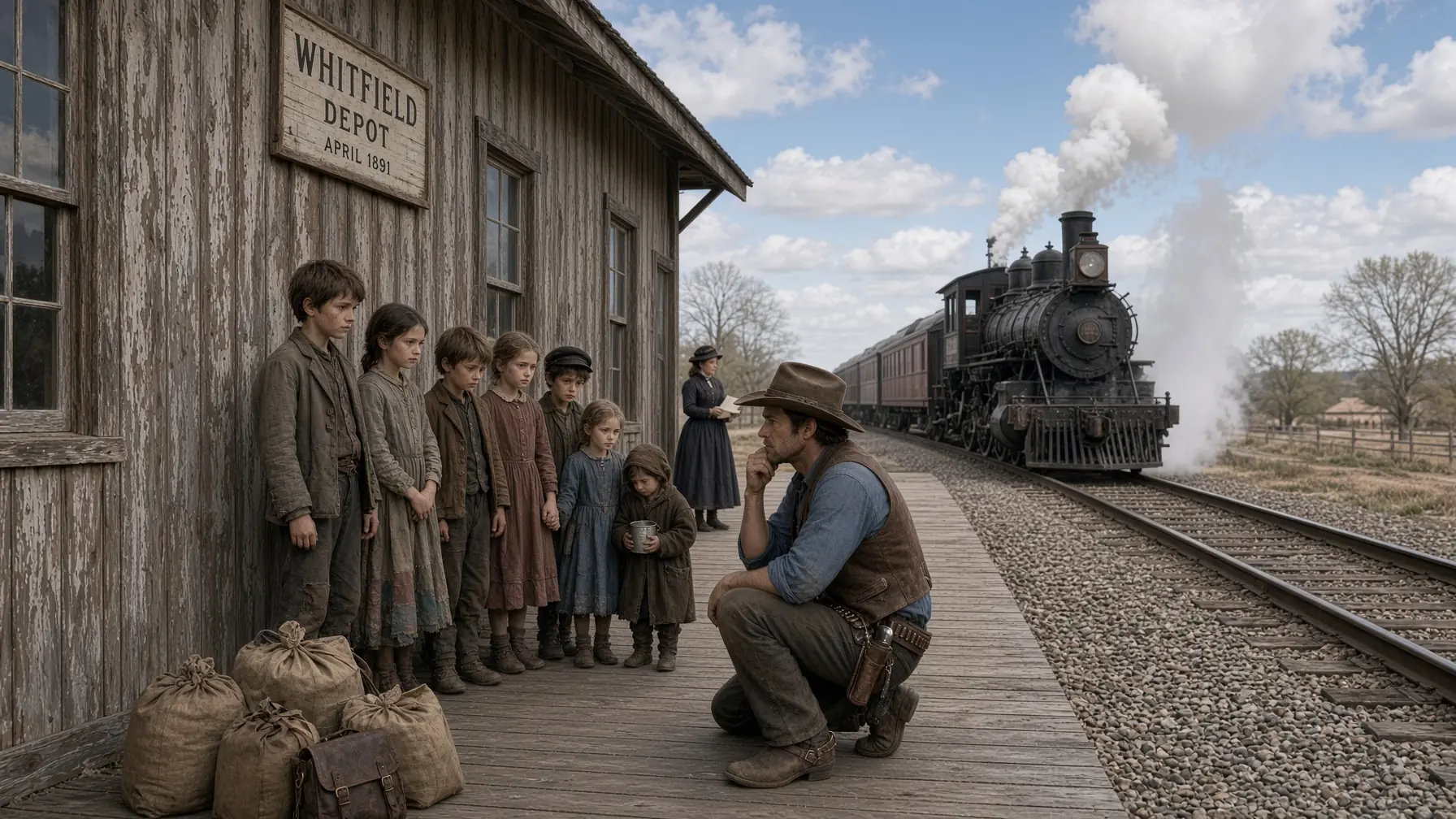
The train came in 40 minutes late on a Tuesday afternoon in April of 1891, and by the time it stopped at the Whitfield depot, there were nine people standing on the platform in the wind. Most of them had come to collect freight. One of them had come to collect a child. Caleb Dunn stood near the end of the platform with his hat low and his hands in his coat pockets and watched the passenger car door open. A woman stepped down first.
She was young, maybe 25, in a dark traveling dress that had picked up dust from four states, and she turned back toward the car and held out her hand the way a person does when the next one off the step is small. A boy came down, then a girl, then another boy, then three more children, one after the other, until all seven of them stood in a loose half circle on the boards with their backs to the wind and their bags between their feet. Seven children. He had been told there would be seven. The woman counted them without moving her lips.
She touched the shoulder of the tallest boy and pointed him to the end of the line, and the boy went without a word. She smoothed the collar of the youngest girl and pressed the child's hands together around the handle of a small canvas sack the girl had been dragging instead of carrying. Then she looked up at the platform and found Caleb Dunn standing there. And she walked toward him with the kind of stride that said she had done this before and expected nothing from the people she met at the end of it. She said, "You are Mr. Dunn."
He said, "I am." She said, "My name is Ruth Ames and I am with the Children's Aid Society out of New York. These seven children are placed out by the society under the terms you were sent in January. You may speak with them and make your selection. The society asks that you choose before the 4:15 northbound, which gives you a little more than 1 hour.
Caleb looked past her at the seven children on the platform. The oldest was a boy of maybe 12. The youngest was a girl who could not have been more than four. They stood in their line with their coats buttoned to the collar and their shoes tied and their hair combed flat and every one of them was looking at him. He said, "I was told I could take one."
Ruth Ames said, "That is correct." One child, the society places according to what each household can provide, and your letter stated 80 acres, no wife, and no help besides a seasonal hand. He said, "That is right." She said, "Then one child is what the placement allows." Caleb Dunn had $52 in his pocket.