On July 26, 2023, in Port Orange, Florida, a series of emergency calls and text messages sent law enforcement racing toward what appeared to be an armed kidnapping in progress. The person communicating with 911 claimed that a friend had been kidnapped from a Chick-fil-A in Palm Coast by an armed man in a white van and that the caller was following the vehicle on Interstate 95. The information sounded detailed enough to be credible, and multiple agencies began searching for the van while a helicopter joined the response. Then investigators traced the phone that had been contacting 911 and discovered that it was not moving along the interstate at all. Its location led them to a residential address in Port Orange.
When deputies arrived, they found a man outside mowing his grass and asked whether the home belonged to him. He said it did. The deputy asked if he had a daughter or another child at the house connected to the name that had appeared with the 911 information. The father did not recognize the name at first and said his family had just returned home from Pennsylvania. He told the deputy that his children were Ava and Mikey and offered to bring them outside so the officers could speak with them.
At first, the family tried to determine whether the phone might belong to another child in the neighborhood. The father knew of another girl nearby and mentioned Poppy Lane while deputies compared the address and phone number associated with the emergency contact. The family had only returned home around 2:00 a.m., and the father explained that they had been traveling from Pennsylvania. Nothing about the situation made sense to him, especially once the officers explained that the phone had been reporting a kidnapping that was supposedly unfolding on I-95 at that very moment.
The father tried to help the deputies rule out other possibilities. He described another girl who sometimes moved around the neighborhood, mentioned that a nearby house might be associated with children, and tried to remember which local phone numbers belonged to whom. The deputies compared those possibilities against the number tied to the 911 contact, but the trail kept returning to the family's address. What had begun as a quick conversation beside a lawn mower was turning into a direct examination of the family's phones and children. The father, still thinking there had to be some misunderstanding, told the deputies they were welcome to see his kids and verify who was actually home.
One deputy explained that someone had texted 911 saying a friend had been kidnapped from the Chick-fil-A in Palm Coast. According to the messages, a blue Jeep was following a white van carrying the victim. The caller claimed to be watching the van on the interstate, yet the location data from the phone pointed back to the family's house. When the father realized which phone number the deputies were talking about, he remembered that it had recently been assigned to Ava. The line had been inactive for some time before the family turned the phone back on.
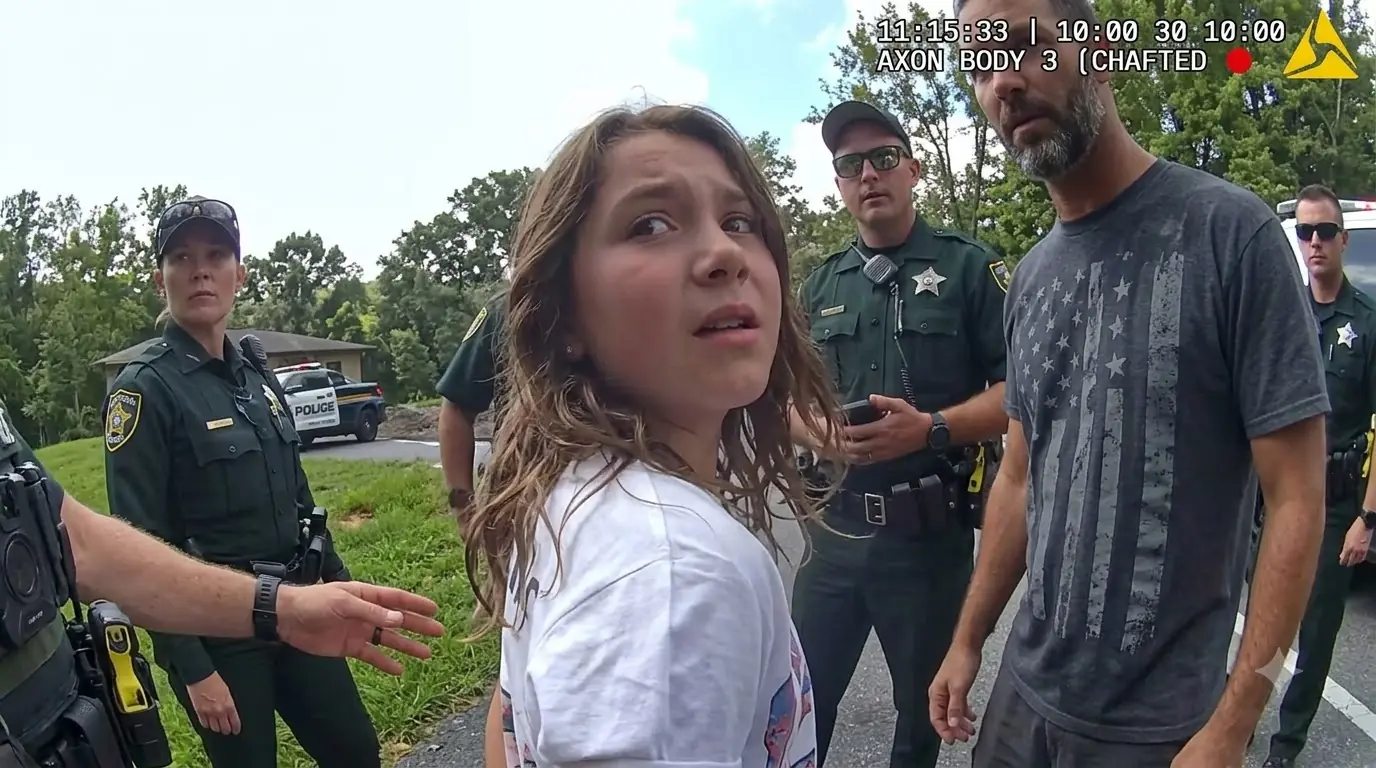
The family began checking the phone's call history. Deputies could see several contacts involving 911 and numbers that appeared to be emergency call-backs. There had been more than one outgoing call. Ava initially said she had not intentionally contacted 911 and appeared surprised as the adults went through the call log. Her father, however, could see the calls on the screen and immediately began asking her to explain what had happened.
The records showed that Ava had made an initial call during the morning and another shortly afterward. A later call came back from emergency communications. Deputies told the family that, during one of the early contacts, the caller had apologized and said there was no emergency. That would have ended the matter if the phone had not later begun sending a much more elaborate story about an armed kidnapping.
Ava continued to insist at first that she had not actually spoken during the calls. Her father pointed out that the phone itself showed otherwise. A deputy explained that the first call had been made and canceled, another call followed, and emergency personnel later called the number back. According to the call notes, someone on the line said the earlier call had been accidental and that there was no emergency. The text messages about the kidnapping came after that.
The call history gave the adults a much more precise timeline than Ava's first answers did. One entry showed a call at about 9:24 a.m. that had been canceled, followed by another call around 9:30. Emergency personnel then called the number back at roughly 9:42, creating another conversation lasting close to a minute. The parents asked whether the 911 audio was recorded and whether they could hear it, but the deputy explained that the recordings were maintained through dispatch and were not something he could simply play from his own equipment at the house. What he did have were the dispatch notes, and those notes said the caller had apologized for dialing by mistake before the later kidnapping texts began.
The contradiction put Ava at the center of the investigation. Officers were no longer searching only for a supposed white van; they were now trying to understand why an emergency report that had mobilized law enforcement appeared to have originated from an eleven-year-old sitting at home. Before questioning her further, a deputy began reading her rights. Ava's parents stood nearby as the deputy explained that she had the right to remain silent, that anything she said could be used in court, and that she had the right to speak with a lawyer.
Ava's father was visibly upset. He told her that what had happened was not a harmless joke and that she needed to take the situation seriously. A deputy reinforced that point, telling Ava that the false report had triggered a response involving numerous officers and at least one helicopter. The deputy emphasized that officers had been driving with lights and sirens while believing they were responding to a serious violent crime. In his view, the danger was not limited to the false report itself; a responding officer or an innocent motorist could have been hurt while police rushed to an emergency that did not exist.
Because Ava was a child, the officers carefully repeated the rights advisement and made sure the family understood what was happening. The deputy again explained that Ava could stop answering questions and could ask for a lawyer. Her parents were asked about any relevant medical or mental-health information, but the transcript does not clearly establish a diagnosis. The discussion then turned back to the phone and how Ava had been using it in the days before the incident.
The Miranda warning itself was repeated in full after interruptions from the family. Ava was told again that she did not have to answer questions, that anything she did say could be used against her, that she could speak with a lawyer before questioning, and that she could stop answering later even if she initially agreed to talk. The deputies paused to make sure she understood rather than treating the warning as a formality. Her parents were also kept involved because of her age. The tension in the driveway was obvious: Ava was crying, her father was angry, and the officers were trying to balance the seriousness of the investigation with the fact that the person they were questioning was eleven years old.
Her parents explained that the family had recently been on vacation in Pennsylvania and had spent a long day driving home. Ava had been allowed significant access to the phone during the trip. They said the device had only recently been given back to her after previously being taken away, and she had begun sharing the number with friends. Her parents described the situation as more freedom on the phone than she had previously been allowed.
A deputy told Ava that this was her opportunity to explain exactly how the story had started. He warned her that continuing to lie would make the situation worse and asked what she had hoped to accomplish. Ava apologized, but the adults pressed her for specifics. They wanted to know how she had decided on Palm Coast, why she had chosen Chick-fil-A, why she had described a white van and a blue Jeep, and how she had learned that she could send a text directly to 911.
The officers also wanted to inspect the phone itself. Ava's parents agreed to provide consent for the device to be examined, and the officers obtained the passcode. One officer placed the phone in airplane mode to preserve what was on it. The family discussed deleted messages and how they might be recovered. Ava's father made it clear that if there was anything else on the device, police were likely to find it.
The phone became its own part of the investigation. Officers asked how to access recently deleted material and discussed obtaining formal electronic consent from the parents. The family provided the passcode, and an officer said the device would be placed in airplane mode so investigators could preserve the contents while examining it. Ava's father asked directly what else police were likely to find once they went through the device. He told her that if she had deleted something or hidden another conversation, the time to admit it was before investigators recovered it themselves. The parents had gone from believing a recycled phone number might explain the problem to voluntarily handing that phone over as evidence.
Her parents asked what else they should expect investigators to see. The conversation was not limited to the calls visible on the screen; the adults knew that digital records could reveal deleted conversations and other activity. The father told Ava that handing over the phone meant there was little point in hiding anything. Officers again asked where she had learned how to send the false information and whether she had first dialed 911 simply to see what would happen.
The sequence increasingly looked deliberate rather than accidental. Investigators believed Ava had first called 911, backed away by saying the call was a mistake, and then returned with the kidnapping story. When asked how she had chosen the location in Palm Coast, Ava said it was simply the first place that came into her head. The deputy was skeptical because the report contained enough specific information to send agencies across the region looking for a moving vehicle.
Ava's father urged her to tell the exact truth. The deputy told her that staying quiet or shifting responsibility would not make the problem disappear. At one point, Ava appeared to suggest that something her younger brother had said contributed to the idea. Officers immediately separated that from the decision she had made herself. They established that her seven-year-old brother had not been beside her when she made the calls or sent the texts.
The deputy told Ava she could not blame a seven-year-old for what she had done on her own. Even if her brother had said something about calling 911, the officer explained, Ava had still chosen to place the call and build the story. Her father made the same point, asking her to take responsibility for the decision. The officers continued asking what had been going through her mind when she turned the idea into an emergency report.
Ava's attempt to connect the idea to her younger brother did not last long. The adults asked whether Mikey had been physically present when the messages were created. He had not. They asked whether he had helped type the kidnapping story or choose the locations. Again, he had not.
The deputy told her that even if a younger sibling had said something as simple as 'call 911,' that did not explain the decision to invent an armed abduction, a van, a pursuit on the interstate, and a specific location. The father added that a child still has to decide whether to follow a bad suggestion, especially when the suggestion involves emergency services.
Then one of the deputies laid out exactly what the false report had caused. The caller had claimed someone was abducted at gunpoint from a Chick-fil-A in Palm Coast, that the victim was being held in a van, and that the vehicle was traveling on I-95. The messages also placed the supposed vehicles near mile marker 234, close enough to the county line that multiple agencies had reason to become involved. The response included Port Orange-area officers, New Smyrna Beach Police, Edgewater Police, the Volusia Sheriff's Office, the Brevard Sheriff's Office, the Florida Highway Patrol, and a helicopter.
The deputy estimated that roughly two dozen law-enforcement personnel had been pulled into the search. The report sounded believable enough at first that officers treated it as a genuine armed kidnapping. That was why the GPS discrepancy became so important. While police were searching the interstate, the device providing the updates was sitting at or near a home in Port Orange.
Ava's mother raised another concern about the phone. When the family first activated the number, she said it had received repeated calls from unfamiliar numbers, and she had spent time blocking them. She wondered whether something about the recycled phone number might have contributed to what happened. The officers acknowledged that phone numbers can have histories and may receive unwanted calls, but they said that issue did not explain the false kidnapping report Ava had already admitted creating.
Her mother explained that, when the line was first reactivated, unfamiliar callers seemed to ring it almost constantly. She remembered answering and hearing people she did not know, then repeatedly selecting the option to block those contacts. To her, that strange activity made the phone itself seem suspicious. The deputies did not dismiss the possibility that the number had previously belonged to someone else, but they separated that issue from the present investigation. Random incoming calls could explain why unknown numbers appeared on the screen; they could not explain why Ava's device had generated a detailed false emergency after she had already acknowledged participating in it.
Investigators returned to the question of intent. They asked Ava what she believed would happen after she told 911 that someone had been kidnapped and that a firearm was involved. The deputy asked whether she had considered how many officers would be diverted or how fast they might be driving to reach the supposed victim. He explained that emergency responders have families too and that a serious crash during the response could have turned the prank into something much worse.
The adults also tried to understand where the idea had come from. Ava was asked whether she had seen a video, heard about a challenge, or watched someone else make a similar false report. The introductory account accompanying the footage states that she eventually acknowledged getting the prank idea from an online challenge. Whatever the source of the idea, officers treated the choice to recreate it as Ava's own decision.
The questioning was difficult for Ava. She cried, became increasingly anxious, and repeatedly looked toward her parents. The officers told her that she might still be taken to a juvenile facility and that telling the truth did not guarantee she would simply remain at home. They also told her that the purpose of the moment was not to frighten her for its own sake but to make sure she understood how serious the consequences of a false emergency report could be.
The deputy returned several times to the same practical question: what had Ava expected police to do once she said a person had been abducted at gunpoint? He asked whether she had imagined officers driving at high speed, whether she had thought about the helicopter, or whether she had considered that an officer responding to the call could crash. The point was not merely that law enforcement had been inconvenienced. The false report had created the conditions for a real emergency during the response. Ava mostly cried and gave short answers, while her parents pressed her to understand why the adults were treating the incident as far more than an online prank.
Her parents remained beside her while officers gathered their identifying information and completed paperwork. The tone shifted from investigation to a decision about custody. At that point, deputies had concluded there was sufficient cause to take Ava into custody. When they told her she would have to get into a patrol car, the reality of the situation hit her much harder.
Ava resisted the idea of getting into the back seat. She cried for her parents and became physically tense as officers tried to guide her into position. The adults repeatedly told her to stop struggling, relax her arms, and take deep breaths. Officers reassured her that no one was trying to hurt her and explained that some of what they were doing was required by policy.
Her parents tried to calm her at the same time. Ava begged not to be separated from them and asked if one of them could ride in the police vehicle with her. Officers said they could not. They explained that her parents would be able to meet her later and that the immediate process would likely involve paperwork, photographs, and fingerprints before the family was contacted about what came next.
Ava's fear intensified when she realized her mother and father could not simply climb into the patrol car with her. She repeatedly asked for them and tried to stay close as officers positioned her beside the vehicle. Her parents assured her they were not abandoning her and would follow the process as allowed. Officers told her they were still at the house finishing paperwork and that she could speak with her parents through the window while they remained nearby. The adults kept telling her to breathe, relax her arms, and stop pulling against the restraints because struggling would only make the cuffs more uncomfortable.
The deputy emphasized that the experience should become a lesson rather than something Ava allowed to define her life. He told her that she was eleven years old and still had the opportunity to learn from what had happened. Another officer reassured her that this was not the end of her life and that she was not being told she would spend years in prison. The point, they said, was that she needed to understand the seriousness of using 911 to create a violent emergency that did not exist.
Ava promised she would not do it again. The deputy told her that the promise mattered less than what she did afterward. She needed to remain calm, follow instructions, and stop making the situation harder. The officers allowed her parents to remain nearby and said they could speak with her through the window while the final paperwork was completed.
There was also concern about Ava's younger brother witnessing what was happening. An officer asked the father whether he wanted the seven-year-old to see his sister in handcuffs. The family sent the younger child back inside while officers continued preparing Ava for transport. They also made sure she had shoes before placing her in the vehicle.
Before Ava entered the patrol car, an officer performed a brief safety check and asked whether she had anything in her clothing or pockets that could hurt her or anyone else. Ava said she did not. The officer loosened the handcuffs slightly once she was seated but warned her not to try to slip out of them. The air conditioning was running, and the officer helped position her so she would be more comfortable while everyone waited.
The scene remained emotional even after she was seated. Ava asked whether her parents were leaving, and officers repeated that they were still nearby and would meet her later. Her father continued to frame the arrest as a consequence she needed to remember. At the same time, an officer softened that message by telling Ava this incident did not have to define the rest of her life. She was being taken through a juvenile process, not told that her future was over. Ava answered that she would never do it again, and the officer told her that the next step was to prove that by following instructions and making better choices after she went home.
For Ava's parents, the incident had moved from bewilderment to anger and then to the practical reality of dealing with a juvenile arrest. Only hours earlier, they had arrived home from a family trip to Pennsylvania. By late morning, law enforcement was standing in their driveway because a phone they had recently returned to their daughter had been used to fabricate an armed kidnapping.
The false report had not simply created confusion. It had occupied dispatchers, patrol officers, sheriff's deputies, multiple police departments, highway personnel, and an aviation unit. For a period of time, all of those responders had been acting on the assumption that a real person was being held against their will in a moving vehicle. The detailed nature of the messages was what made the report especially serious and what caused officers to continue searching until the phone trace contradicted the story.
According to the case summary, Ava was charged with making a false police report concerning a violent crime, a felony, and misuse of 911, a misdemeanor. She was processed through a family resource center and then held at a county juvenile detention facility. Because juvenile case information is restricted, the complete court record was not publicly available in the material provided with the footage.
The source further states that less than a week later, a judge allowed Ava to return home under her parents' supervision. Whatever happened later in the confidential juvenile process, the public portion of the case ended with the same lesson deputies had tried to impress on her in the driveway: a prank involving emergency services can mobilize real people, real vehicles, and real public-safety resources long before anyone discovers that the emergency itself was invented.