On July 26, 2023, dispatchers in Volusia County, Florida, began receiving urgent 911 text messages from someone claiming to be following an armed kidnapper's vehicle on the interstate. The texter said a friend had been kidnapped from a Chick-fil-A in Palm Coast and was being held inside a white van while the reporting person followed behind in a blue Jeep. Deputies, officers from multiple nearby agencies, and a helicopter were pulled into the search as updates continued to arrive. What appeared to be an unfolding violent felony would soon turn into something completely different once investigators traced the phone sending the messages.
The first calls and texts began shortly after 9:30 that morning. A phone associated with the later messages had dialed 911, and when the call taker asked about the emergency, a female voice believed to be a juvenile said she had called the wrong number. Not long afterward, the same number began sending detailed text messages describing the supposed kidnapping. The texter used the name "Lily Lee" and claimed to be watching the victim being restrained inside the white van.
The messages kept coming. One update gave a description of the alleged suspect, saying he had brown hair and blue eyes. That detail immediately struck deputies as odd because the reporting person was supposedly behind the van on the interstate, raising the question of how she could know the color of the driver's eyes. Another message repeated that the reporting party was in a blue Jeep and that the victim could be seen restrained through the window of the white van.
Deputies tried calling the number that was sending the messages. "Hello? Hello? Can you hear me?" one deputy asked when the line connected, trying to reach the person who had supposedly called 911. The call did not produce a useful conversation, and the deputy eventually reached voicemail. With officers already searching for a vehicle matching the description, they continued comparing the information coming in against what they were seeing on the road.
A GPS trace changed the entire direction of the response. Instead of moving along the interstate as the texter claimed, the phone was showing up at a residence in Port Orange. The signal indicated that the person sending the kidnapping updates was staying in one place. Deputies redirected to the address to determine whether the 911 report had been fabricated or whether there was some other explanation.
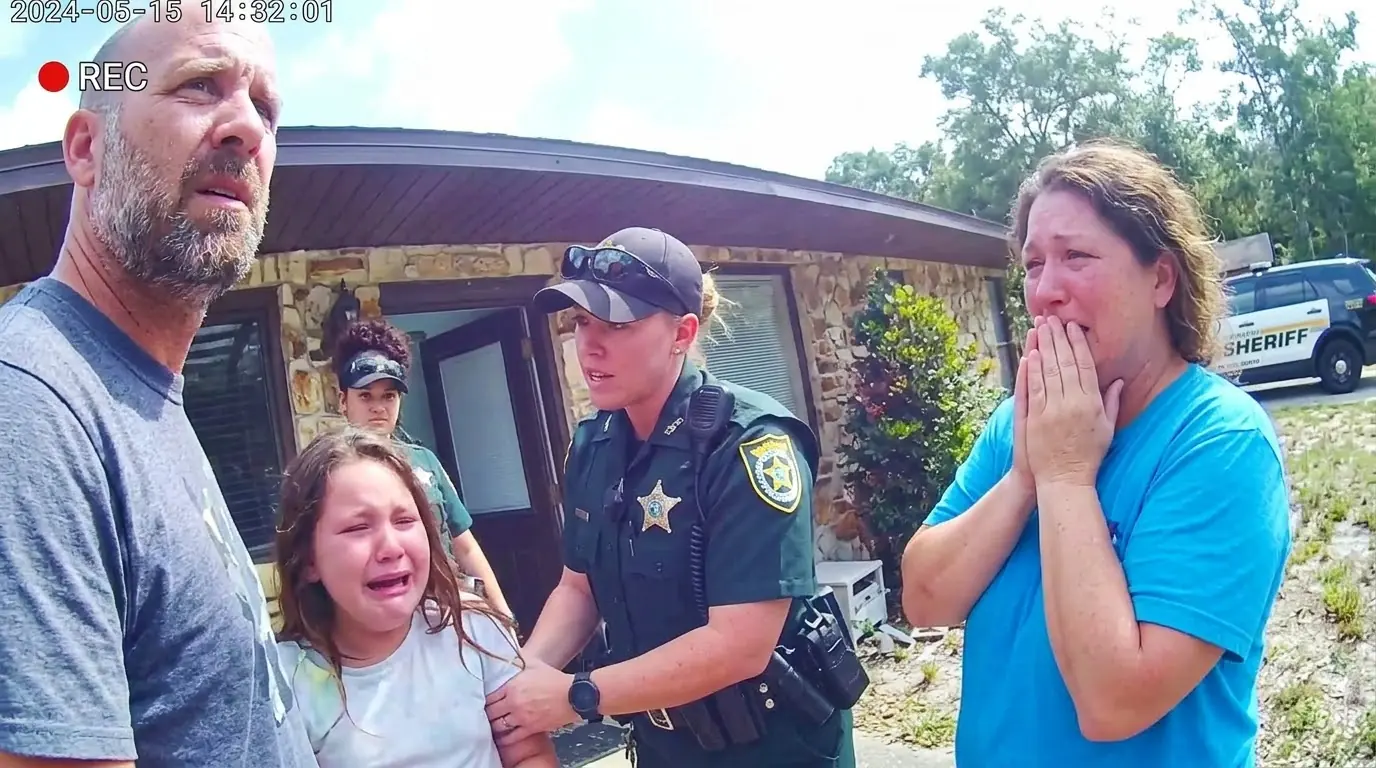
At the Port Orange residence, a deputy approached a man outside and asked whether he lived there. He said he did. When the deputy asked whether he had a daughter or another child in the home named "Lily Lee," he said no, but explained that his wife and children had just returned from Pennsylvania. He identified his children as Ava and Mikey and offered to bring the deputy to them.
The deputy followed him to the house and explained the reason for the visit. Someone had texted 911 saying a person had been kidnapped and that the reporting party was following the suspect on the interstate, but the phone trace was pointing directly to their home. The parents were confused. They said the family had arrived back at the house in the early morning hours after traveling home from Pennsylvania and had been there since.
Then Ava stepped into the garage, and her phone rang. A deputy answered it. The caller was another member of law enforcement trying to reach the person associated with the emergency messages. Once the deputy identified herself as being with the sheriff's office and confirmed she was standing with the girl and both parents, the connection between the phone and the false kidnapping report became difficult to ignore.
The deputy began reviewing the phone's call log in front of the family. There were multiple outgoing calls to 911, including one around 9:30 a.m., along with incoming calls from blocked or unidentified numbers that appeared to be law enforcement calling back. Ava said she had not meant to make the initial call. The deputy pointed out that, intentional or not, the call had happened, and the same phone number had later begun sending the kidnapping texts.
The family also tried to reconcile the timing. Ava's mother asked again when the texts had supposedly been sent and emphasized that everyone had been home since shortly after 2:00 a.m. after the drive back from Pennsylvania. The deputy explained that the emergency traffic was from that morning, not from the family's overnight trip. That left the phone itself as the central piece of evidence, because the calls and the GPS location placed the activity at the residence while the texter was claiming to be on the interstate.
Ava's mother struggled to understand what she was hearing. She asked when the alleged interstate incident was supposed to have happened, explaining that the family had arrived home around 2:10 or 2:15 in the morning and had gone to bed. The deputies made clear that the 911 activity had occurred that morning, long after the family was already home. Ava looked surprised, but her parents immediately pressed her to explain what had happened.
"You called 911," one of them told her. Ava denied speaking to anyone. A deputy answered that everything on the phone showed that the 911 calls came from her device, even if she insisted she had not talked during the calls. Her parents told her they needed the truth because officers were still trying to make sure there was not a real kidnapping victim somewhere on the interstate.
Other officers from the Port Orange Police Department arrived as deputies continued sorting through the call notes. One deputy explained that the daughter did, in fact, have 911 calls in her phone history. She also said they had not found obvious text evidence still visible on the phone and wondered whether the messages had been deleted or sent through another application. By then, however, the GPS data and call history were pointing strongly toward the child at the residence rather than a person driving on the interstate.
The arriving officers were briefed on how extensive the dispatch notes had become. The original report was no longer just a vague emergency message; it had grown into a story about an armed kidnapping, a victim visible through the window, a white van, a blue Jeep, and a suspect with a detailed physical description. One officer remarked that the amount of information made the call difficult to untangle, while another noted that the girl appeared to be only around 10 or 11 years old. Even with that realization, they still had to treat the fabricated report as a serious police matter because the resources had already been deployed.
Ava's parents became increasingly upset as the seriousness of the situation sank in. The deputies prepared to question the 11-year-old formally and advised her of her rights. She was told that she had the right to remain silent, that anything she said could be used in court, that she could speak to a lawyer before questioning, and that a lawyer could be appointed if necessary. The tone of the conversation had shifted completely from a welfare check on a supposed kidnapping victim to a juvenile investigation involving a potentially serious false report.
One deputy explained why law enforcement was treating the incident so seriously. He told Ava that an armed kidnapping report had sent a large number of officers, multiple agencies, and a helicopter into an urgent search. He estimated that at least 20 law-enforcement officers had been involved. Those officers had been responding with lights and sirens to what they believed was a violent felony in progress, trying to locate and stop a vehicle before someone was hurt. The deputy stressed that emergency responders could have been seriously injured or killed in a crash while racing to a call that appeared to have been created as a joke.
Ava began to cry, but the deputy told her this was something she needed to understand. A false emergency report was not harmless simply because no real victim existed. Law enforcement had diverted substantial resources to search for the white van and the supposed kidnapping victim. The deputy warned her that the consequences could include being taken into custody and processed through the juvenile system.
Under pressure from both her father and the deputies, Ava tried to explain how the idea had started. She mentioned something her younger brother had said. The deputy immediately asked whether her brother had been with her when she made the calls or sent the texts. Ava said no.
Her brother was only seven years old. The deputy told Ava she could not blame him for a decision she had made by herself. Even if he had said something about calling 911, he had not been beside her sending the messages, and he had not created the detailed kidnapping scenario. The deputy compared it to being told to do something obviously dangerous and asked whether she would simply obey without thinking about the consequences.
Ava's mother then raised a separate concern about the phone. She said that when they first obtained the number, it had received repeated calls from random numbers, sometimes every few seconds, and she had spent time blocking contacts she did not recognize. The deputy acknowledged the concern but told her it did not explain what had happened that morning. Whatever strange activity had occurred before, the current investigation centered on the false kidnapping report sent from Ava's phone.
The deputies continued asking Ava what she had expected to happen. They wanted to know what she thought police would do after receiving messages saying someone had been kidnapped and that a suspect had a gun. Ava appeared not to have considered the scale of the response. A deputy walked her through the reality of officers driving at emergency speeds and the possibility that someone could have been injured responding to a fabricated violent crime.
The conversation was not simply about punishment. The deputies were trying to make Ava understand why emergency systems are treated differently from ordinary phone calls or online jokes. A false report of an armed kidnapping can draw officers away from real emergencies, create traffic risks, and place responders and members of the public in danger. Her father, who openly expressed support and appreciation for law enforcement, was visibly frustrated that his daughter had created a situation involving so many officers.
According to the official report, Ava eventually admitted that the idea had come from a YouTube challenge or video. The footage did not capture the first admission, but a deputy later questioned her about what she had watched. He asked whether she remembered the creator or poster and whether the video involved a Palm Coast Chick-fil-A and the idea of calling or texting 911 with a story about someone having a gun or being kidnapped.
Ava indicated that she had seen material online and tried to recreate the idea. That explanation filled in the missing piece investigators had been looking for. The armed kidnapping had not been something she witnessed on the interstate. It had been a fabricated scenario inspired by online content, then sent to emergency dispatchers as though it were real.
Another deputy added that he had reached Ava by phone shortly before officers arrived at the house. According to him, she had spent roughly 27 minutes misleading the dispatcher or call taker through text. When he eventually confronted her over the phone and indicated that law enforcement was beginning to understand the report was false, he said Ava responded with profanity and told him to stop contacting her. He also believed she began deleting information once she realized officers were closing in on the truth.
Based on Ava's statements, the phone records, the GPS trace, and the false emergency messages, deputies determined they had probable cause to take her into custody. The moment officers moved to place the 11-year-old in handcuffs, the reality of what had happened finally appeared to hit her. Ava said she was not going to the car, pulled against the adults directing her, and became increasingly emotional as her parents and deputies tried to calm her. Her family repeatedly told her to take a deep breath and stop struggling because the officers were not going to hurt her.
"Stop struggling," the adults told her. They assured her that no one was trying to hurt her and explained that she would be taken to be processed, photographed, and fingerprinted before her parents could later be contacted about what happened next. The deputies told her not to make the situation worse by fighting them. Ava repeatedly said she would never do something like this again.
One deputy told her to remember the feeling of the handcuffs. He said that at 11 years old, she needed to understand that choices could carry real consequences and that repeating reckless behavior in the future could lead to more serious outcomes. The point, in his framing, was not that her life was over, but that she needed to learn from what had happened before she was older and the consequences became even more severe.
After Ava was placed in the back of the patrol car, her father spoke to her through the open door. He told her she would probably be away from them for a few hours while she was processed. He explained that she would be taken inside a facility, fingerprinted, and handled through the juvenile process. "Your life just changed over a phone call," he told her, making clear how deeply disappointed he was.
A few minutes later, Ava's parents spoke privately about what had happened. They acknowledged that the experience was painful for them as well, but one parent said it might be the strongest lesson Ava could receive because she had not understood the seriousness of her behavior until officers arrived. They reflected on the effort they had made to give their children a normal childhood and their frustration that an online prank had escalated into a criminal investigation.
According to a statement from the Volusia County Sheriff's Office, Ava was charged with making a false police report concerning the use of a firearm in a violent manner, a felony, and misuse of 911, a misdemeanor. She was processed at the Family Resource Center and later transferred to the Volusia Regional Juvenile Detention Center in Daytona Beach, Florida. Because the case involved a juvenile, additional court information was not publicly releasable when more details were requested.
What began as a text claiming that a kidnapping victim was being driven down the interstate in a white van ended at a quiet Port Orange home with an 11-year-old in the back of a patrol car. The case became a stark example of how quickly an online prank can become a real emergency response involving officers, multiple agencies, and aviation resources. For Ava, the consequences were immediate, and the lesson deputies wanted her to remember was simple: emergency services are not a game, and a false report can become very real long before the person who made it understands what they set in motion.