"You saved me. So now, according to the sacred law, I must bear you children," said the Apache woman. The wind carried a steady whine across the basin, pushing grit against the sides of the cabin and making the stovepipe clatter. The land around the place stretched open and bare, a long sweep of sage and rock that only broke where the creek cut through. It was late winter of 1882, and nights like this still had the bite of snow, even if the ground was already patchy and hard.
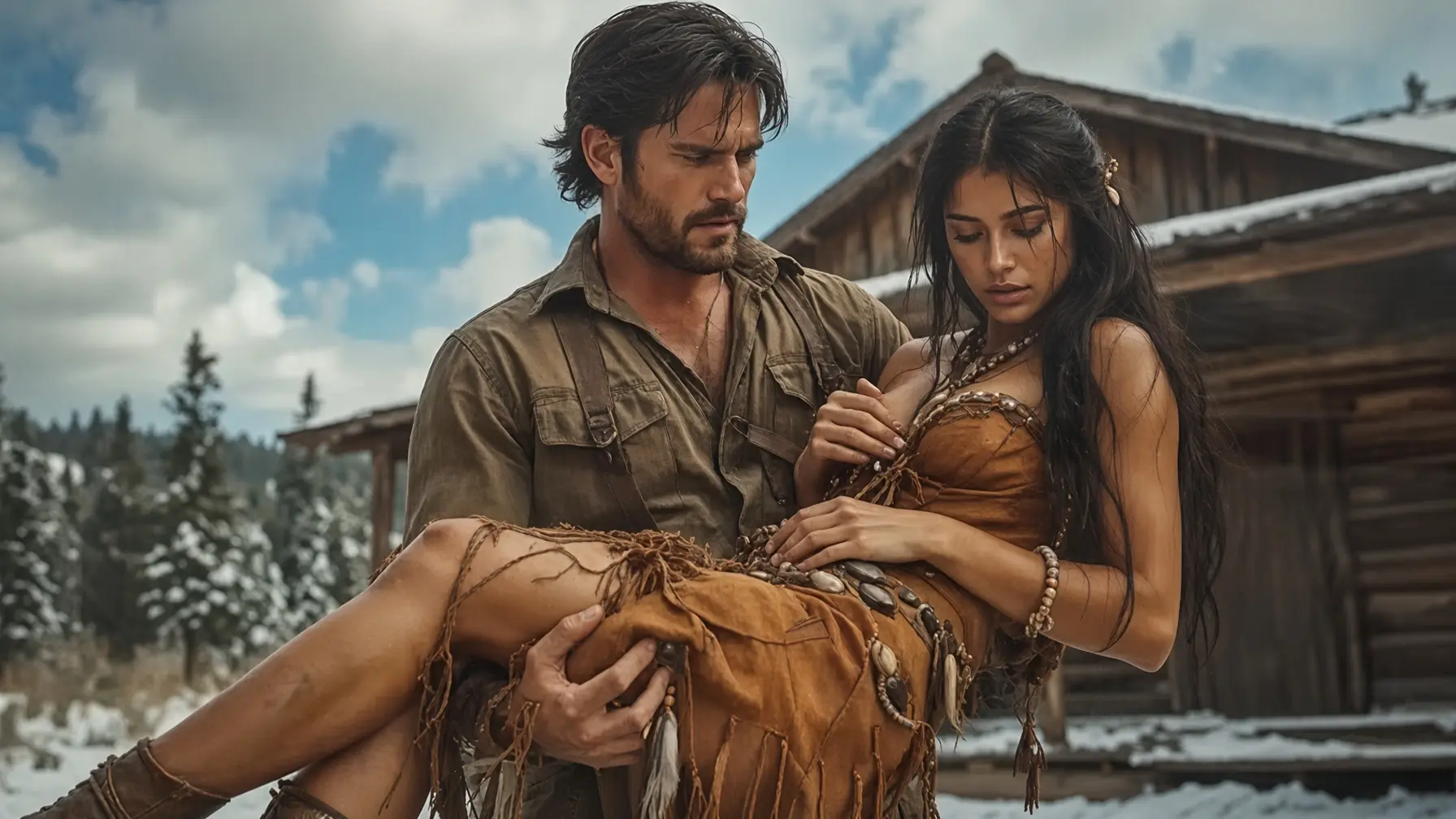
Inside the cabin, the man sat at the table sharpening a knife, his lantern swaying faintly from a draft. He was 34, lean from work with a frame hardened by years of lifting fence posts and carrying feed sacks. His dark hair fell over a jaw that carried more stubble than he usually kept. Scars lined one forearm. Marks from the war he didn't talk about.
Once he had a family, a wife who hadn't survived a fever, a child lost before a first birthday. He had come west to get away from the memory of a graveyard back east. Building this cabin on the far edge of the basin, so no one asked questions and no one needed him to talk. The ranching work kept his hands full, but it never dulled the empty silence that waited in the room each night. That was why he noticed the sound outside.
Something too heavy to be a branch, too soft to be a horse. He set the knife down, pulled his coat from the peg, and stepped onto the porch with a lantern in one hand. The light swept across the frozen ground, past the fence posts, and caught a shape collapsed near the wire. He tightened his grip on the lantern. For a moment his chest clenched with the old reflex of war, expecting a trick, some ambush, but then he saw the long braid, the bare legs against the snow, and he realized it was a woman.
She was face down, her body folded in on itself. The torn deerskin dress clung to her with frost. Beads and shells still dangled from the seams, though most had broken away. Her skin was bronze and bruised. Her lips cracked.
He felt a rush of conflict, fear at the risk of bringing a stranger into his home, stress at what danger might follow her, but also a sharp edge of empathy he couldn't set aside. He lowered to his knees, touched her shoulder. Her skin was cold, breath faint, but there he slid his arms under her, lifting carefully. She weighed hardly more than a sack of grain, and it unsettled him how light she was. He carried her inside, the door shutting shut on the wind and laid her on his bed.
For a moment he just stood there, heart heavy. He had come west to keep to himself, to avoid being tied down again. And yet here was a decision he couldn't ignore. Leave her to die or help her and accept whatever came with it. He fetched water from the stove, dampened a cloth, and cleaned her face.
Dirt and dried blood came away in streaks. Rope Burns marked her wrists. He muttered low, not expecting her to hear, "They left you to die out there. " His jaw tightened as he said it because he knew what that meant. Someone wanted her gone.
He tucked his coat over her and set bread and beans on the small table nearby. Close enough that when she woke, she would smell them. The lantern's glow softened her features. She looked younger than he first thought, no more than 24, but her body showed the toll of hunger and flight. He sat in the chair beside the bed, boots planted, hands clasped together.
Thoughts churned. What if whoever hurt her came looking? What if he was dragged into a fight he didn't want? But looking at her shallow breathing, he knew he had already chosen. He wouldn't put her back outside.
So he sat through the night, eyes on her, stove ticking, and the smell of beans filling the room. The decision had been made the moment he lifted her from the snow. And though he didn't yet know her name, he knew she had crossed into his life, and nothing about the quiet existence he had built out here would stay the same. Morning came slow, a pale light edging through the small window above the bed. The stove had burned down to embers, but still gave off a faint warmth.
The man rose from the chair, his back stiff from sitting upright all night, and poured fresh water into the kettle. He checked the woman, her breathing steadier now, skin not so cold. He hadn't moved her dress aside, but he had seen enough bruises on her arms, her shins, and her wrist to know she had been treated roughly before collapsing at his fence. What he didn't know was who had done it, how far she had come, or if someone was still chasing her. Her eyelids fluttered.
She stirred against the weight of his coat, then opened her eyes, dark and watchful, even through the haze of exhaustion. For a long moment, she looked at him without speaking, her gaze steady, but uncertain, as though deciding whether he was a threat or not. He kept his hands where she could see them, on his knees, voice low and even. Water. He set the cup within reach on the small table and stepped back.
Her fingers trembled when she reached for it. She drank, each swallow careful, as though afraid it might be taken away. When the cup was empty, she held it between both palms and finally spoke. Her voice no more than a whisper, but clear enough. You saved me.
So now, according to the sacred law, I must bear you a child. The man froze caught off guard. He had expected fear, perhaps a plea for food or for shelter. Not this. The words hung heavy in the room, carrying a kind of finality he hadn't invited.
He shook his head, his voice firm, but not harsh. No law binds you here. You don't owe me anything. Her eyes narrowed faintly, not in anger, but in confusion, as though she couldn't understand why he would turn aside what her people had taught her. My people say, "If a man saves a woman's life, she gives him life in return.
" She touched the edge of her torn dress, fingers brushing a broken strand of beadwork. It is how no one remains alone. He leaned back slightly, went out of breath he hadn't realized he was holding. He remembered her bruises, the rope burns at her wrists, the half-starved way she had felt in his arms. "You've had enough taken from you," he said.
"This place, this house, you can rest here without fear. No bargain, no debt. " For a moment, her face softened, though suspicion still lingered. She looked around the cabin, taking in the rifle propped by the door, the single chair, the rough-hewn table, the life of a man alone. She asked in a halting tone, "Why are you here so far from the town?
" He paused, weighing whether to answer. Part of him wanted to stay silent, keep his past buried where it belonged. But he saw in her eyes that she needed to know who had taken her in, whether he was a man she could trust. "I fought in the war," he said slowly, his hand brushing the scar on his forearm. "I lost a wife after, lost a child, too.
I came out here to start over, to stay clear of folks and their questions. " His gaze dropped for a moment. Didn't figure on company. Her lips pressed together as though she carried a story just as heavy, but wasn't ready to give it yet. She pulled his coat closer around her shoulders and whispered.
I was cast out. There was no food left for me. No family left for me. Her voice caught, but she steadied it. I walked until I could not.
The man nodded once. He didn't press her for more. "Then you're here now," he said. "You'll eat. You'll rest.