This case began in Key West, Florida, on November 8, 2024, when two women contacted police after their iPhones warned them that unknown Apple AirTags appeared to be moving with them. Both women had been at BodyZone Fitness that morning. BodyZone is located inside the Overseas Market shopping plaza on North Roosevelt Boulevard, which explains why the official Key West Police Department release described the victims as receiving notifications after leaving Overseas Market while the body-camera conversation focused on the gym.
The man later identified by detectives was 52-year-old Key West resident Mariusz Swiecicki. Key West police said their Criminal Investigations Unit worked with local Department of Homeland Security agents to identify subscriber information associated with the two AirTags. Detectives arrested Swiecicki on January 3, 2025, after he admitted placing the devices on both vehicles. He was charged with two counts of installation or use of tracking devices under Florida Statute 934.425, each a third-degree felony under the law applicable to the case.
The source transcript ends by saying he could face up to fifteen years in prison. Under Florida's ordinary felony penalty structure, however, a third-degree felony is generally punishable by up to five years. Two separate third-degree felony counts could therefore expose a defendant to as much as ten years if maximum terms were imposed consecutively, absent some other sentencing enhancement. Public reporting confirms that Swiecicki was released after his arrest on a $70,000 bond. I did not locate a sufficiently reliable public source confirming a final plea, conviction, dismissal, or sentence through the current search, so the documentary does not state an unverified final court outcome.
THE ALERT
The case did not begin with an officer seeing anyone place a tracker. It began with an iPhone notification. One of the women explained that she had gone to her usual early-morning workout at BodyZone Fitness, then returned home and later noticed a warning on her phone that an unfamiliar Apple AirTag might be traveling with her.
"I don't have an Apple AirTag," she told the officer. "I've never bought an Apple AirTag."
At first she did not know whether the alert meant anything. She used the phone's "play sound" feature while sitting in her vehicle, but she could not hear the device. When she stepped outside and tried again, she heard a faint beeping sound near the rear of the car.
She continued with her day, traveling around Key West for errands and work. Later, as she turned toward Duval Street, her phone again warned that an AirTag was moving with her. By then the notification had followed enough of her route to feel much less like a coincidence.
At another stop, she brought a friend outside and played the sound again. The beeping grew louder near the rear passenger side. She eventually got down on her hands and knees and crawled beneath the vehicle.
There, near the wheel area, she found a small tracker concealed inside a makeshift holder and secured in a way that made it difficult to see casually. The woman told police the object appeared to have been wrapped or attached with black duct tape.
The discovery frightened her for an obvious reason. A tracker attached beneath a car does not simply reveal where the vehicle is at one moment. It can potentially reveal routines: where someone lives, where they work, where they spend time, and when they travel between those places.
"They now know where I live," she told the officer. "They know where I work. And I live by myself."
A SECOND VEHICLE
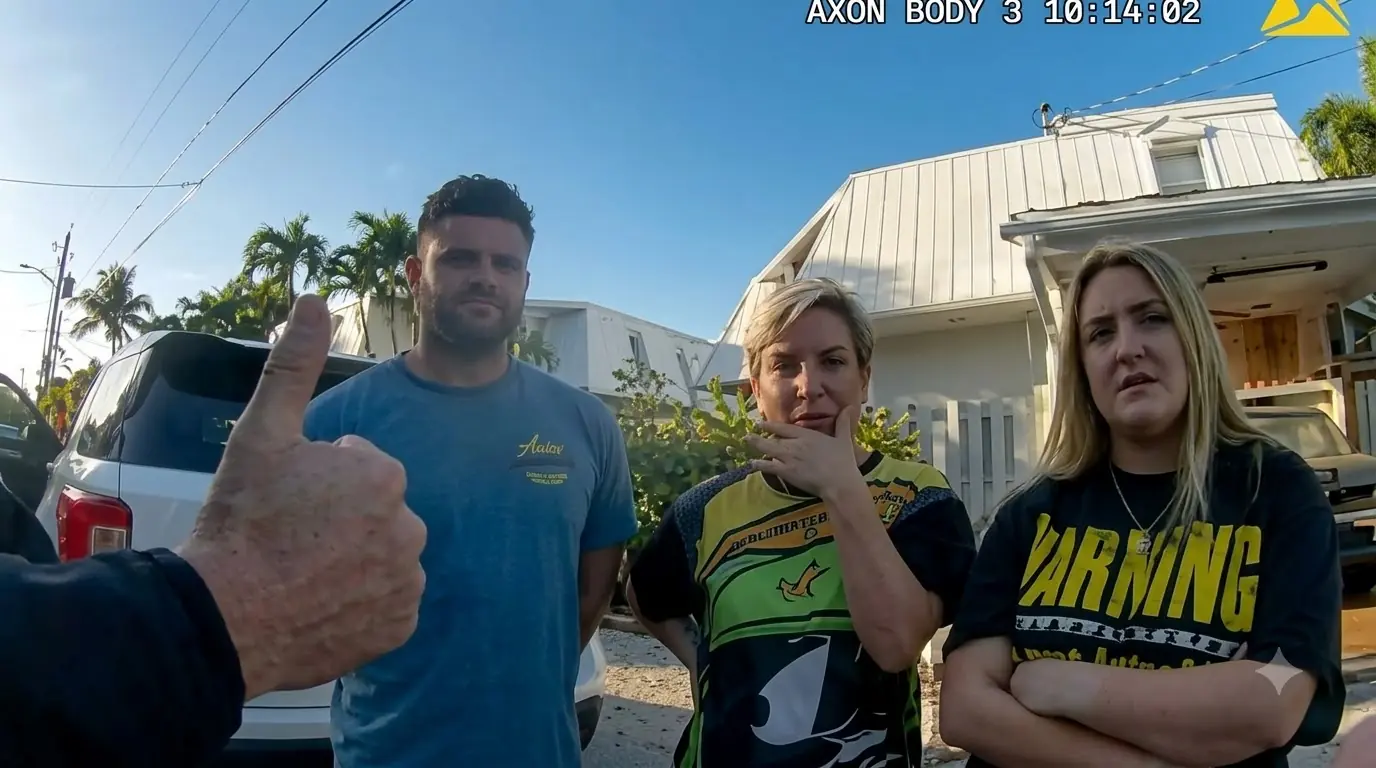
What initially looked like one deeply unsettling incident became stranger when another woman reported a nearly identical alert. She had also been at BodyZone that morning. The two women realized that their vehicles had been parked in the same general row and that they had entered and left the gym at roughly the same time.
Police went to the second vehicle and used the phone's sound feature to narrow down the AirTag's location. The beeping appeared to come from underneath the rear of the vehicle.
"Can you play the sound?" an officer asked.
The victim activated it again. The sound was clear enough that officers began searching beneath the car while trying not to disturb whatever might be recovered.
"Keep in mind that you might want to preserve fingerprints or whatever," someone at the scene cautioned.
The AirTag was located in another improvised concealed mount, this time attached around the spare-tire area on the rear undercarriage. The similarity mattered. Two people who had been in the same place at the same time had received nearly identical warnings, and both vehicles contained concealed tracking devices.
An officer reacted to the discovery with a short observation: "Two of them in one night."
The women went back through the morning in detail. They had arrived at BodyZone shortly before six. They had worked out, spoken with friends and left around seven. One woman said the AirTag's tracking history appeared to begin around 7:10; the other's showed roughly 7:11.
That timing made the gym parking lot the obvious point of interest. The women were asked who had been around them, whether anyone had behaved strangely, and whether they shared acquaintances who could have known both vehicles.
They described another man they regularly saw at the gym. They did not initially accuse him. In fact, their first reaction was the opposite. They described him as friendly, someone who had routinely told them to be safe and had not previously given them a reason to think he would secretly track them.
The women said he arrived only several minutes after them that morning. He spoke briefly with them, completed his workout, and later met up with them again near the end. They remembered leaving the parking area around the same time.
"Nothing shady," one woman told police. "Same time, 'bye, have a great weekend,' and that's it."
That did not prove who had installed the devices. It did, however, give investigators a narrow time window and a shared location.
RECONSTRUCTING THE MORNING
The first woman gave police a detailed account of where she had been because she was trying to understand when the device could have been attached. She said she reached the gym shortly before six in the morning, stayed for roughly an hour and left with friends shortly after seven. At home she initially heard only a faint sound when she activated the AirTag alert, and she wondered whether the signal might belong to something nearby rather than to her own car.
She then continued through a normal Key West workday. She stopped at a government office, went to work and later drove toward another part of the island to meet a friend. The warning continued to show that the same unknown AirTag was moving along with her. That repeated movement was what finally convinced her that the alert could not be dismissed as a nearby stranger's device.
When she and her friend searched the car, the tone became strongest at the rear passenger side. The tracker was not sitting in a cup holder, luggage compartment or any place a passenger could have accidentally left it. It was beneath the vehicle, positioned where a person would have to crouch or crawl under the car to reach it. The device had been concealed inside a dark holder and secured with black tape.
The second woman's account made the situation more difficult to explain away. She said her own phone did not alert her until later in the day. After the first victim called and asked whether she had seen anything unusual on her iPhone, she checked more carefully and realized that her phone had also recorded an unknown AirTag moving with her.
The women compared their timelines. They had been at the gym together, parked within a few spaces of each other, exercised at roughly the same time and left the parking lot within minutes of each other. Their tracking histories appeared to begin only about a minute apart. For detectives, that common location and extremely narrow time window were more useful than any theory about a random stranger.
They were also asked whether anyone had been lingering around the vehicles. Both said they had not noticed anyone behaving suspiciously when they arrived or left. Another gym acquaintance had joined them a few minutes after they arrived and had chatted with them before doing his own workout. According to the women, he later left around the same time they did and did nothing that immediately caused alarm.
One officer asked bluntly whether they thought that man could have done something like this. Their answer was no. They described him as kind and familiar, the type of person who had told them to be careful and stay safe. That reaction became important later because it showed that, at the beginning, the victims were not trying to force the evidence toward a particular person. They genuinely did not know who had placed the devices.
The women also struggled to identify any other shared connection. Their broader friend groups did not offer an obvious explanation, and they could not think of anyone outside the gym who would have known exactly where both cars would be parked at the same time. The simplest common point remained the early-morning workout at BodyZone.
THE DIGITAL TRAIL
The physical AirTags were only one half of the evidence. Apple tracking devices are associated with account information, and detectives sought records that could identify who had activated or controlled the two devices.
The Key West Police Department Criminal Investigations Unit worked with local Department of Homeland Security agents on that part of the case. According to the department's later public statement, investigators obtained subscriber information associated with each AirTag.
Both trails led to the same person: Mariusz Swiecicki, then 52, of Key West.
By January 3, 2025, detectives believed they had enough evidence to confront him. They went to his home, where members of his family were present. The conversation began calmly.
"I'm Detective Boyd," one investigator introduced himself. He told Swiecicki that the discussion could happen in front of his wife and son if Swiecicki wanted, but suggested that for Swiecicki's own privacy, they should speak alone first.
"I'm completely comfortable talking to you in front of your wife and your son," the detective said, "but for your sake, I think we should probably have a conversation alone."
That wording immediately signaled that the investigators believed the subject matter might be embarrassing or damaging to Swiecicki's family relationships.
They moved to a vehicle to talk privately.
"Do you know what an AirTag is?" a detective asked.
Swiecicki indicated that he did. He knew the device could be used to locate objects such as keys or wallets. At first, however, he denied currently having any AirTags.
The detective then shifted from general questions to the actual investigation. He explained that police had information connecting the trackers to Swiecicki and that two women from the gym had been involved.
"Do you know her?" the detective asked while showing him an image.
Swiecicki recognized one of the women. When shown the second, he recognized her as well, describing them as people he knew from the gym.
The detective explained that, based on the investigation, police believed they already had probable cause to arrest him. He made clear that Swiecicki did not have to say anything further, but offered him the opportunity to explain why the AirTags had been placed there.
"I have enough information based on my investigation with these AirTags to arrest you without you saying one word," the detective said. "But you may be able to tell me something that makes sense."
Before continuing with detailed questioning, the detective advised Swiecicki of his Miranda rights.
A CONVERSATION AWAY FROM HIS FAMILY
The decision to move the interview away from Swiecicki's wife and son was not evidence of guilt by itself, but it shaped the tone of the encounter. The detective repeatedly told him that he was willing to speak openly in front of the family, yet suggested privacy because the investigation involved two younger women Swiecicki knew from the gym. Swiecicki agreed to continue the conversation in the police vehicle.
He initially spoke as though AirTags were ordinary objects he understood but did not currently possess. When asked whether he had ever owned any, he said he had purchased a pack in the past. Detectives then showed him images of the two victims. Swiecicki recognized them and acknowledged that he had spoken with them at BodyZone.
One detective asked whether his wife knew about the women. Swiecicki said she did not. That answer did not prove a motive, but it explained why the detective had been reluctant to discuss the case in front of the family. The officers were trying to establish the nature of the relationship before revealing exactly what their records showed.
The detective also referred to information from the gym and the AirTag records. The point was not that surveillance footage alone showed Swiecicki physically attaching each device. Rather, investigators believed the combination of the victims' shared timeline, the account information returned for the AirTags and other evidence had already established probable cause.
Swiecicki was told directly that he did not need to talk his way into an arrest. Police believed they could arrest him without a confession. The opportunity to speak was presented as a chance to offer an innocent explanation if one existed. Only after that warning and the Miranda advisement did the questioning become more direct.
THE ADMISSION
The conversation changed when detectives showed him one of the recovered devices and the concealed mount used beneath the cars.
Swiecicki first said he did not recognize part of the apparatus. Then, when asked directly about the AirTag, he admitted placing one.
"I put that one," he said.
"Why?" the detective asked.
"For joke."
Swiecicki said his intention had been to make the AirTag beep and confuse the women. He portrayed the entire incident as a prank among people who knew one another from the gym. According to him, he expected them to hear the beeping, search for it and eventually laugh about what he had done.
The detectives did not have to accept that explanation as fact. The important point was that Swiecicki was now acknowledging that he had deliberately attached the devices to vehicles that did not belong to him and had done so without first telling the women.
One investigator told him why the women had reacted so differently from the way he claimed to have expected.
Police had approached the case without knowing who had installed the trackers or why. The victims knew only that devices hidden beneath their cars appeared capable of following their movements. They were afraid that someone could be monitoring their homes, workplaces or daily routines.
"They were scared," the detective told him. "They didn't know who put it."
Swiecicki insisted he had no intention of harming them. He said the women already knew him from the gym and that he knew ordinary details about them through conversation. He argued that because they had spoken openly with him in the past, he had no reason to secretly use an AirTag to learn where they lived or worked.
The detective then asked the question that mattered legally and evidentially.
"Did you put the AirTag on both cars?"
"Yeah," Swiecicki answered, again describing it as a joke.
He said the plan was short-lived, lasting less than a day. During the interview, he suggested that he deactivated or removed the AirTags from his phone after only several hours. Police reporting later stated that both recovered devices had in fact been deactivated around the time the victims reached the police department.
But deactivating a tracker after placing it did not erase the fact that the devices had been installed without the vehicle owners' permission.
THE "JOKE" EXPLANATION
Swiecicki's explanation depended on one central claim: he said the trackers were never intended to secretly monitor the women over a long period. He said he wanted to trigger the devices' sound and make the women wonder what was beeping beneath their cars. In his telling, he expected to reveal the joke later and laugh with them.
Detectives pressed him on the contradiction. An AirTag hidden beneath a vehicle is not visible to the owner, and neither woman had been told a prank was underway. The devices had traveled away from the gym with the cars, causing the phones to display maps and warnings that an unknown tracker was following them. Whatever Swiecicki said he intended, that was the experience the women reported to police.
He also said he already knew general information about both women because they talked at the gym. He claimed they had discussed where they worked and other ordinary details, so he had no reason to use the trackers to obtain that information. Detectives did not treat that assertion as proof that the placement was harmless. The legal question was much simpler: whether he knowingly placed tracking devices on property belonging to other people without their consent.
Swiecicki said the AirTags were active for only several hours and that he removed or disabled them from his account the same day. That part was at least partly consistent with the police statement that both devices had been deactivated around the time the women arrived at the department. But it did not explain why the devices had been concealed under both vehicles in the first place.
The interview therefore produced two different narratives that should not be confused. Swiecicki called the act a prank and denied any harmful intention. The victims described being frightened because an unknown person had secretly placed location trackers on their vehicles and could have followed their movements to private locations. The criminal case was based on the physical placement and use of the devices, not on detectives proving the more frightening theories the women initially feared.
THE FAMILY OUTSIDE
The body-camera footage captures another unusual part of the arrest. Detectives repeatedly tried to keep the details of the accusation away from Swiecicki's wife and son while they finished paperwork.
The officer told Swiecicki that when they stepped out of the vehicle, they would sign documents away from the family. At one stage he described paperwork as a summons and told Swiecicki that the arrangement would allow the family not to hear every detail immediately.
The conversation then turned to Swiecicki's phone. Detectives wanted the device because it could contain records relevant to the AirTags, including account information, communications and activation history.
An investigator explained that law-enforcement forensic software might eventually access the device without Swiecicki providing his passcode, but that the process could take a long time. He told Swiecicki that police intended to seize the phone and seek judicial authorization to examine it.
The officer contrasted two possibilities: Swiecicki could provide the passcode voluntarily, or investigators could send the phone to the Florida Department of Law Enforcement and attempt to access it through forensic tools if a judge approved the search.
The footage then shows officers arranging Swiecicki's personal property for his family. Swiecicki wanted them to have his belongings and asked to speak with his wife and son before leaving. The officer said that once he was secured in the police vehicle, his son could come to the window and speak with him.
Whatever the tone of that interaction, the case was no longer a misunderstanding between gym acquaintances. Swiecicki was being taken into custody.
THE CHARGES
On January 6, 2025, the City of Key West publicly announced the arrest. The department said Swiecicki had confessed to placing the AirTags on each victim's vehicle and had been charged with two counts of installation or use of tracking devices.
Florida Statute 934.425 prohibits knowingly installing or placing a tracking device on another person's property without consent, subject to specific statutory exceptions. The statute defines a tracking device as a device whose primary purpose is revealing location or movement through electronic signals.
For the conduct charged in this case, the offense was classified as a third-degree felony. Under Florida's ordinary sentencing structure, a third-degree felony carries a maximum term of five years. Because Swiecicki faced two counts, the theoretical ordinary maximum would be ten years if maximum terms were imposed consecutively, although actual sentencing would depend on the disposition, criminal-history scoring, judicial findings and other applicable law.
Local reporting said he was released from jail on a $70,000 bond shortly after the arrest.
Police also made clear that the investigation did not end with the confession. Detectives were still trying to determine motive and whether anyone else had experienced similar conduct. The Key West Police Department publicly asked people who knew Swiecicki, or anyone who had recently received an unknown-AirTag warning, to contact investigators.
That request was significant because the recovered AirTags answered who controlled the two devices, but not every question about why they had been placed. Swiecicki's explanation was that it was a joke. The victims' experience was that an unknown person had secretly attached trackers beneath their cars and followed enough of their movements for Apple's safety system to warn them.
THE CASE AS VERIFIED
The strongest verified facts are straightforward. On November 8, 2024, two people who had been at the same Key West shopping plaza and gym received warnings about unknown AirTags traveling with them. One victim found a concealed device beneath her car. Police found a second concealed device beneath the other victim's vehicle.
Investigators linked subscriber information for both trackers to Mariusz Swiecicki. On January 3, detectives confronted him at his Key West residence. During the body-camera interview, he acknowledged placing AirTags on both vehicles, while claiming he meant the act as a prank rather than an attempt to harm or stalk the women.
Police arrested him and filed two third-degree felony tracking-device charges. He was later released on bond. The department continued investigating for motive and possible additional victims.
The source transcript presents the arrest as though a conviction and prison exposure were the inevitable next steps. That distinction matters. An arrest and confession reported by police are not the same as a final adjudication. Without a reliable, independently verified public court disposition, the most accurate ending is where the confirmed record ends: two concealed trackers, two frightened victims, an admission, two felony charges, and an investigation that police said was continuing.