Isaac Boone stopped walking the moment he saw her fall. The wind was cutting down the San Pedro Valley. Dry and sharp, carrying a thin scatter of snow that never should have been there. It clung to the ground in broken patches, just enough to show where someone had been stumbling, just enough to prove how far they had already gone on borrowed strength. The young Apache woman dropped to her knees beside the riverbank and did not rise again.
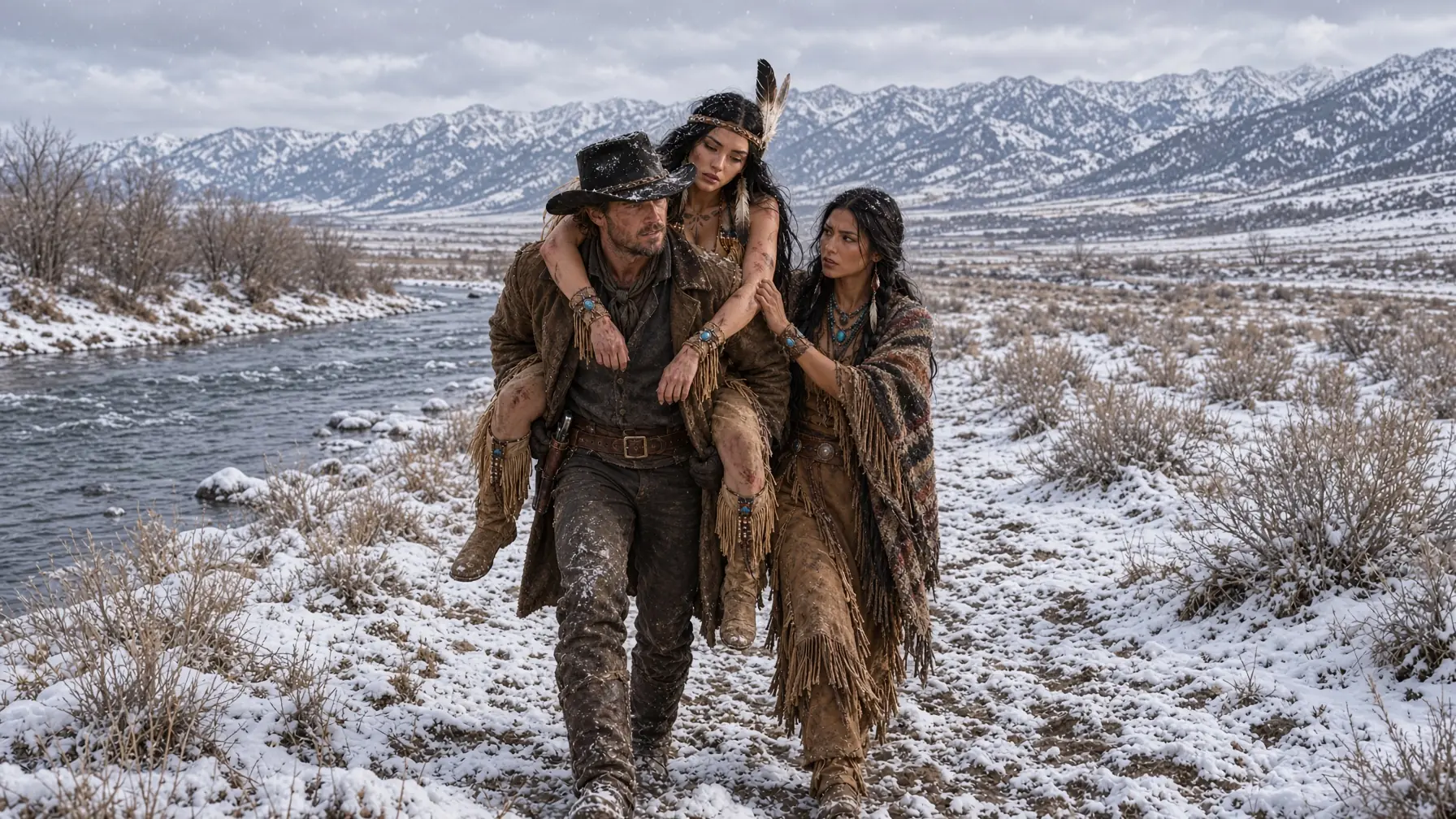
Isaac stood several paces away, his rifle heavy in his hands, his breath turning white in the cold. He had learned years ago that hesitation could kill a man just as surely as violence. He had also learned something worse, that stepping forward could cost more than walking away. The last time he chose to stay, his wife and child died while he guarded land that could not remember their names. This time, the land watched quietly as Isaac Boone made another choice.
The San Pedro Valley lay open and exposed beneath a pale winter sky. Its wide grasses were bent flat by the wind. This was not a land that hid its dangers. It showed them plainly dry riverbanks cut sharp by stone, cottonwoods stripped bare, the ground stiff with frost that would vanish by noon and leave mud in its place. Men who lived here learned early that survival had less to do with luck than with restraint.
Isaac Boone had chosen this place because it offered no comfort. His rancho sat far from the nearest trading post. A low structure of timber and packed earth built for function, not permanence. The cattle grazed thin pastures. Water came from the river when it could be trusted.
Everything in Isaac's life was measured, rationed, and deliberate. He woke before dawn, worked until the light failed, and slept with the same quiet discipline. That routine had carried him through years he did not speak about. There were signs of a life once shared. A second chair pushed against the wall, unused but never moved.
A child's wooden cup tucked into a corner shelf, too worn to throw away, too heavy with memory to touch. Isaac did not look at these things often, but he never pretended they were not there. The two women he carried back to the cabin did not fit into that carefully maintained stillness. The younger one, Nidita, barely stirred as he laid her near the hearth. Her hair was dark and tangled, her skin drawn tight with cold, but her face held no softness, even half-conscious.
She seemed alert, as if some part of her refused to fully let go. When her eyes opened briefly, they did not plead. They searched. The older woman, Dasan, noticed everything. She tracked Isaac's movements with steady focus, placing herself between him and her sister whenever she could manage it.
Her clothing was worn thin from travel. Her hands cracked and swollen from cold. Yet her posture carried control. This was a woman accustomed to danger, to reading intent before words ever formed. Isaac spoke little.
He built the fire higher, set water to warm, and moved with practiced efficiency. He did not ask where they had come from. He did not explain himself. In a land like this, explanations were often used as leverage, and he had no intention of giving any. Outside, the wind continued to scrape across the valley, carrying the last of the night's cold away with it.
Inside the cabin, heat began to settle into the walls, slow and reluctant. The space felt altered, not invaded, but unsettled, as if the quiet Isaac had cultivated for years had been forced to acknowledge another presence. As the fire crackled, Isaac became aware of a truth he had avoided since lifting Nidita from the riverbank. Bringing them here was not an act that could be undone. Whatever followed would not pass with the melting frost.
Night settled slowly over the valley, not with darkness alone, but with sound the steady push of wind against the cabin walls. There was the quiet shift of timber as heat worked its way into the beams. Isaac Boone remained on his feet long after the fire had taken hold, moving through the space with the same restraint he brought to every decision that mattered. Nidita's condition worsened before it improved. Her breathing grew shallow, uneven, and her skin burned beneath Isaac's hand when he checked her forehead.
He had seen fever before. He knew how quickly it could turn from something manageable into something final. He fed the fire, warmed the water, and waited until the heat returned slowly enough to avoid shock. Every motion was careful, every pause deliberate. Dasan watched him without blinking.
She had positioned herself near her sister's head, one hand resting lightly against Nidita's shoulder, as if anchoring her to the world. When Isaac stepped closer, Dasan's body shifted, not aggressively, but decisively, placing a boundary he did not challenge. He understood it. Out here, trust was never given freely, and it was never offered twice. "You can stop," Dasan said at last.
Her voice was low and steady, not a command but a warning. Isaac lifted his hands a fraction, showing they were empty. "I'm not done yet," he replied. His tone carried no urgency, no insistence, only fact. Dasan studied his face, weighing the words against the man who spoke them.
Whatever she saw there did not alarm her, but it did not soften her either. She stepped back just enough to allow him space, never fully removing herself from between him and her sister. For a long while, nothing else was said. The fire crackled softly. Outside, the wind lost some of its edge, settling into a constant, grinding presence.
Isaac took a seat against the far wall, far enough to avoid crowding, close enough to respond if Nidita's condition shifted again. He kept his rifle leaned against the door, not as a threat, but as habit. Old habits had a way of resurfacing when the night grew long. Nidita stirred sometime after midnight. It was not a full waking, just a faint movement.
A sound caught in her throat as the fever broke unevenly. Isaac stood at once, careful not to rush. Dasan's grip tightened, her eyes sharp with readiness. Nidita's gaze found Isaac through the haze, unfocused, but searching. Her lips parted, and for a moment, it seemed she might speak.
Instead, she swallowed and whispered a single word in her own language. The sound was thin but deliberate. Dasan answered her softly, brushing hair back from her face. Isaac waited. When Nidita's eyes returned to him, clearer now, she did not look afraid.
There was exhaustion there and pain, but also something else, a quiet insistence, as if she were taking measure of him in return. "Why?" she asked at last. The word was rough with effort, but unmistakable. Isaac did not answer immediately. He had learned that explanations offered too quickly were rarely honest.