The stop began with almost nothing unusual. Officer Sharon Cashman had been watching traffic when she noticed a vehicle moving a little faster than the posted limit. She paced it at about 80 miles per hour in a 75-mile-per-hour zone and pulled it over. There were several people inside, including two minors, and at first the encounter looked like the kind of traffic stop that might end with a warning or a citation.
Cashman approached the driver and introduced herself. "The reason I stopped you is you're going a little fast. Do you know what the speed limit is here?" The driver answered, "Seventy-five." Cashman told her she had been traveling at about 80 and asked for her license, registration, and proof of insurance.
The first complication appeared almost immediately. The woman handed over the insurance information but did not produce a valid driver's license. When Cashman asked why, she admitted that her license was suspended. She explained that the owner of the vehicle had become tired, so she had taken over the driving even though she knew she was not legally supposed to be behind the wheel.
Cashman asked whether the suspension was related to a DUI. The woman acknowledged that it was. The officer told her she would be receiving a criminal citation for driving on a suspended license, then asked her to step back toward the patrol vehicle so they could talk away from passing traffic. The woman also explained why she had pulled onto the left side of the highway, saying she had never been stopped on a highway before and had mistakenly thought she was supposed to move left.
The conversation remained calm. Cashman asked where the group was coming from and where they were headed. The driver said they had been visiting family and that her friend's daughter had gone to Mexico to see her father, who had recently been deported. She said they had arrived on Saturday, stayed for two days, and were now traveling home.
Cashman asked who was in the car. The driver said it was herself, her friend, her friend's daughter, and her friend's niece. None of her own children were with her. She again explained that her friend had become tired, which was why she had started driving despite the suspended license.
Then Cashman asked a question she said she asked everybody in similar situations. Was there anything illegal in the car? The driver said no. Cashman listed examples, including methamphetamine, cocaine, marijuana, fentanyl pills, or anything else illegal. The answer remained no, and the driver pointed out that there were children in the vehicle.
Cashman walked back to the vehicle and spoke to the owner. She explained that the driver had already said there was nothing illegal inside and had given permission for a search, but because the second woman owned the vehicle, Cashman wanted her consent as well. The owner agreed. Cashman told the women she did not expect to find anything because they had been straightforward with her and said the owner could resume driving afterward if her license was valid.
The search changed everything.
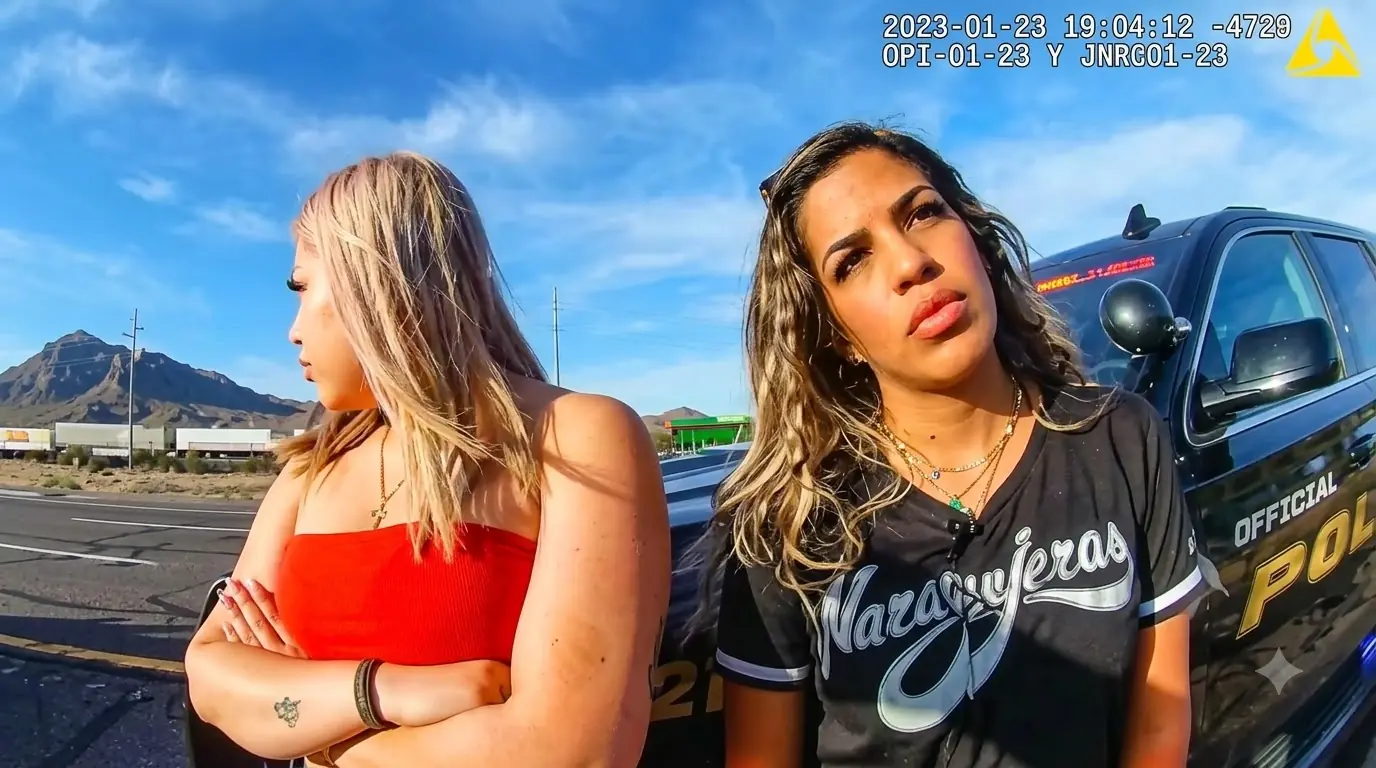
While the women and the minors waited outside, another officer called out to Cashman. "There's a gun under the passenger front seat." The tone of the stop shifted immediately. Cashman radioed for additional assistance and transport units. The women were told to remain near the patrol vehicle while officers continued working through what they had found.
The presence of the two minors became an immediate concern. An officer asked who could pick them up if the adults had to be taken into custody. One of the women said a friend named Hosco might be able to come, while the child's father was in Mexico and a temporary guardian was her mother. The grandmother, however, did not know how to drive that far. Officers said they would need supervisor approval before releasing the children to anyone and wanted to make sure they went to a responsible adult.
The roadside conversation now sounded very different from the relaxed exchange just minutes earlier. Before the search, the women had been told the likely outcome was a citation for the suspended license and that they would soon be able to continue their trip with the licensed owner driving. Cashman had even told them she did not expect to find anything because they had seemed honest with her. After the gun was located, officers began requesting transport units and discussing who could safely take responsibility for the minors.
That contrast mattered because both women had explicitly denied having illegal drugs in the vehicle. When Cashman listed fentanyl pills among the examples, the response had still been no. One of the women had emphasized, "We have kids in here," presenting the minors as another reason officers should believe there was nothing dangerous in the car. Now those same children were standing beside a vehicle that officers were treating as the center of a major criminal investigation.
The firearm was not the only discovery. Officers found numerous pill containers inside the vehicle. The source describes the pills as counterfeit tablets associated with the marking "M30," a form commonly linked to illicit fentanyl. What had started as a five-mile-per-hour speeding violation was now being treated as a major narcotics investigation.
The two women were taken to the Casa Grande Police Department and questioned separately. The driver was identified as 30-year-old Martha Lopez, while her friend and the owner of the vehicle was identified as 31-year-old Tanya Solis. At the beginning of Martha's interview, Officer Cashman briefly called her Tanya before Martha corrected her: "Tanya's my friend." Cashman apologized and continued.
After advising Martha of her rights, Cashman returned to the traffic stop. She reminded Martha that she had been driving with a suspended license related to a DUI. Then she told her what officers had found during the search.
Cashman said the first thing that caught her attention was a pill bottle. When she opened it, the contents were not what the container suggested they should be. There were many pills in the vehicle, and Cashman told Martha that officers believed they were dealing with an enormous amount of fentanyl.
The officer urged her to be honest. "Let's start kind of from the beginning, how we got to this point," she said. Martha answered that she did not really know anything. She repeated that the group had gone down for a short trip and said she did not even know where she would begin explaining the items in the vehicle.
Cashman pointed out that Martha's luggage was in the car and that there were multiple suitcases and other property in the back. The officer's question was simple: if they had traveled south with one set of belongings and returned with a large amount of additional property, where had it come from?
Martha said she did not know. When Cashman asked what she thought the containers held, Martha said, "Well, I thought it was collagen pills." She insisted she had not known there was anything else inside. That answer immediately created another problem for her account.
Cashman asked how Martha could claim not to know where the containers came from while also saying she believed they were collagen pills. Martha said she did not know when they had appeared in the vehicle. She admitted she had seen perhaps two bags but said she had not asked questions and had no idea what else was there.
The officer pressed the point. Martha had traveled to Mexico, returned with a substantial amount of property, and was now saying she neither knew who owned it nor how it had entered the car. "That didn't concern you?" Cashman asked. Martha acknowledged that her explanation sounded bad but continued to say she simply had not asked.
Cashman then explained how serious the situation had become. She told Martha she was facing felony allegations that could include possession or transportation of narcotics for sale and endangerment because two minors had been riding in the same vehicle. She also told her the quantity was close to 500,000 pills.
Asked whether she now understood why the children had been placed in danger, Martha said yes. The officer asked what Martha believed should happen to someone who transported that amount of fentanyl into the country. Martha said she did not know what to say and appeared overwhelmed by the scale of what Cashman was describing.
Cashman returned to the purpose of the trip. Martha said she and Tanya had been friends for more than 15 years. According to her version, Tanya became tired during the drive home and asked Martha to take over. Martha maintained that she had not discussed the containers in any meaningful way and did not know what was really inside them.
Cashman made clear that she did not believe that explanation. She told Martha investigators had her phone and could examine location history, messages, and other digital information. The officer said the phone would eventually show where Martha had gone and whom she had contacted, so the interview was her opportunity to explain the truth before investigators reconstructed the trip for themselves.
Cashman framed the issue as a credibility problem. If Martha's phone contained no messages about a pickup, no address in Mexico, and no evidence of a planned transport, then her denial could be tested against the data. But if the phone showed the opposite, the officer said Martha would have lost the opportunity to explain it in her own words. Martha listened but did not offer a different version of events.
Martha did not change her account. "I don't know anything," she said.
Investigators then questioned Tanya separately. The difference between the two stories became apparent almost immediately.
Asked when she first became aware of the items in the vehicle, Tanya said they had been asked to bring them back, although she claimed she did not know what they contained. She initially described the request as coming through a family connection, then clarified that the connection belonged to Martha rather than to her.
The officer also challenged the timeline both women had given during the traffic stop. They had spoken as though they had entered Mexico earlier and stayed for multiple days, but law enforcement had access to license plate reader information near the border. The officer told Tanya the vehicle records showed that they had actually gone down the previous day.
"Don't start the conversation off lying to me," the officer told her. Once someone lied about a basic detail, he explained, it became difficult to trust the rest of the account. He asked Tanya again where they went after crossing the border.
This time Tanya said they went to a hotel. She also acknowledged that they knew they were there to pick something up. According to Tanya, an address was later sent to Martha's phone, and the women drove to that location.
The officer asked when the pickup occurred. Tanya said it was around 1:00 p.m. Afterward, she said, they drove straight back. That admission was far different from Martha's claim that she did not know when or how the containers had entered the vehicle.
Tanya said she had been told the load consisted of a large amount of medication. Her understanding, she claimed, was that it was something they were not supposed to formally report because there would be taxes involved. She did not say she had been told it was fentanyl.
The officer asked who drove to the pickup location. Tanya said Martha did. Once they arrived, Tanya said she went into the residence while two people loaded the product into the vehicle outside. She was not the person physically placing the containers in the car, but she knew a large quantity of something was being loaded.
The officer asked whether that situation had concerned her. Tanya admitted that it had, at least partly. She said she had wondered whether it might be illegal, though she also claimed she was uncertain. The officer told her that uncertainty should have been a reason to leave before the vehicle was loaded and the return trip began.
Tanya continued to insist that she had not known the product was fentanyl. The officer emphasized that the quantity made the allegations extremely serious and again confronted her with the fact that the women had not simply gone to Mexico for a family visit. Tanya finally agreed that the original family-visit story was not accurate.
According to Tanya, Martha had asked her to come along for a trip to pick something up. Tanya said she asked what they were retrieving and was told it was medication. She agreed to go. When the containers were loaded, she said she had concerns but did not know what to do and continued with the trip anyway.
After that interview, the officer returned to Martha.
"This is looking worse and worse for you," he told her. Tanya had now provided a version that directly contradicted Martha's story. The officer summarized what Tanya had said: they had stayed one night at a hotel, Martha had received an address, Martha had driven them to the pickup location, the vehicle had been loaded there, and the trip had been made specifically to retrieve product.
He gave Martha another opportunity to change her account. Martha did not. She said she did not know what had happened and refused to say Tanya was lying, even though the officer pointed out that the two stories could not both be true.
The questioning became very specific. Had Martha received a message telling her where to pick up the bottles? "No," she answered. Had she gone to an address where the vehicle was loaded? "No."
Had she asked Tanya to travel to Mexico with her to pick up the items? Again, Martha said no. The officer ended that portion of the interview by telling Martha that if she continued denying facts investigators believed they could establish independently, there was little reason to keep asking the same questions.
The interviews, however, were not finished. Investigators also asked about money and whether this was the first time either woman had participated in a similar trip.
One of the women was asked how much they expected to be paid for the load. She said she was not sure because this was a new person they were supposedly going to work with. The officer then asked about previous trips.
The answers suggested there had been at least one earlier transport. Asked how much they had been paid previously, the woman indicated a figure of roughly $10,000 per trip. When asked how much product had been moved on that occasion, she said it was about half the amount they had with them now and estimated approximately 80 containers.
The officer reasoned that if the current load was about double the prior one, the expected payment could have been around $20,000. The woman responded that this was more than likely. That exchange was significant because it moved the conversation beyond a claim that two friends had unknowingly transported mislabeled supplements. It suggested investigators were examining whether the trip was part of an ongoing arrangement.
Even during the questioning, the two minors remained on the women's minds. At the end of one exchange, one woman asked whether her daughter had been picked up yet. The officer said she had not but promised to let her know when that happened.
By the time the interviews ended, the original traffic explanation had almost completely unraveled. The first story had been that the women went to Mexico to visit family, stayed for two days, and returned with children in the car. Martha said she knew virtually nothing about the containers. Tanya, questioned separately and confronted with border records, admitted that they had gone down the previous day, stayed at a hotel, received a pickup address, went to a residence, had the vehicle loaded, and drove directly back.
The search of the vehicle was also broader than the drug evidence alone. Officers had recovered a firearm from beneath the front passenger seat. Because of that discovery, the investigation included not only narcotics allegations but also a weapons issue connected to the trip.
According to the source, authorities ultimately reported finding more than half a million suspected fentanyl pills concealed inside containers made to resemble collagen supplements. The estimated street value was described as roughly $2.5 million to $3 million. Those figures reflected the scale of the seizure as it was presented at the time of publication.
The legal cases did not end at the same stage for both women. According to the source, Martha Lopez was charged with transportation of narcotic drugs and child endangerment. Her proceedings were still ongoing at the time the source was produced, and the source explicitly noted that she remained presumed innocent unless proven guilty in court.
Tanya Solis faced two transportation-related narcotics counts as well as an allegation involving possession of a weapon during a drug offense. The source says Tanya later accepted a plea agreement in which she pleaded guilty to one count of transportation of narcotic drugs in exchange for the remaining charges being dismissed. At the time of publication, she had not yet been sentenced.
The source also noted that a first offense involving this quantity of a controlled substance could carry a lengthy prison term, potentially reaching 15 years depending on the applicable case and sentencing factors. It did not provide a final sentence for Tanya and did not claim that Martha's case had reached a verdict.
The broader context of the seizure was part of the original report as well. The source described illicit fentanyl as one of the deadliest drugs in the United States and cited approximately 400,000 deaths between 2013 and 2023. It also emphasized fentanyl's extraordinary potency compared with heroin and said tens of thousands of Americans continued to die from overdoses each year.
Those statistics were not what brought Officer Cashman to the highway that day. She stopped a vehicle that was traveling about five miles per hour over the limit. The driver had a suspended license, the owner said the officer could search the car, and the people inside initially insisted there was nothing illegal with them.
From there, nearly every new detail changed the meaning of the one before it. A suspended license led to a consent search. The search produced a gun and containers. The containers led to questioning. The questioning produced two different versions of the trip. Border records challenged the original timeline, and the second interview introduced a pickup address, a loaded vehicle, previous trips, and expected payment.
By the end, the most important evidence was not a single dramatic confession. It was the accumulation of contradictions. Martha continued to deny knowing how the load entered the vehicle, while Tanya described a deliberate trip to receive it. Investigators believed digital records could independently reconstruct the route, and the legal process moved forward from there.
What had looked like a minor speeding stop was no longer about five miles per hour over the limit. It had become a case about what was inside the car, what each woman knew before the trip, why two minors had been riding alongside the load, and which version of the journey the evidence would ultimately support.