The warehouse woke before the sun did.
Bay doors groaned upward in the gray morning cold, forklifts beeped between stacks of shrink-wrapped pallets, and the smell of diesel, cardboard dust, stale coffee, and industrial cleaner seemed baked into the walls. Men and women moved through the aisles with the quiet efficiency of people who had learned that speed kept them employed, but silence kept them safer.
At Alderstone Distribution, nobody laughed too loudly near the supervisors’ office.
Nobody complained where a radio could hear.
Nobody asked why some people got breaks and others got punishments disguised as assignments.
That was why Mariah Sutton walked in through the employee entrance wearing cheap sneakers, black cargo pants, a faded brown jacket, and a temporary worker badge that did not say anything worth noticing. Her hair was pulled back plainly. Her nails were bare. No jewelry, no expensive watch, no driver waiting outside.
Nothing about her looked powerful.
That was deliberate.
Mariah Sutton had not come to Alderstone Distribution to be welcomed.
She had come to find out what happened in the building when people believed no one important was watching.
For almost eight months, complaints had reached her executive office in broken pieces. A line in an anonymous email. A voicemail left from a blocked number. A resignation letter that said nothing directly but everything between the words. Employees described bullying, racist comments, injury threats, unpaid overtime pressure, humiliation in front of teams, and managers who treated fear like a productivity tool.
On paper, the warehouse looked excellent.
Output was up.
Accidents were down.
Employee complaints were almost nonexistent.
But Mariah had built Sutton Freight Group from two leased box trucks in Baton Rouge into one of the fastest-growing logistics companies in the country, and she knew clean numbers could hide dirty rooms. Her father had worked warehouse floors for thirty-seven years. He used to come home with cardboard cuts on his hands and stories he told lightly because the heavier version would have scared his children.
“Bad bosses don’t start by breaking laws,” he once told her. “They start by teaching people to accept disrespect in small doses.”
Mariah never forgot that.
So she chose a cold Monday in November, before any announced executive review, before anyone could polish the place and pretend decency was standard procedure. She entered the warehouse alone at 5:12 a.m., carrying a paper cup of gas-station coffee and an old canvas backpack.
Her badge said: temporary floor support.
Her name tag said: M. Sutton.
Nobody looked twice.
That alone told her something.
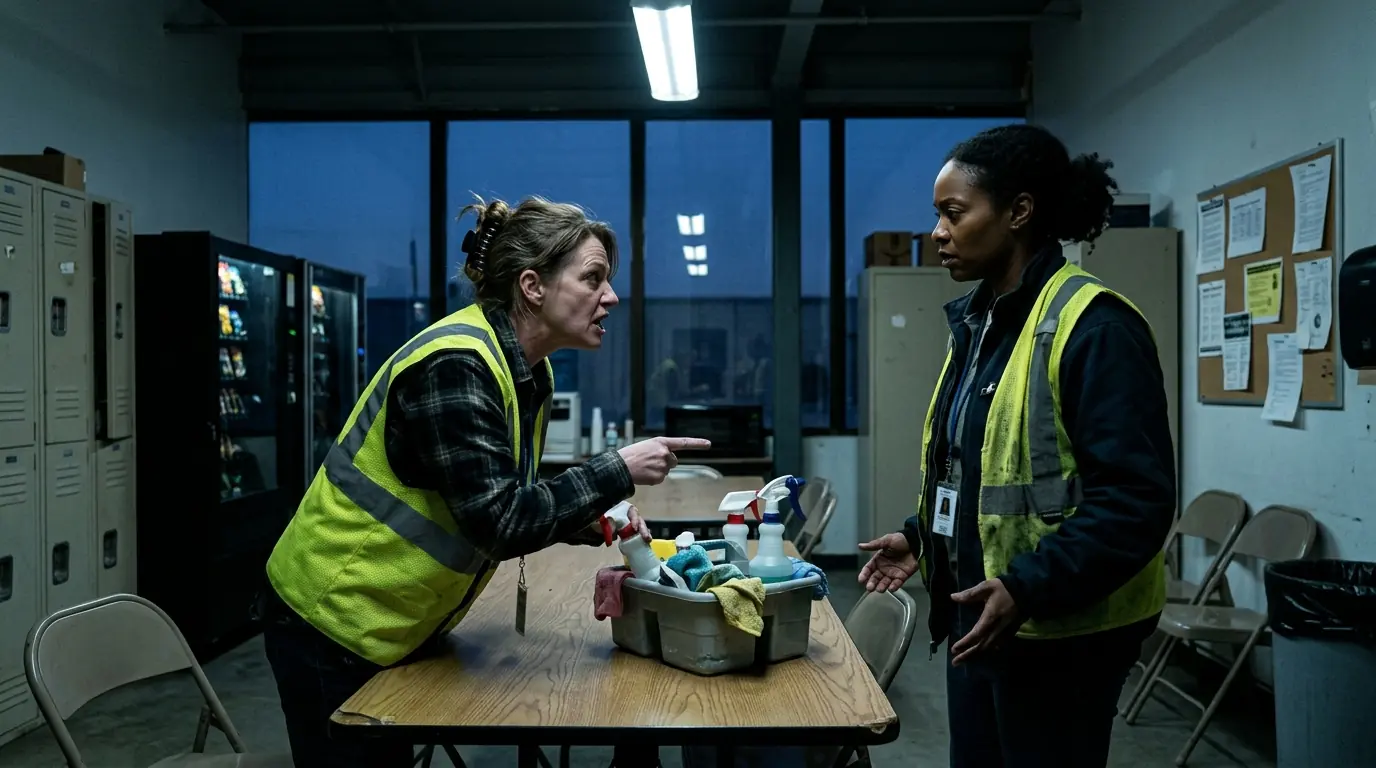
The breakroom sat near the loading docks, a square room with vending machines, scratched tables, and a microwave that hummed louder than the conversations around it. Mariah stood by the coffee machine and listened.
A young picker named Jordan Price sat at one table rubbing his wrist as if every movement hurt. A woman from returns quietly counted bus fare from a coin purse. An older custodian stood beside the sink with his back brace visible beneath his uniform shirt, staring down into a paper cup he had not touched.
The room did not feel like a break.
It felt like a waiting room before punishment.
At 5:31, Valerie Knox walked in.
The room changed before she spoke.
Conversations died.
Chairs stopped moving.
A man near the vending machine stood up so quickly that a packet of crackers fell from his lap, but he did not bend to pick it up until Valerie passed him. Her boots hit the tile with intentional force, each step announcing that the morning belonged to her.
Valerie Knox was the senior floor supervisor for the early shift.
She had a blond ponytail pulled tight enough to sharpen her face, red lipstick that never smudged, and a company radio clipped to her belt like a weapon. Behind her came two assistant leads, Carly Voss and Martin Dade, both young, both eager, both wearing the kind of smile people wear when cruelty has trained them to stand near it instead of under it.
Valerie scanned the breakroom.
Her lip curled.
“Look at this,” she said. “Six minutes before shift and half of you are sitting around like this is a retirement home.”
Nobody answered.
“You want the trucks to unload themselves? You want the orders to walk into boxes and tape themselves shut?”
A few workers stood.
Valerie pointed at Jordan. “Price, if I see you favoring that wrist again, I’m sending you home without hours. I’m tired of watching people fake injuries for sympathy.”
Jordan’s face tightened. “It’s swollen, ma’am.”
“Then stop moving slow enough for me to notice.”
Carly laughed.
Martin smirked.
Mariah watched Jordan lower his eyes.
Valerie turned toward the woman counting bus fare. “Ana, if your station is behind again today, don’t start crying about child care. Everybody has problems. Some of us just don’t bring them to work like luggage.”
Ana’s hand closed around the coins.
The older custodian by the sink looked away.
Mariah kept her face still, but something inside her went very quiet.
Reports used words like intimidation and hostile communication. Those words had no smell, no temperature, no echo. They did not show the way workers made themselves smaller when Valerie’s shadow crossed the floor. They did not show the assistant leads laughing because laughter helped power feel normal.
Then Valerie saw Mariah.
Her eyes paused, then traveled slowly from Mariah’s sneakers to her jacket to her temporary badge. The decision formed immediately on her face.
“You,” Valerie said.
Mariah looked up. “Yes?”
“Why are you standing around my breakroom?”
“I’m waiting for assignment.”
“Perfect,” Valerie said. “Restrooms by Dock Four are nasty. Grab gloves, bucket, brush. Start there.”
A few workers looked down.
Ana closed her eyes for half a second.
Mariah set her coffee on the counter. “I was told I’d be helping with floor operations.”
Valerie stared at her like the sentence amused her.
“You were told?” she repeated. “Who exactly do you think cares what you were told?”
“I’m asking for clarification.”
“No, you’re testing me.” Valerie took two steps closer. “And I don’t play cute little clarification games before sunrise.”
Mariah did not move. “Why did you choose me for the restroom?”
The breakroom went still.
The question had been calm, but it landed like a dropped tool on concrete.
Valerie’s smile thinned. “Because I said so.”
“That’s not a reason.”
“It is the only reason you get in this building.”