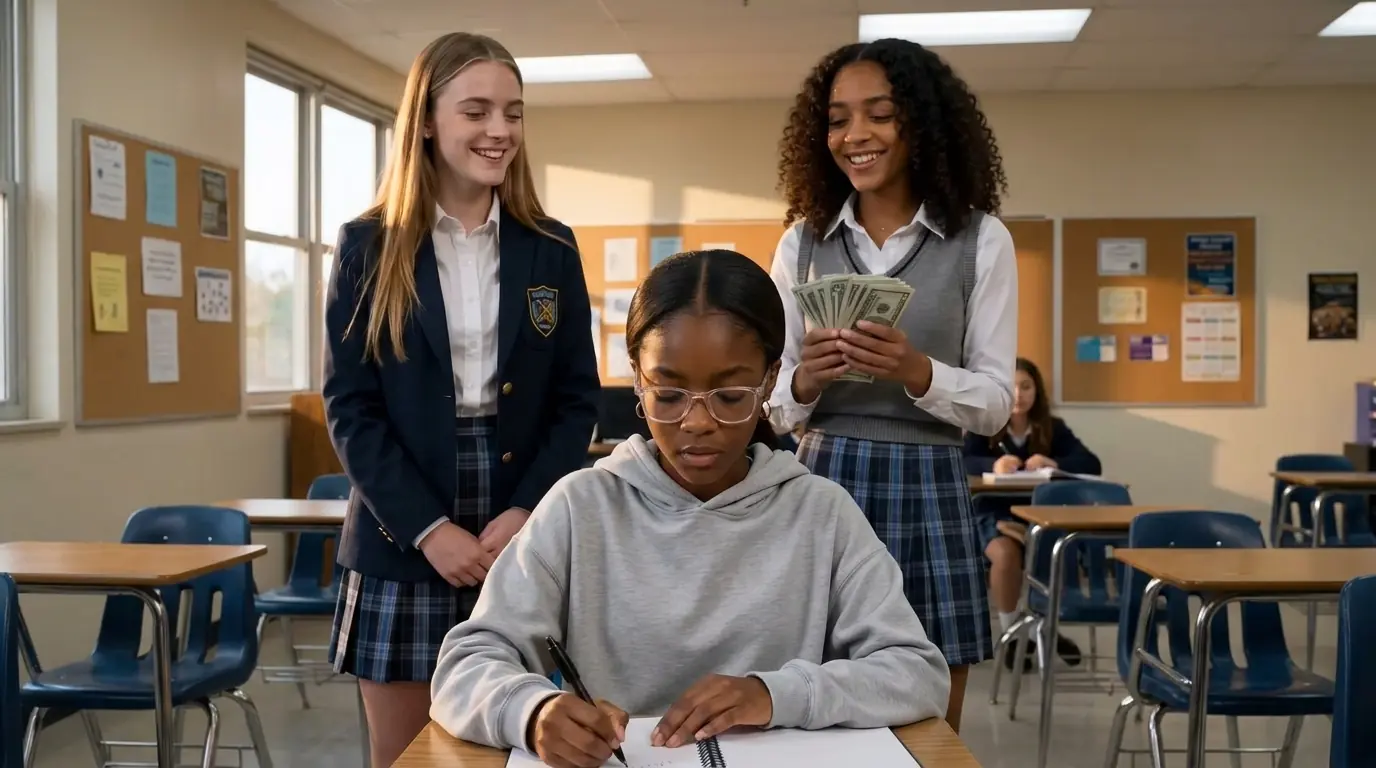
By seven-thirty Monday morning, custodian Raymond Cole had already pulled thirty-seven dollar bills from beneath the desks in Room 214. More were wedged under the radiator, trapped beside chair legs, and stuck beneath the teacher’s rolling cabinet where students had kicked them during the chaos on Friday. The classroom smelled faintly of floor cleaner, but nothing could erase the image now circulating through Crestwell Academy of money raining over an eighteen-year-old Black girl while two classmates laughed behind her. Before first period began, almost everyone at school knew something ugly had happened in that room.
What most students did not know was why Amara Ellis had eventually stood up, removed her glasses, and faced the girls who had been tormenting her. They did not know why one of those girls ended up flat on the classroom floor with loose bills scattered around her navy blazer, or why Amara had calmly held a black-and-gold card in front of everyone before walking away. The fifteen-second clip made it look like an extraordinary reversal between a poor scholarship student and two wealthy bullies. The real story was much less convenient.
Eight months earlier, Amara had arrived at Crestwell Academy for senior year with a gray hoodie, a plain black backpack, clear-framed glasses, and no interest in announcing anything about herself. She was eighteen, Black, slim, quietly athletic, with long neat braids that she usually tied behind her shoulders when she studied. Crestwell sat outside Boston on a manicured forty-acre campus where stone buildings, ivy-covered walls, and century-old traditions made the private school look more like a small university. Amara had earned one of six places in the Harrison Merit Scholars Program, a highly competitive academic award that covered most of senior-year tuition.
The scholarship was not need-based, but almost nobody bothered learning that distinction. Amara’s mother, Dr. Camille Ellis, was an anesthesiologist at a Boston teaching hospital, while her father, Marcus Ellis, had built a cybersecurity company that employed more than eighty people across three states. The family lived comfortably, though Marcus drove a six-year-old SUV and Camille considered designer handbags an excellent way to turn two hundred dollars of leather into two thousand dollars of insecurity. Amara had grown up around money without being taught to display it.
The black metal credit card that would eventually become the most replayed object in the viral classroom video had been added to her parents’ account the summer before senior year. Marcus gave it to her for emergencies, school expenses, and college travel, then warned that ordering sneakers did not qualify as an emergency. Amara rarely used it because she had her own checking account and a part-time summer job editing promotional videos for her father’s company. Nobody at Crestwell knew any of that because Amara saw no reason they should.
Sloane Mercer noticed the scholarship before she noticed anything else. Sloane was eighteen, white, blonde, tall, and polished, with long hair that fell perfectly over the navy Crestwell blazer she wore above the school’s white blouse and blue plaid skirt. Her family had attended Crestwell for three generations, her father managed a private investment firm, and her mother chaired the annual foundation dinner. Sloane had never needed to introduce herself on campus because her last name already appeared on the plaque outside the performing-arts center.
Her closest friend, Delaney Brooks, was also eighteen and white, with dark auburn hair, blue eyes, and the gray sweater vest Crestwell seniors often wore instead of their blazers. Delaney was less openly cruel than Sloane but quicker to laugh, record, repeat, and validate whatever Sloane decided was funny. Together, they had spent years near the center of Crestwell’s social life, where expensive vacations, college consultants, and luxury cars were discussed with the casualness other teenagers used for cafeteria food. Amara entered that world without asking for permission.
Their first conversation happened during orientation when Sloane saw the Harrison Scholars folder under Amara’s arm. She asked whether Amara was “one of the scholarship transfers,” and Amara explained that Harrison was an academic merit program. Sloane smiled and said Crestwell had been “really focused on opening doors lately.” When Amara asked what door she meant, Sloane said she was only talking about new students.
The comment was small enough to ignore, so Amara ignored it. Two days later, their AP Literature teacher returned an essay on Beloved, and Amara had the highest grade in the class. Sloane looked at the score, then asked whether Harrison Scholars received different grading consideration during their first semester. Amara said no and went back to annotating her book.
Sloane laughed and told Delaney she had only been curious. Amara heard Delaney whisper that scholarship programs usually needed their students to look successful. Neither girl lowered her voice enough to hide the comment completely. Amara decided then that the safest thing was not to give them the confrontation they seemed to want.
That choice became harder during September. When Amara joined the debate team after winning a trial round, Sloane told classmates Crestwell was probably eager to feature its “new scholarship face” at competitions. When Amara wore a new pair of headphones, Delaney asked whether the Harrison program covered electronics too. When Amara bought lunch for a friend who had forgotten her wallet, Sloane joked that she must be spending carefully because “aid money had rules.”
Amara corrected the last remark. “There is no aid money,” she said, explaining that Harrison was based on academic achievement rather than family income. Sloane shrugged and answered that scholarship was scholarship. Amara realized the facts did not matter because Sloane was not asking questions in order to learn anything.
The assumption had attached itself to Amara before anyone knew her. Black girl, new student, scholarship program, therefore poor, grateful, lucky to be there, and somehow dependent on generosity from people like Sloane. Whenever reality contradicted that story, Sloane simply adjusted the details without changing the conclusion. Amara still remained the outsider who had been given something.
Her first real friend at Crestwell was Priya Desai, an eighteen-year-old Indian American student who had attended since ninth grade and possessed almost no patience for social hierarchies. Priya heard Delaney make a joke about Amara’s “free Crestwell experience” during lunch and immediately asked whether she had ever read the Harrison program requirements. Delaney said she did not need to read them to know what a scholarship meant. Priya answered that confidence was not a substitute for literacy.
Amara nearly choked on her drink laughing. Priya sat beside her after that and explained that Sloane had always treated Crestwell as though her family personally issued visas to everyone entering campus. Amara asked whether Sloane behaved that way toward all scholarship students. Priya shook her head and pointed across the cafeteria toward Connor White, a wealthy white senior who held an academic scholarship covering almost half his tuition.
Nobody called Connor poor. Nobody asked whether his family could afford new shoes, whether his laptop came from scholarship money, or whether his college opportunities existed because Crestwell needed a particular type of student on its brochures. The difference became harder for Amara to dismiss once she saw it clearly. She started paying attention.
October produced the first written evidence. Crestwell’s admissions office posted a photograph of Amara speaking during a debate tournament, and someone forwarded her a screenshot from a private senior chat. Sloane had reposted the image with the caption, Crestwell getting maximum value out of that diversity scholarship.
Delaney responded with laughing emojis. Another student asked whether Harrison was actually a diversity scholarship, and Sloane replied, Come on, you know how schools work now. Amara saved the screenshot instead of replying.