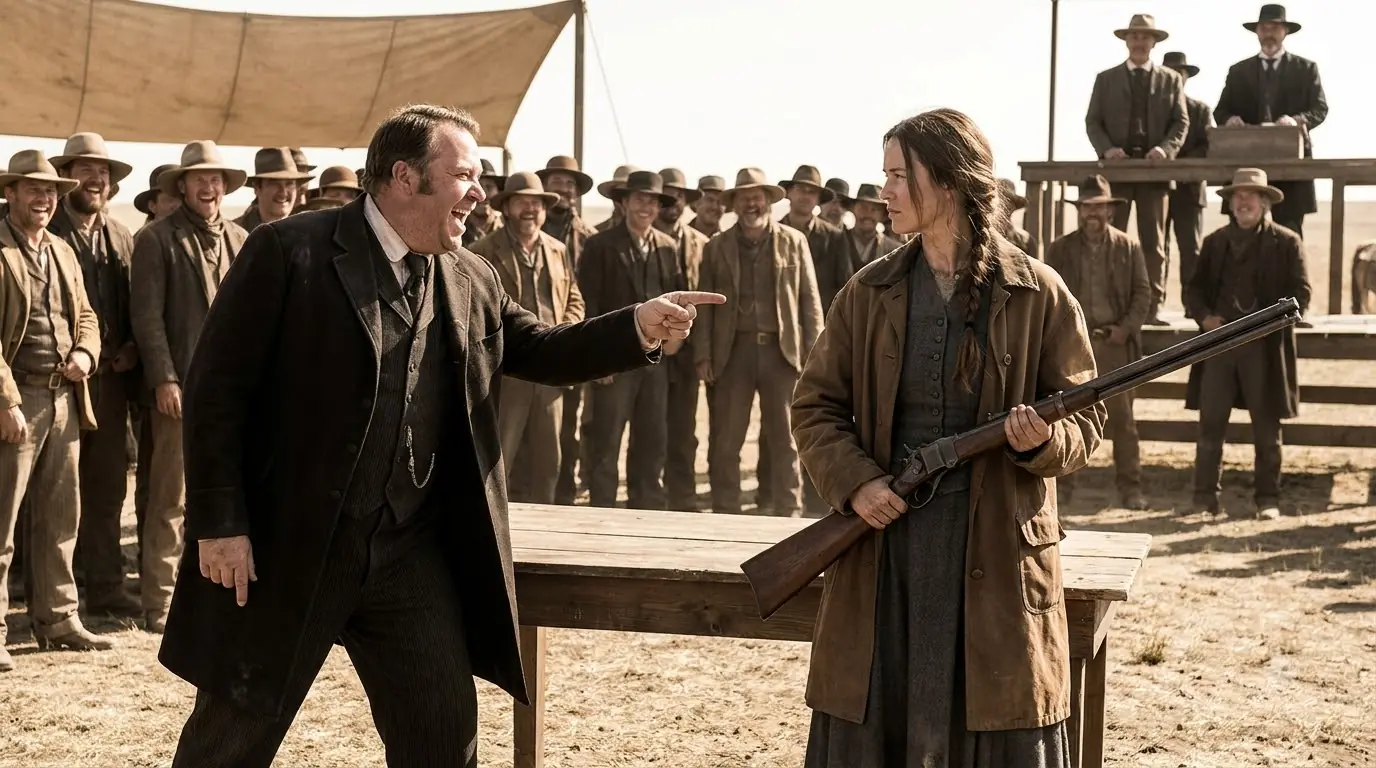
41 Shooters paid $2 a piece for Ernest Fosters's rifle match outside Mile City that October, and 40 of them were men. The one who was not came in a dead man's coat with a dead man's rifle across her arm, and she owed the Kuster County Bank $400 by the 1st of November. They laughed at her at the registration table. Whose gun did you steal, girl? A minute after the first round started, nobody on that flat was making a sound.
There was an answer to Ernest's question. It was cut into the steel of that rifle in letters deep enough to read by touch, and not one man on that range thought to look. Anna Lambert was 34 years old, and there were 8 miles of bad road between her place on the Tongue River bottom and the town of Mile City, which suited her. Her husband Paul had been dead three winters. She ran chickens and a garden and a milk cow and took in mending, and every quarter she carried her payment into the bank herself, so nobody would have to come out and ask her for it.
Then came a winter that killed half her hens, and a summer with no rain in it. And in September, a letter arrived that used the word foreclosure twice. $400, six weeks. She had $11 in a coffee tin. The handbill was nailed to the post outside the merkantile. A rifle match on the flats east of town put up by the cattleman earnest. $500 to the winner. $2 to enter, and it said open to any shooter.
That night, Anna Lambert climbed a ladder into her own hoft and took down a thing she had sworn she would never touch again. The registration table sat under a canvas fly at the edge of the flats, and above it hung a painted banner with Ernest Foster's name on it in letters 3 ft high. He had paid for the banner, the purse, the steel, and the two bees turning on spits behind the wagons, and every man in Kuster County knew it because Ernest had a way of mentioning it. He was 51 that fall. A wide, well-fed man in a good coat, who had come to Montana with money and made more of it.
And he ran the rifle match the way a man runs a thing he owns. Anna Lambert got to the table at half 7 with $2 in her hand. She had walked the last mile leading the horse because the near wheel of her wagon had a crack in it. She wore a gray dress and a man's canvas coat that hung wrong on her shoulders, and the rifle was in a leather case under her arm. The line went quiet in front of her before it went quiet behind her.
Otis Yates was the range officer, a spare, dry man of 60 who had been running firing lines since before the war, and he was holding the pen. He looked at her and at the case, and he did not look surprised, which was the first small kindness she got that day. Name: Anna. He was still writing it when Ernest came around the end of the table. Ernest had a way of arriving that made the ground around him smaller.
He put one finger on the wet ink of her name, turned the sheet toward himself, read it, and laughed. It was not a cruel laugh. Exactly. It was worse. It was the laugh of a man being told a mildly good joke.