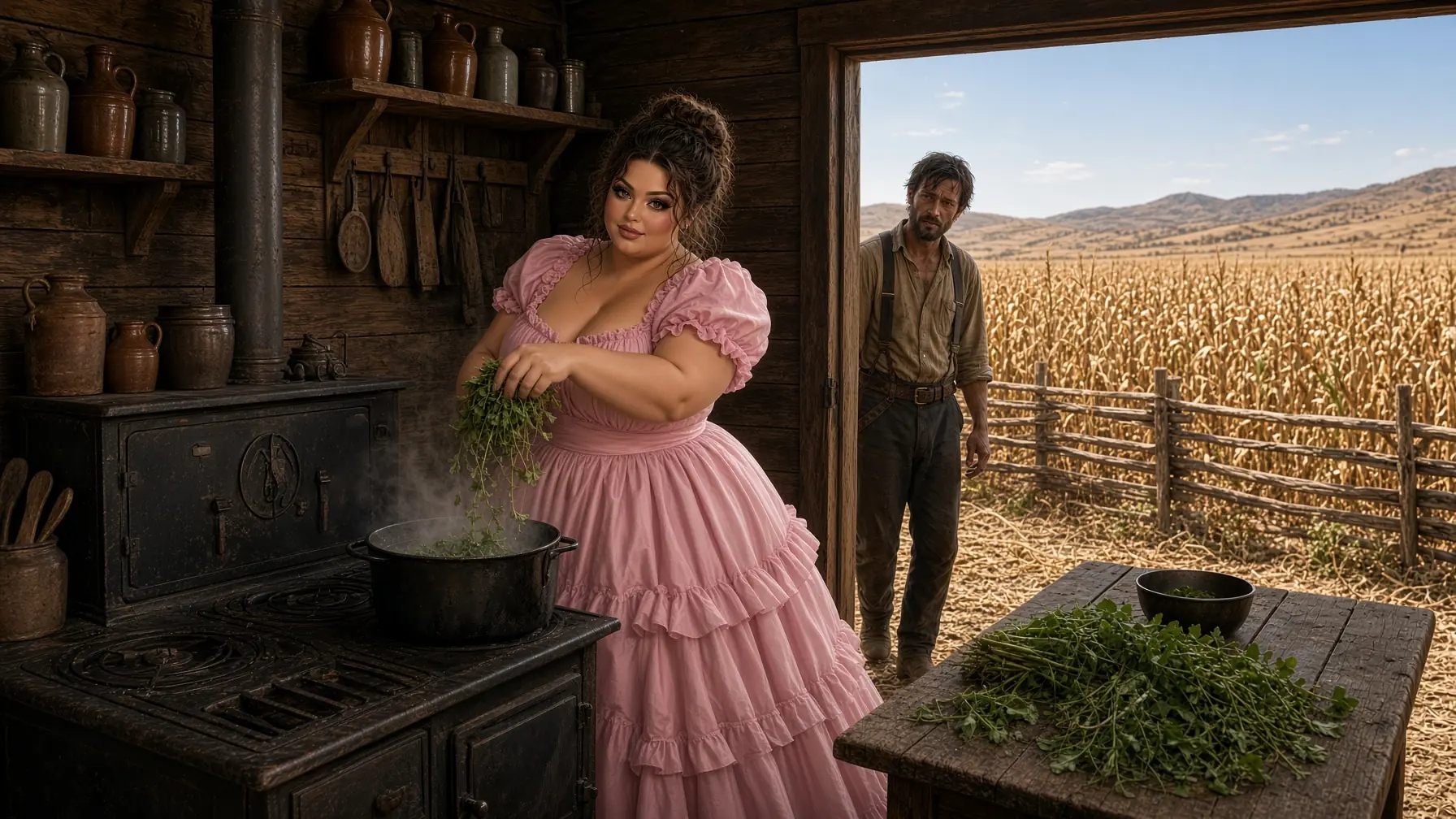
By eleven o’clock on Thursday morning, six families in Sun Hollow Valley were sitting inside the town hall with contracts spread in front of them and fountain pens waiting beside their hands. Outside, the Colorado heat pressed against the windows, and beyond Main Street the fields had turned the color of old rope after the third failed summer in a row. At the head of the room stood Conrad Vale, regional director of Basin Crown Land & Water Company, wearing a black suit too expensive for a town where half the farmers were deciding whether they could afford flour until winter. He was smiling because he believed that before noon, nearly a third of the valley would belong to him.
Then the back doors opened.
Sarah Whitcomb walked inside carrying a rusted metal box against her chest, with dust on her skirt and a bundle of wild green plants tied beside the handle. Her husband Daniel followed several steps behind her, and behind him came a thin gray-haired man whose presence wiped the smile from Conrad’s face almost immediately. The farmers near the door whispered Sarah’s name first, then the nickname some of them had used all summer when they saw her walking the hills with a basket.
The weed woman.
Sarah heard it.
She kept walking.
Three months earlier, those same plants had been the reason people laughed when she carried food home while everyone else was watching gardens die. That morning, they had led her to documents suggesting the drought devastating Sun Hollow was not entirely natural. Now six families were seconds away from selling land to the very company Sarah believed had helped make them desperate enough to sell.
Conrad placed one hand on the stack of contracts. “Mrs. Whitcomb, this is a private meeting,” he said, still wearing the polite expression he used whenever powerful men were watching. Sarah placed the metal box on his table and answered, “Not anymore.”
No one signed anything.
But to understand why, you had to go back to the summer when people still thought Sarah Whitcomb was gathering weeds because she was too poor to buy proper food.
The drought had begun with one disappointing spring and then settled into Sun Hollow like something planning to stay. Snowfall in the mountains had been light, irrigation ditches ran thin by June, and wells that had supplied families for generations began dropping one after another. By the third summer, farmers were selling cattle early, gardens were failing before vegetables matured, and men who once argued about harvest prices were discussing which bank might give them another year.
Sarah and Daniel Whitcomb owned seventy acres near the western hills. It was not much compared with the large ranches farther down the valley, but Daniel’s family had worked the land since his grandfather arrived with two horses and a broken wagon. Their wheat field failed first, then half the bean crop, and by July their well had dropped enough that Daniel stopped watering anything that could not feed either people or animals.
Sarah responded differently.
She took a wicker basket and walked into the hills.
Women in town noticed her returning with lamb’s-quarter, purslane, miner’s lettuce, wild onions, and several other plants most people stepped over without looking down. Sarah washed them, cooked some with beans, dried others for soup, and taught her two young nieces which leaves could be eaten and which could make them sick. Daniel never complained about the meals, although the first bowl of boiled greens made him stare suspiciously at Sarah before admitting they tasted better than they looked.
The neighbors were less kind.
At the feed store, one man joked that Daniel’s wife had started feeding him rabbit food. A group of boys called after Sarah one afternoon, asking whether she wanted them to collect weeds from behind the schoolhouse. Sarah ignored them because hunger had a way of making pride feel considerably less useful.
Her knowledge came from her grandmother, Adelaide Monroe.
Adelaide had spent nearly all her life in Sun Hollow and knew the mountains with the intimacy other people reserved for family. When Sarah was a child, Adelaide taught her how to find water after storms, where wild onions returned first in spring, which roots could be dried for winter, and which plants remained green longer than everything around them. Sarah assumed those lessons came from an old woman’s obsession with survival.
Adelaide died when Sarah was seventeen.
Years later, Sarah still carried one of her notebooks.
Most pages contained recipes, sketches of plants, weather observations, and small maps that seemed to lead nowhere. On the inside cover Adelaide had drawn the same symbol again and again: three leaves surrounding a small circle. Sarah never knew what it meant.
Then one August morning, the valley nearly ran out of water.
Daniel woke before dawn and pulled the pump handle three times before anything came from the kitchen tap. The first burst was cloudy, the second weak, and the third barely enough to fill a kettle. He stood staring at it while Sarah entered the room tying her hair back.
“The well dropped again,” he said.
Sarah looked toward the bucket beneath the sink.
“How much?”
“Maybe another foot overnight.”
“That fast?”
Daniel nodded.
Their well had survived drier years.
That was what neither of them understood.
Rainfall had been bad, but older farmers remembered droughts when the creeks still fed underground reserves long after crops failed. Sun Hollow sat beneath mountains crossed by springs, and some of the oldest deeds in the county mentioned water in places where nobody had seen open streams for decades. Yet wells were failing from north to south as if the entire valley were being drained from beneath.
Sarah took her basket after breakfast.
Daniel asked where she was going.
“The ridge.”
“Again?”
“The greens are still growing up there.”
Daniel looked through the window at fields the color of dust.
“That doesn’t make sense.”
Sarah paused.
For the first time, she thought about the sentence instead of the plants.
No, it did not make sense.
The valley had been dry for months.
Small streams were gone.
Even juniper looked tired.
Yet certain patches of wild greens remained bright beneath exposed hillsides.
Sarah took Adelaide’s notebook with her.
The path above the Whitcomb farm climbed through dry grass and broken shale before turning toward a shallow ravine. Sarah had gathered there several times because purslane grew beside one rock formation no matter how hot the summer became. That morning, she noticed the plants formed a line.
Not a random patch.
A line.
It curved around the slope, crossed beneath a fallen cottonwood, and continued toward another cluster of green fifty yards away. Sarah crouched beside the first patch and pushed a finger into the dirt.
The soil beneath it was damp.
She sat back.
Then she opened Adelaide’s notebook.
One old drawing showed almost the same hillside.
Three leaves.
A circle.
A crooked line.
Sarah looked at the plants again.
“Grandma, what were you showing me?”
She followed the green.
The line climbed toward a knot of roots beside a dead cottonwood. Sarah knelt and began clearing soil with the small garden knife she carried in her basket. Six inches down, the blade struck metal.
The sound made her freeze.
She scraped again.
Metal.
Sarah removed more soil.
A black corner appeared beneath the roots.