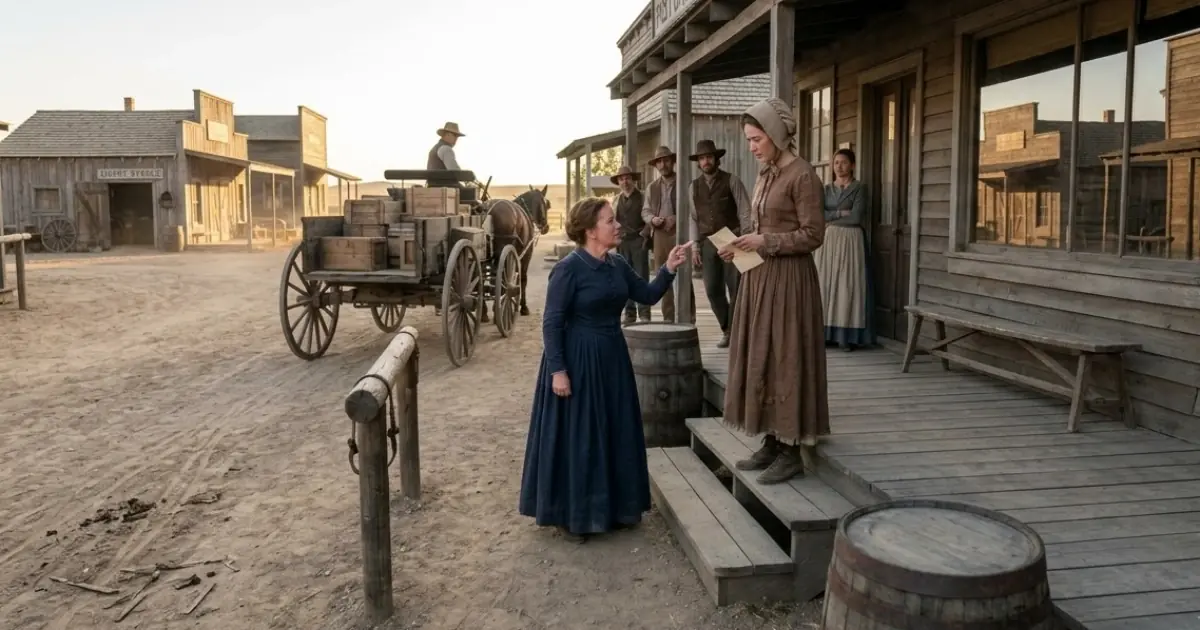
The woman arrived on a Wednesday, which was the day the supply wagon came through Haller's Creek, and people found reasons to be near the road. She was standing outside the post office when it happened, not waiting for anything, exactly. She had a letter in her hand, one she had been carrying for 3 days, and she was looking at the building the way a person looks at something they have decided to walk into. The letter was sealed.
She had written it herself in the careful script she had learned from a woman named Sister Agatha at the Caldwell County Home, where she had lived from the age of 7 until the age of 16. And the letter was addressed to a Mr. Delbert Crane of Haller's Creek, who had promised her work as a housekeeper and had written to say so, and who had, it turned out, promised the same thing to his wife without telling her. Mrs. Crane was the one who came out of the post office first. She was a compact woman with a voice built for distance, and she used it.
She said that she didn't know what kind of woman showed up in a town with a letter and an expectation and no references anyone could verify, and she said it in the way of someone who has prepared the speech in advance and is relieved to finally deliver it. The street was not empty. Three men stood near the wagon. A woman with a basket of dry goods paused.
The boy who swept the post office steps stopped sweeping. The woman with the letter did not look at any of them. Her name was Vera Marsh, and she was 31 years old, and she kept her chin level in the way of a woman who has decided in advance not to fall apart. She said only that she understood, and she was sorry for the trouble, and she folded the letter carefully in half and placed it in the small bag she carried, and she stepped off the post office steps and walked to the bench at the far end of the road and sat down.
That was all. She did not argue. She did not cry where anyone could see it. By the second autumn, people in Haller's Creek would stop calling her simple. She didn't know that yet.
She sat on the bench with her bag across her knees and looked at the far end of the road where it curved out of town and became a dirt track heading into the hills. And she thought about what she had, which was $4.60, a change of clothes, a small Bible with Sister Agatha's handwriting in the margins, and the ability to read, which was not nothing, though it had not yet proven itself useful in any way that paid. A man had been leaning against the post office wall when Mrs. Crane came out. He was still there.
He was tall in the way of men who have worked outdoors since they were boys, broad through the shoulders, with hands that looked like they belonged to a trade. He wore a canvas coat, and his hat was pulled low, and he had watched the whole thing with the stillness of someone who has learned that watching costs nothing and speaking costs something, and he was careful with what he spent. His name was Caleb Rourke. He ran the sawmill 2 miles east of town, the one people said had been cursed since his wife died 4 years back, which was the kind of thing people said when they didn't want to think too carefully about what they meant.
He had two children, a daughter of nine named Bess, and a boy of five named Martin. He had a housekeeper who had left in March and had not been replaced, and he had a mill to run and a house that showed it. He pushed off the wall and walked to the bench. He did not sit down.
He stood at a slight angle, which was less confrontational, and he looked at the road rather than at her when he spoke. He said, "Can you cook?" She looked up at him.
He was not looking back. She said, "I can, and I'm not afraid of hard work." He said he had a mill and two children and no one to keep the house, and that it was not easy work, and the house was not close to town, and that he could pay $4 a week and meals and a room of her own.
She said, "When would you need me to start?" He said, "I've got the wagon. I'm heading back now." She stood up. She picked up her bag.
"All right," she said. And that was how it began, with no ceremony and no promises, and the bench empty behind them, and the boy on the post office steps watching them go, and Mrs. Crane watching from the window, which was as close to concern as she was likely to get.
The road to the mill was 2 miles of ruts and pine shadow, and Caleb Rourke did not say much on the way out. He told her the children's names. He told her that Bess was particular about certain things, which he did not specify. He told her that Martin would follow her everywhere if she let him, and that she should not feel obligated to let him.
He told her where the larder was, and that the pump in the yard needed a firm hand, and that he took his coffee before first light, and again at midday. She listened to all of it and said, "I understand," at the appropriate places, and she looked at the trees and the light coming through them, and the way the land opened up as they came around the last bend, and the mill appeared, and then the house behind it, and she took stock of both without letting her face say anything about what she thought. The house was a square, practical structure of plain timber with a covered porch and windows and a kitchen garden that had gone to weeds along one side. There was a wood pile that was adequate, and a porch step that had come loose from its nail and rocked when you put your weight on it.
She noticed the step. She did not say anything about the step. Bess came to the door when the wagon pulled up. She was a serious child with her father's stillness and her mother's eyes, which Vera did not know yet, but would come to understand. She looked at Vera the way a person looks at weather they have not decided about.
Martin came around from behind the house with mud on his boots and a stick in each hand, and stopped dead when he saw her, and then said, "Are you staying?" Vera said, "For a while." Martin considered this, and then held out one of his sticks, which was an offering of some kind, and Vera took it with the gravity it deserved.
Bess said nothing and went back inside. The kitchen was large and cold and had not been properly cleaned in some time, which was not a judgment, only a fact, and Vera set her bag down on the chair near the door and rolled up her sleeves and started the fire and found the larder and took stock of what was there. And by the time Caleb came in from unhitching the horse, there was water heating and she had found the flour and the salt pork and was already making something that would be ready before dark.
He stood in the kitchen doorway for a moment. Then he went to wash up and nothing was said and supper was ready when he came back and the four of them sat at the table and ate. And Martin talked about the stick which had apparently been involved in an important project. And Bess ate in silence and watched Vera with the careful attention of someone taking measurements.
The food was good. Caleb did not say so. He had a second helping which said the same thing. That night, in the small room off the kitchen that would be hers, Vera sat on the edge of the narrow bed and looked at the window and listened to the mill settling in the dark and the wind in the pines on the ridge.