The auction block in Willow's Ferry, South Carolina, stood in the shadow of the old customs house, and it was there on a morning thick with the smell of river mud and tobacco smoke that Millicent Fairweather first saw the man who would change the whole remaining shape of her life. He was perhaps 22 years old, though the trader calling out his particulars claimed younger. And he stood on that block with a stillness Millicent would later understand was not submission, but a kind of iron control. The stillness of a man who had learned that any flicker of feeling shown in public was a weakness other people would use against him.
His name, the trader announced, was Tobias, and he had come off a ship out of the Windward Coast some 3 years past, though something in the way the trader said it, too quick, too rehearsed, struck Millicent as a lie even before she understood why it mattered. Millicent had come to town only to collect a delivery of seed corn. A 38-year-old widow managing 40 acres alone since her husband Warren had gone into the ground of a fever two winters back, she had no business at an auction, no money for a purchase of that magnitude, and every intention of walking past without stopping. But the man on the block was watching the crowd with an expression Millicent recognized from her own mirror in the months right after Warren's funeral.
The particular blankness of a person holding himself together through sheer will because falling apart was not a luxury available to him. Then a man near the front of the crowd, a merchant Millicent recognized as one of Warren's old creditors, called out that the man had papers on him when he was taken off the coastal packet at Charleston, manumission papers signed by a British naval officer who'd intercepted the slaving vessel and freed its cargo before the ship ever reached American waters. And that the trader standing on the platform now had likely destroyed or hidden those papers rather than lose his profit on a man who was by law already free. The trader's face went tight and careful at that.
The particular carefulness of a man who knows he's been caught in something and is calculating how much the courthouse would care. "There's a processing fee owed on this man regardless," he said too fast. "17 cents for the dock registry and the auction bond. And until that's settled, he's held as surety."
"Then I'll pay it," Millicent said before she had fully decided to say anything at all. The words arriving the way words sometimes do when a person's conscience moves faster than their good sense. She held up the coins from her coin purse meant for seed corn and the crowd went quiet the way crowds do when they sense a scene about to unfold that they'll be repeating over supper for a week. The trader took the coins with visible reluctance and under the pressure of the watching crowd because a crowd that has just heard the words manumission papers and British naval officer becomes, however briefly, a crowd of witnesses rather than mere spectators.
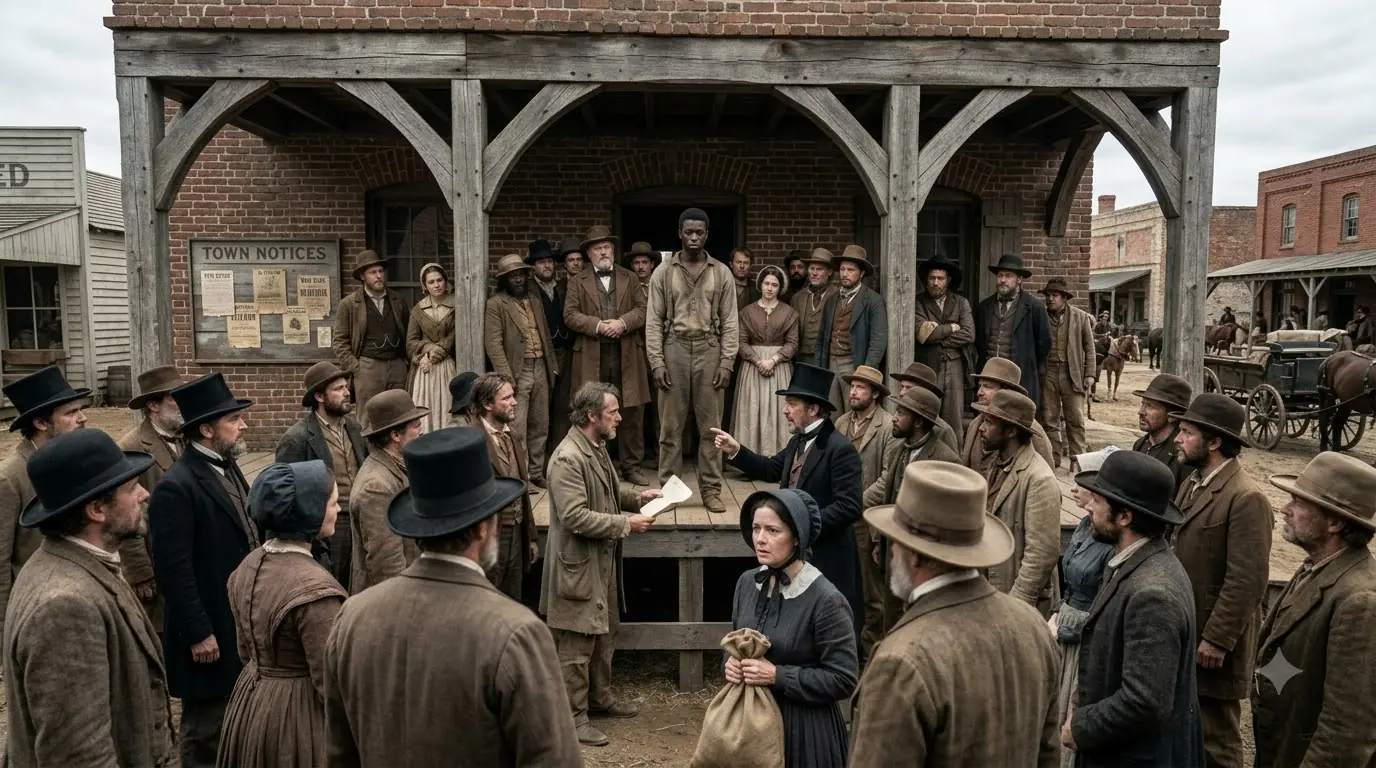
He produced from a strongbox at his feet a folded document that had clearly been meant to disappear entirely. Millicent took it before he could reconsider his generosity and unfolded it enough to see the man's name written in a careful clerk's hand along with a seal she did not recognize but which the merchant beside her confirmed with some authority was genuine. "You're free," Millicent said, turning to the man on the platform feeling suddenly and entirely uncertain what to do with the moment now that she had made it happen. "This says you're free."
"You have been free since the ship. He had no right to sell you at all." The man, Tobias, looked at her for a long moment with an expression Millicent could not immediately read, some complicated mixture of hope too dangerous to fully feel and suspicion too well earned to abandon. "Free to go where?" he said, and his voice carried an accent Millicent had never heard before, English learned somewhere else first, "with no coin, no letter of introduction, in a country where a man who looks like me can be put back on that block by the next man with a rope and a lie, papers or none."
It was a fair question, and Millicent had no immediate answer for it beyond the one that came to her the same way the coins had, quickly before caution could argue her out of it. "Then come to my farm," she said. "40 acres, gone half to seed since my husband died, and I've no one to help me work it properly. I'll pay a wage and give you a room, and you can stay as long as it serves you, and leave whenever it doesn't. That's the whole of what I have to offer, but it's offered honestly."
Tobias studied her for a long moment, the crowd still watching, still murmuring, and Millicent understood, standing there, that she had just done something Willow's Ferry would not soon let either of them forget. "Show me this farm, then," Tobias said finally, stepping down off the block under his own power rather than anyone's hand, "before I decide whether your honesty is worth trusting."
The wagon ride to the farm passed mostly in silence, Tobias sitting rigid on the bench beside Millicent with his small bundle of belongings, everything he owned in the world, Millicent understood, fit into a single cloth sack, held tight against his chest like something that might be taken from him the moment he loosened his grip. "You needn't hold it so tight," Millicent said eventually, when the silence had stretched long enough to feel like its own kind of conversation. "No one's going to take it from you here." "You said that about my freedom, too," Tobias said.
"And yet I've watched three separate men in the last 3 years promised the same and mean none of it." His voice was not accusatory, only flat with the particular exhaustion of someone reciting a fact he had long since stopped being surprised by. "I was born in a trading town on the Windward Coast, son of a merchant who dealt honestly with the Europeans who came through our harbor until a rival of his arranged to have our whole household seized in the night and sold to a slaving crew as revenge for a debt my father never truly owed. The naval officer who freed us off that ship gave us papers and put us ashore in Charleston with promises that America honored British manumission. He was wrong or the men waiting on the dock simply didn't care to be corrected."
"How many times has this happened?" Millicent asked. "Since Charleston?" "Twice before Willow's Ferry," Tobias said.
"Each time someone eventually intervened for reasons of their own, not kindness exactly. A lawyer wanting to make an example, a preacher wanting a testimony for his congregation. Never simply because a person looked at me and decided I was worth the trouble for no other reason than that I was standing in front of them needing help." He looked sideways at Millicent then, something sharp and searching in his expression.
"So forgive me if I don't yet understand why you're any different." Millicent considered the question with the seriousness it deserved, the wagon wheels creaking beneath them over the rutted road.
She said finally, "I paid your fee the same way I might have paid for seed corn quick before I thought better of it. But I've spent 2 years alone on that farm since Warren died doing chores built for two people's hands and if I'm honest, some part of what moved me standing at that block wasn't only your papers. It was recognizing something in your face. I've been wearing myself since the funeral. The look of a person holding himself upright through sheer refusal to fall down in front of an audience that would enjoy watching it."
Something in Tobias's rigid posture eased fractionally at that. Not trust, not yet. But the first loosening of a guard held too long at full tension.