In 1930, in the city of Chicago, Illinois, a Black man stood on the South Side and watched the bottom fall out of the world he had built. He had come to this city from the deep South years before as part of the largest migration in his people's history, chasing a dream that the North had seemed to promise. He had found work in the great factories and stockyards. He had put a few dollars in a bank run by his own people. He had begun, at last, to build something.
And now, in the first full year of the Great Depression, he was watching all of it come apart in his hands. This is the story of that man, the Black worker who survived the Great Depression in Chicago. And it is one of the most important chapters in all of Black American history. Because it is the story of a people who climbed out of the cotton fields, reached for a better life in the northern city, and then were struck harder by the collapse than almost anyone else in America. For many people listening, this is family history.
If your people came up from Mississippi or Alabama or Georgia to Chicago, then this is the story of how they survived the hardest years the country has ever known. The dream that had brought him was real. He had fled the Jim Crow South, the plantation and the lynch rope, and he had come to a city where a Black man could earn a wage, cast a vote, and walk the streets with a measure of freedom the South would never allow. For a while, in the booming 1920s, it had even seemed to be working. The South Side of Chicago had become a Black metropolis, alive with churches and businesses and music.
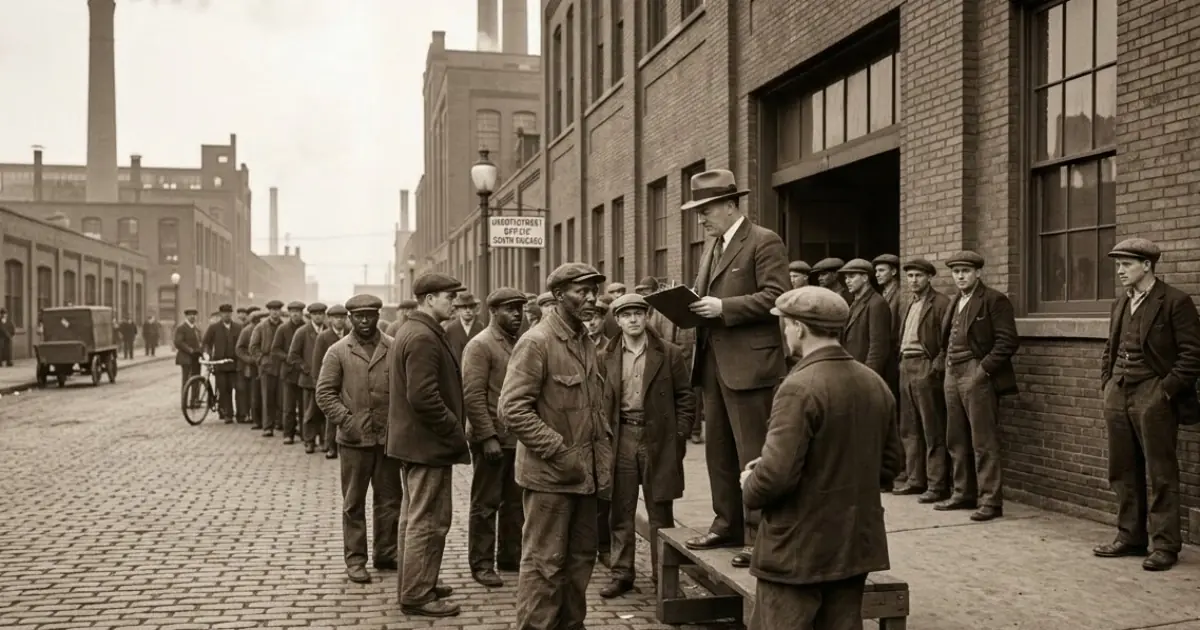
Then came the crash and the dream began to die. Before this story's over, you will hear the questions it must answer. Why was a man who had finally climbed into a good factory job the very first to be thrown out of it when the hard times came?
How could the bank he had trusted with his life savings, a bank built by and for his own people, vanish in a single day in 1930 and take everything with it? And when the police came to throw an old woman's furniture out onto the street, what made the people of the South Side decide they would rather face the guns than let it happen? The answers run through the stockyards and the steel mills of Chicago, through the kitchenette apartments of the Black Belt, through the doors of a failed bank at 35th and State, and onto the sidewalks where the unemployed made their stand. They begin, as so many Black American stories do, with a journey out of the South toward the promise of the North.
Bronzeville, the Black Metropolis.
The Chicago that drew the migrant was a Black city within a white one, and in the 1920s, it was thriving. The white city called it the Black Belt, but the people who lived there gave it grander names. They called it the Black Metropolis, and they called it Bronzeville. And for a generation of Black Southerners, it was the closest thing to a promised land that America had to offer. The growth was staggering.
At the turn of the century, in 1900, Chicago had only about 30,000 Black residents. By 1920, that number had grown to more than 109,000. And by 1930, the year this story begins, the Black population of Chicago had reached nearly 234,000. In three decades, it had grown nearly eightfold. Swelled by the steady stream of migrants riding the trains north out of the Mississippi Delta and the cotton South, they poured into the South Side, into a strip of the city that grew as their numbers grew.
By 1920, Bronzeville stretched from 18th Street down to 39th. By 1930, it had pushed past 63rd Street. A long corridor of Black life running down the spine of the city's South Side. And within that corridor, the migrants built a world. They could not live where the white city lived.
So, they made Bronzeville into something of their own. The streets filled with Black-owned businesses, with barber shops and funeral homes, with restaurants and insurance companies, and newspapers. The great Chicago Defender, the Black newspaper that had helped call the migrants north in the first place, was published here. Churches rose on the corners, storefront congregations and grand stone sanctuaries alike, anchoring the community in faith. Above all, there was the music.
Bronzeville in the 1920s was one of the birthplaces of the sound that would become the soundtrack of Black America. The blues and the jazz that the migrants carried up from the South found a home in the clubs and theaters of the South Side. And the neighborhood pulsed with it. To walk the streets of Bronzeville on a Saturday night in those years was to feel the energy of a people who had come north with nothing and were making something extraordinary. For the migrant worker, this was the proof that the journey had been worth it.
He had a community here. Neighbors who shared his story, a church that knew his name. He could shop in stores owned by Black hands, read a newspaper written by Black writers, and feel for the first time in his life that he was part of a people building their own future rather than merely surviving someone else's design. It was not paradise. The neighborhood was crowded, the housing was poor, and the white city pressed in on every side, but it was theirs.
And in the prosperous years of the 1920s, it seemed to be growing stronger every year. The migrant had reason to believe that he and his children were on their way up. What made that belief possible more than anything was work. The wages that built Bronzeville came from somewhere, and they came from the great engines of Chicago industry, where the migrant had won, for the first time, a real place on the payroll.
The slaughterhouse, the steel, and the trains.
The wages that built Bronzeville came from the hardest work in Chicago. And winning even that work had been a victory. For the Black migrant, getting a foothold in the city's great industries was a recent and hard-won thing. And he held on to it with everything he had. The transformation had happened fast.
As recently as 1910, Black workers had been almost entirely shut out of Chicago's factories. But the labor shortages of the First World War and the flood of migrants willing to take any job changed that. The share of Black men working as laborers in the stockyards, the slaughterhouses, the steel mills, and the building trades of Chicago jumped from just 3.5% in 1910 to nearly 21% by 1920. In a single decade, the Black worker had pushed his way into the industrial heart of the city. The work itself was brutal and dangerous.