At four twenty in the morning, three freight wagons rolled into the Dry Creek railroad depot under a sky that had not yet decided whether it was night or morning. Their wheels rattled over frozen ruts while lanterns swung from the wagon beds, illuminating sacks of flour, crates of onions, barrels of potatoes, smoked meat, and more bread than station foreman Elias Murray had ever seen arrive from one ranch. At the front of the first wagon sat Mara Ellison Hart, wrapped in a dark wool coat with a ledger balanced across her knees. Nine months earlier, almost no one in Dry Creek County had known her name.
By sunrise, the richest merchant in western Wyoming Territory would know it very well. Silas Crowe had spent sixteen years convincing the railroad that no farm, ranch, mill, bakery, or cooperative in the county could replace Crowe Provision & Freight. His money reached storekeepers, freight agents, lenders, and at least one man wearing a sheriff’s badge, which was why ordinary farmers lowered their voices before saying anything unkind about him. Mara had no intention of lowering hers.
Elias Murray walked beneath the depot lamps with two railroad clerks and inspected every wagon. Each sack had been weighed twice, each barrel carried a written count, and every supplier had signed beside her contribution in Mara’s book. He finished the third wagon, looked up at Mara, and said quietly, “If these numbers hold, you have enough to cover the shortage.” Mara answered, “They’ll hold.”
A man beside her tightened both hands around the reins. Caleb Hart was thirty-nine, broad through the shoulders, gray already touching the hair above his ears, and quieter than the Wyoming winter before a storm. He had once believed the stone-covered yard in front of his ranch was nothing more than the strange final project of his dead wife. Now he knew that every wagon behind him existed because that woman had hidden a war beneath those stones.
Caleb looked down the railroad road disappearing into darkness. “Crowe will come,” he said. Mara closed the ledger and tucked it beneath her coat. “I know.” What she did not say was that she had been waiting for him since the day her fingers struck rusted metal beneath his front yard.
That story had begun nine months earlier.
Chapter 2: The Woman From Iowa
Mara Ellison arrived at the Hart ranch on an October afternoon carrying one trunk, two dresses appropriate for church, a winter coat patched at one elbow, and a marriage certificate signed less than six hours earlier in Dry Creek. She was thirty-two, raised on an Iowa farm, competent with numbers, livestock, preserving food, and nearly every household task except pretending helplessness made men comfortable. Two years of drought followed by her father’s death had erased the small inheritance she expected, and by the following spring she was working as a schoolhouse bookkeeper for wages too small to build a future.
Caleb Hart had not advertised for romance. His letter, passed through a church acquaintance, said plainly that he owned eight hundred acres, ran cattle, had been widowed three years, and needed someone capable of managing a household that had gone neglected since his wife died. He offered security, respect, a separate bedroom, and legal rights to household money. Mara wrote back that she was interested provided he did not expect obedience to substitute for conversation.
Their correspondence lasted eleven weeks. Caleb’s letters were brief, practical, and almost aggressively honest, which Mara preferred to poetry from a man she had never met. He told her the roof over the west pantry leaked, the nearest doctor lived sixteen miles away, and his cooking had been described by a hired hand as evidence of personal hostility. Mara told him she was five feet four, disliked unnecessary horses, and would not tolerate drunkenness.
Nothing in those letters prepared her for the yard.
The Hart farmhouse stood on good land beside a shallow creek and a line of cottonwoods, but nearly a quarter acre around the house had been covered in smooth gray and white river stone. The stones had been fitted closely enough that hardly any grass pushed between them, creating a clean, lifeless expanse from the porch to the fence. Mara set down her traveling bag and stared at it.
Caleb came from the barn carrying a saddle over one shoulder. “You must be Mara,” he said. She turned and found a man taller than she expected, weathered from sun, with a face that looked as though smiling required advance planning. Mara introduced herself and then pointed toward the stones.
“What happened to your yard?”
Caleb looked at them.
“Nothing happened.”
“Someone covered excellent planting ground in river rock.”
“Yes.”
“Why?”
His expression changed.
“My wife did it.”
Mara stopped.
Caleb lowered the saddle.
“Ruth died three years ago.”
“I’m sorry.”
He nodded once.
Then he gave Mara the first rule of their marriage.
“The stones stay.”
Chapter 3: One Rule
Caleb showed her the farmhouse before supper. Her room stood across the hallway from his, the pantry contained enough preserved food to survive several months, and a kitchen drawer held household cash along with a notebook listing ranch expenses. Nothing about the arrangement felt romantic, but almost everything felt orderly.
At the front window, Caleb stopped. “I meant what I said outside,” he told her. “You can change curtains, furniture, pantry shelves, whatever you need, but leave the yard alone.” Mara looked through the glass at the stones glowing pale beneath the evening light.
“No garden?”
“Not there.”
“Flowers?”
“No.”
“Even near the porch?”
Caleb’s jaw tightened.
“Ruth built it.”
That ended the conversation.
Mara did not ask whether Ruth had loved stones, hated weeds, or simply possessed an imagination unlike anyone else in Wyoming. Grief made strange architecture inside people, and she had no intention of walking into Caleb’s home and immediately rearranging the monuments he needed to survive. For three weeks, she respected the boundary exactly.
She cooked, repaired the curtains, found six years of arithmetic errors in the ranch accounts, and reorganized the pantry so Caleb no longer stored kerosene beside flour. Caleb left before sunrise most mornings and returned after dark with cold hands and mud on his boots. He was never rude to her, never treated her like hired help, and never entered her room without knocking.
That decency made his silence easier to live with.
It did not make the stones less strange.
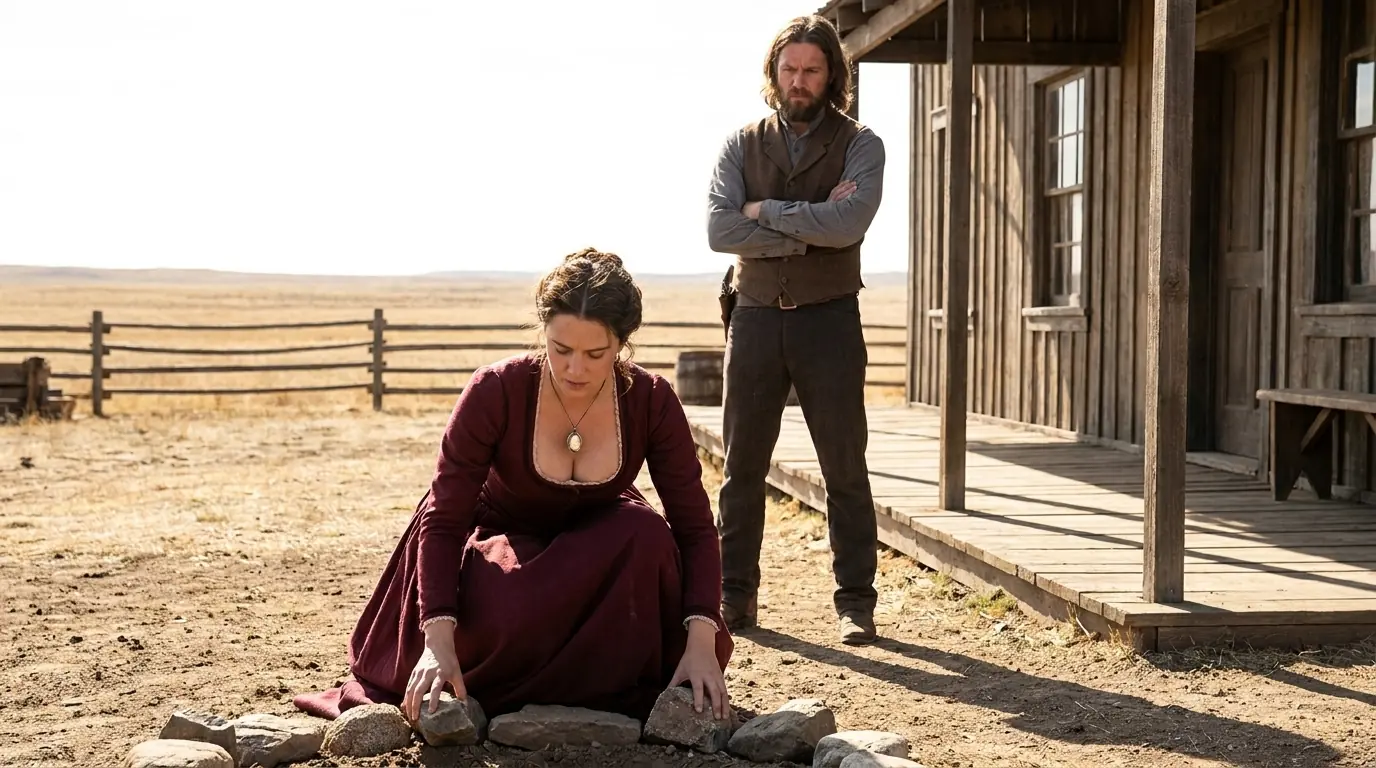
One afternoon, Mara carried a bucket outside and noticed several stones near the side of the porch had shifted after heavy rain. Dark soil showed beneath them. She knelt, moved one stone aside, then another, and pushed two fingers into the earth.
The soil was black.
Not hard prairie dirt.
Rich, damp loam.
Mara rubbed it between her fingers and frowned.
A farm woman knew good ground instinctively.
This was ground people fought to own.
Covering it made no sense.
Chapter 4: The Sound Beneath the Soil
A week later, Caleb found Mara kneeling near the same place. She had not planted anything, but several stones were stacked beside her and a small hand shovel lay on the ground. He stopped halfway across the yard.
“Mara.”
She looked up.
“I didn’t plant.”
“I can see that.”
“I wanted to understand the soil.”
“I asked you to leave it alone.”
“I know.”
Caleb stepped closer.
“Then why aren’t you?”
Mara started to answer, but the edge of her shovel struck something.