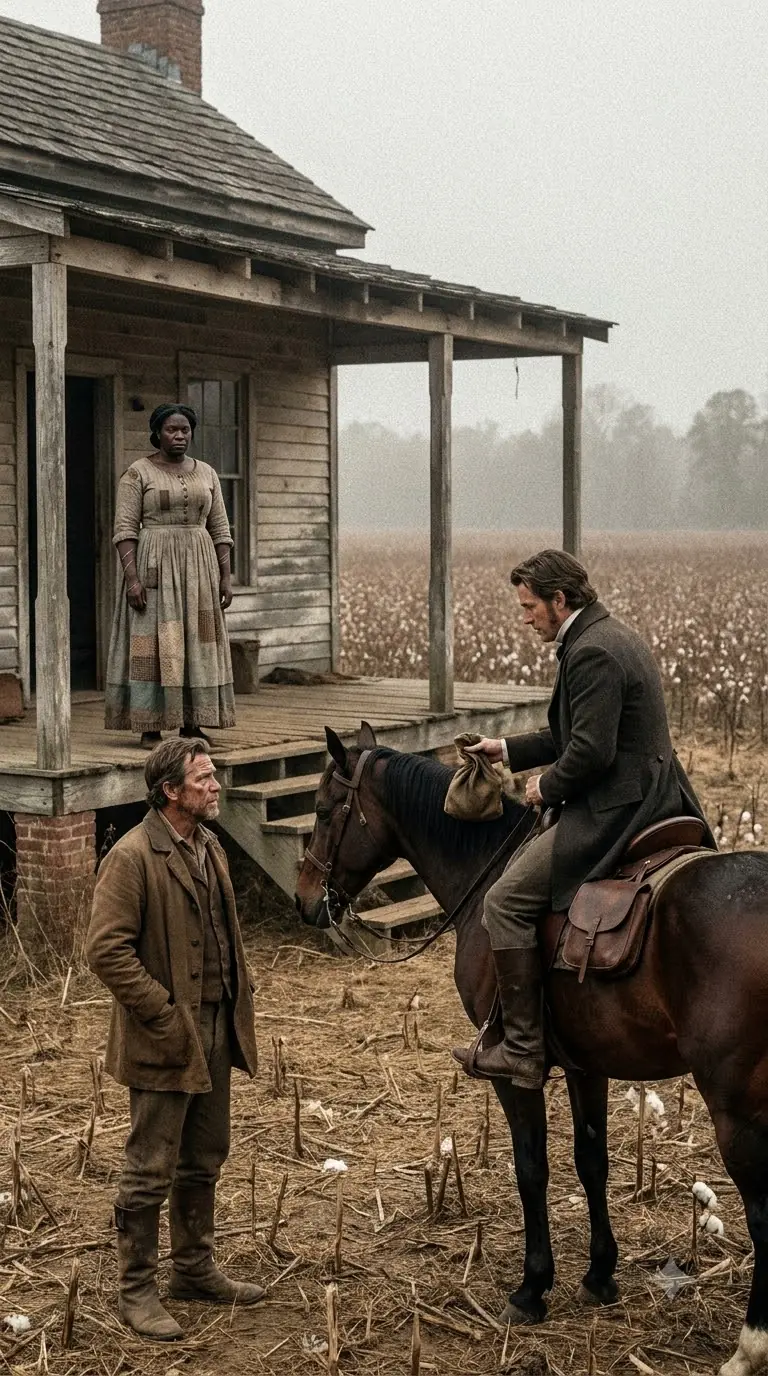
“Heard you made a purchase, Warfield,” he said. “Whole district's talking. $3.” He let the number hang, savoring it. “Now I'll be honest with you, neighbor. A creature like that, that's a working investment, whatever the district says.”
Field hand that does the work of four. I'll give you 200 for her cash money and I'll knock 50 off the note besides. He spread his hands as if offering a gift. You'd be a fool not to take it.
You could pay down what you owe me and buy yourself two ordinary hands who won't frighten the horses. Behind Elias in the doorway of the house, Delphia had gone motionless. He could not see her, but he could feel her there, feel the stillness of her, the particular held breath of a person who has learned that decisions about her life are made by other men over her head, in her hearing, as though she were furniture being haggled over, which in the eyes of the law and of Royce Pettigrew she was. Elias did not turn to look at her.
He kept his eyes level on the mounted man, and said, “She's not for sale.” Pettigrew's smile thinned. “Everything's for sale, Warfield,” he said softly. It's just a question of the price and the pressure. You remember I hold your paper.
He gathered his reins in no hurry. A man who had said what he came to say and knew it would work on the listener like water on stone given time. “Think on it. $200 solves a great many of a man's troubles. Pride solves none of them.” and he turned his fine bay horse and rode away into the dusk, unhurried, and the threat rode away with him and settled over the farm like the first cold of the coming winter.
When Elias finally turned to the doorway, Delphia was gone from it, back into the shadows of the house, and at supper she would not meet his eye, and he understood that Pettigrew's words had landed on her, too, the $200. The plain public reckoning of what she was worth as meat and muscle set against the $3 he had paid. Every number a fresh humiliation dressed up as commerce. That night for the first time Delphia spoke to Elias of her own accord about something other than the work.
She found him on the sagging gallery where he sat with his head in his hands over the ledger and its columns of figures that never balanced. She stood at the foot of the steps. She was tall enough that even so their eyes were nearly level, and she said, “You should have taken his money.” Elias looked up. “No,” he said.
“You don't owe me nothing,” she said. And there was something raw under the roughness now. “You paid $3. That man's offering 200.”
Any sane man takes it. You take it. You save your place, and I go work his ground instead of yours. It's all the same to me.“ ”One master's like the next.“ But even as she said it, Elias saw that it was not all the same to her.”
Saw the way she watched his face for his answer, and he understood that she had said the cruel practical thing precisely to see whether he would agree to it. One more test of the ice. “It's not the same,” Elias said quietly. “Not to me.” He closed the ledger.
I don't know what all's been done to you, Delphia. I can see some of it. I expect I can't imagine the rest, but you came onto this place and you didn't laugh at it the way everybody else does, and you put your back into ground that beat me, and you've been square with me from the first mile of that road. I paid $3 because nobody else would give you the plain decency of a bid.
And I'll be damned before I hand you to a man like Pettigrew for 200 so he can wring you dry and toss you aside. That's not a bargain. That's just a longer way of doing the same wrong they did you in that yard. He stood tired and picked up the lamp.
You've got a bed and a door that latches same as I said good night and he went inside and Delphia stood a long while in the dark yard with the crickets soaring around her and something in the frozen creek of her began very slowly to thaw. Winter closed over Chesterfield District and it was a hard one. The cotton came in thin and poor, barely enough to cover the interest on Pettigrew's note, and Elias sold the last of the good mules and two hogs to make up the difference, riding into town himself to hand the money to Pettigrew's agent, so he would not have to see the man's satisfied face. But if the farm was failing slower now, it was failing slower because of Delphia, and everyone on the place knew it.
She had dug the well 8 feet deeper single-handed, standing in the cold muck at the bottom, and passing up buckets of clay until sweet water welled in where before there had been only silt. She had mended the barn roof, walking the ridge pole with a load of shakes on her shoulder that would have staggered two men. She had done the killing work, the work that had been slowly killing Elias, and she had done it without complaint, and something had shifted in the small, strange household because of it. They had become, without any of them quite saying so, a kind of family, the failing widower, the old man, and the giant woman nobody wanted.
It was a strange household, and it would have scandalized the district had the district troubled to look closely. But the district had written the Warfield place off, and its very failure gave it a kind of privacy. Behind the sagging gallery, out of the world's sight, three people, who had each been discarded in their own way, the widower by fortune, the old man by age, the woman by the auction block, kept each other warm through a hard winter. In the evenings they sat around the kitchen hearth, the only warm room in the drafty house.
And Kato told stories of the old days on the place, of Elias's grandfather, and the year the creek froze solid, and the time a panther took a calf right out of the near pasture, and Elias mended harness, and Delphia sat with her great scarred hand still in her lap, and listened. Sometimes, when the fire burned low, and the talk ran out, the silence in that kitchen was the first easy silence Delphia had known in her life. A silence with no threat in it, no waiting for the blow, just three tired people and the pop of the fire, and the wind shut out beyond the walls. She had begun to talk a little more, not about her past, never about that, but but about the work, about the land, about small things.