On a white-hot afternoon in the summer of 1852, Augustine Peton called every soul on Cedar Hollow Plantation into the yard between the big house and the quarters, and he did it the way he did most things that mattered to him, without warning, without mercy, and without the slightest concern for who might be watching. The Alabama sun sat directly overhead, flattening every shadow into a thin dark line, and the cotton fields beyond the fence rippled white and endless in every direction, as if the whole world had been sewn from the same cloth. Marengo County in those years was the beating heart of what men called the Black Belt, ground so rich and dark it seemed to swallow the light. And Augustine Peton had built his fortune on 1,100 acres of it and on the backs of the 106 people he claimed to own.
Augustine was fifty-one years old that summer, thick through the shoulders going soft in the belly, with mutton chop whiskers gone gray at the edges, and pale eyes the color of creek water in winter. He had married twice, buried one wife, and built a house with white columns that could be seen from the county road a mile off, a house meant to announce to anyone passing that here lived a man of consequence. And on that afternoon, standing on the bottom step of his own front porch with his thumbs hooked into his waistcoat, he intended to make an announcement that had been building in him for twenty-two years. "Bring my daughter out," he said, and the words fell into the yard like a stone into still water.
There was a silence that lasted too long. Then came the creak of wheels over hard-packed dirt, and Dileia, the house servant who had cared for Theodosia Peton since the day she was born, pushed the wheeled chair around the side of the house and into the sun. Theodosia sat with her spine straight as a fence post, her hands folded in her lap, her dark hair pinned back so severely that not a strand dared move in the small hot wind. She was twenty-two years old, and her legs had never once carried her a single step in her life.
The chair itself was crude, built of ashwood by a plantation carpenter a decade earlier. Its iron-rimmed wheels groaned with every turn, and Theodosia occupied it the way a queen occupies a throne she never asked for, and has long since stopped resenting, because resentment, she had learned, was a luxury reserved for people whose suffering someone still cared to notice. Doctors from as far as Mobile and Montgomery had examined her as a child, and none of them could explain why her legs had simply never obeyed her. Her mother, Cordelia Peton, had died in the birthing bed, hemorrhaging until there was nothing left to save, and Augustine had never said aloud what he believed in the darkest part of himself, that his wife's life had been spent to purchase a daughter who could not even stand.
But he thought it every single day, and the thought had curdled inside him for two decades, until it hardened into something closer to disgust than grief. "This girl," Augustine said, gesturing at Theodosia the way a man gestures at a mule he is done arguing with, "has cost me twenty-two years of doctors and nursemaids and chairs and patience. She will not marry. No man of standing in this county will have her, and I have stopped pretending otherwise."
"I am done carrying that weight." Theodosia did not flinch. Behind her, Dileia's knuckles went pale where she gripped the chair's handles. Somewhere in the crowd, a child began to cry and was hushed immediately. "Titus," Augustine called.
The man who stepped forward from the cluster of field hands was not a man anyone in that yard could pretend not to notice. He stood nearly six and a half feet tall, a height that in those years bordered on the impossible, and fifteen years of unbroken labor had built him into something the overseers liked to show off to visiting planters, as proof of what Cedar Hollow's soil and discipline could produce in a man. His shoulders were wide as a doorframe, his forearms roped with muscle from years at the cotton scales and the timber saw, and his face—with high cheekbones, a jaw set like poured iron, and eyes so dark and still that very few people claimed to have ever read anything in them—gave away nothing. He had been brought to Cedar Hollow at thirteen years old, purchased off a coffle out of Savannah, along with four other boys, and in the years since, no one on the place had ever heard him complain or beg or weep.
That silence made him more dangerous in Jared Kums's eyes, and more of a mystery in everyone else's. "You are the strongest hand I own," Augustine told him. "The most useful. I've given you privileges other men here don't get, and now I'm going to give you something more." Titus waited, his expression unmoved.
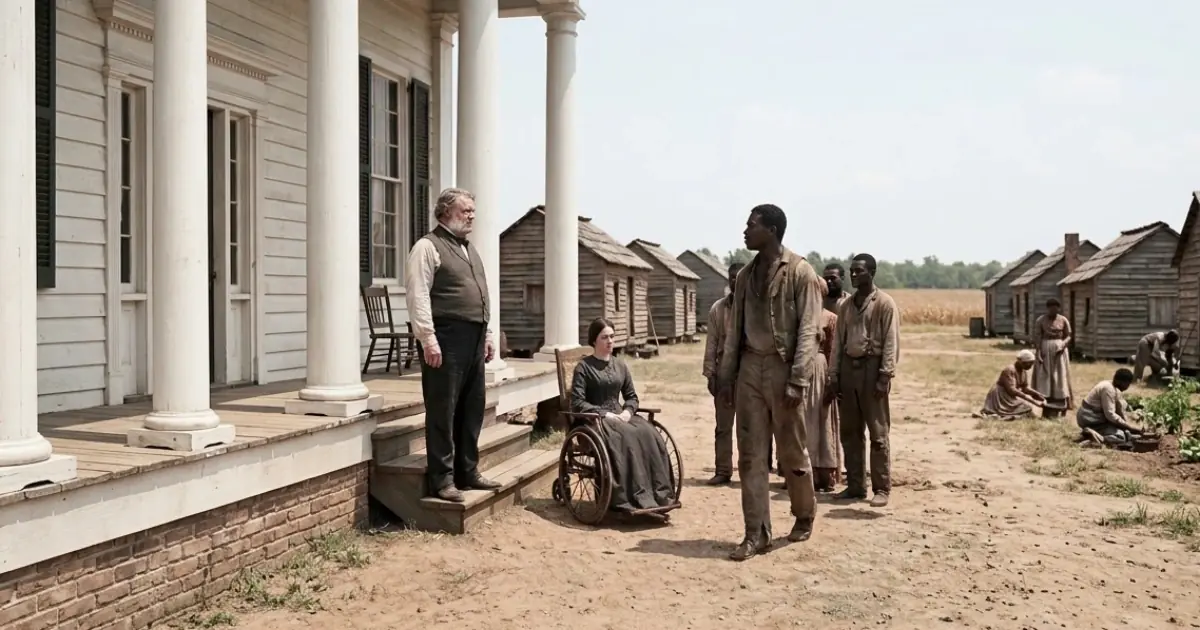
"I'm giving you this woman. She's yours now. Feed her, carry her, do with her whatever you please. She is no longer my concern."
The whole yard held its breath. Nobody spoke. The enslaved men and women stared at the ground. The few white hands exchanged uneasy glances.
Jared Kums, the overseer, stood near the west corner of the porch with his hat pushed back, and something like pleasure moved across his thin mouth. The particular pleasure of a small man watching someone else be made smaller. Theodosia, for the first time in the whole scene, turned her head toward her father, just for a moment, just long enough to look at him with eyes that were not crying, because Theodosia Peton had not cried in front of another living soul since she was nine years old. She had learned instead to simply record what was done to her, to file it away in some cold locked room in her chest, and to bury the person who had done it a little deeper each time.
Then she faced forward again toward the fields, toward nothing in particular. Titus looked at her. She looked at him. Neither said a word.
"Everyone's dismissed," Augustine said, and turned back toward the house without waiting to see what happened next, because to him nothing that happened next could possibly matter. What happened after was not what anyone in that yard expected. Titus did not seize her, did not carry her off against her will, and did not speak a single word about ownership or rights. Instead, once the yard had emptied and only the two of them remained—Theodosia in her chair, Dileia hovering a few feet back with her hands twisting in her apron, and Titus standing a careful distance away—it was he who spoke first, quietly, with the same enormous calm he seemed to carry into everything.
"Where do you want to go?" Theodosia looked at him as though the question might be a trap. "What do you mean, where do I want to go? To the women's quarters, I suppose, wherever you're told to put me." "I asked you, not him."
Dileia looked at Titus with something between confusion and what might have been gratitude, if she had not still been so frightened. Theodosia took a long moment to answer.
She was not a woman who usually needed time. Her answers came fast and sharp, honed over years into the only weapon a woman in her position was permitted to carry. But this question unsettled her, because no one had ever asked it of her so plainly. Without pity and without mockery folded into it.
"Put me wherever suits you," she said finally, her voice flat. "I don't have choices." "You do," Titus said. "There's always something to choose, even inside what you're given."