The master's widow looked at the saddest slave, then said the only words he could not walk away from. The coffin was closed, but Caroline Whitfield's eyes were not on the coffin. They were on the man at the edge of the crowd, the one everyone said had killed her husband. She should have hated him and she should have wept, but instead, standing in mourning black with the whole plantation watching, she stepped past the grave, past her father-in-law's glare, and said the one thing no one expected: "Uncage him."
They buried Elias Whitfield on a gray Tuesday morning, and not one person on Cotton Hollow wept for him. Not the house servants who still bore the marks of his temper, not the field hands who had watched him ride down a boy for walking too slowly behind the wagon, and not even, if she was honest with herself in the small locked room of her own heart, his widow. Caroline stood at the graveside in unrelieved black, the veil doing its work of hiding a face that refused to arrange itself into grief. Her father-in-law, Josiah Whitfield, stood rigid beside her, his jaw working like a man chewing on something bitter.
Behind them, in a loose half circle kept at a respectful distance by old habit and older fear, the enslaved people of Cotton Hollow watched the pine box go into the ground with expressions carefully wiped clean of anything the overseer might read as satisfaction. Caroline understood that discipline. She had spent three years learning to read the plantation the way its people had been forced to learn to read her husband, watching for the flicker of a jaw, the set of a shoulder, and the difference between a silence that meant nothing and a silence that meant everything. It was in that watching that her eyes had found Gideon.
He stood near the back, wrists bound in front of him with rope that had rubbed the skin raw, flanked by two of Elias's men as though he might bolt for the tree line at any moment. Anyone who knew Gideon knew he would do no such thing. He held himself the way he always did, spine straight, chin level, eyes fixed on some middle distance that gave nothing away. Only she seemed to notice how his bound hands had gone white-knuckled, or how his gaze slid once, briefly, to the coffin and then away as though he could not bear to look at it directly.
The sheriff would come for him tomorrow. Everyone knew it. Elias Whitfield had been found dead behind the smokehouse three nights earlier, fatally injured against the stone foundation, and Gideon had been the last man seen near that building before the alarm went up. That was all the proof the overseer, Mr. Hale, required, and all Cotton Hollow seemed to require: a dead master, a convenient suspect, and a rope already being measured in the minds of men who had wanted an excuse for years.
"A mercy, really," Josiah murmured to Caroline as the first shovel of dirt struck the coffin lid. "That we know who did it. Spares us the unpleasantness of wondering." Caroline said nothing. She had learned, in three years of marriage to his son, the value of saying nothing at the right moments.
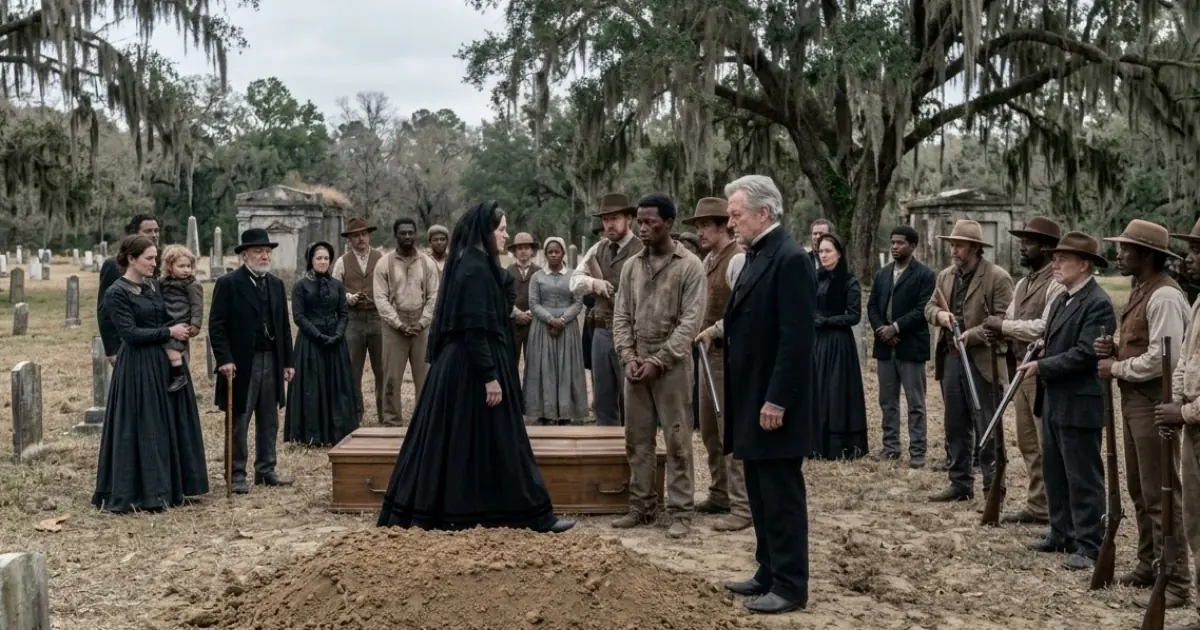
She had not loved Elias. She would not insult herself or her God by claiming otherwise now that he was safely under six feet of Carolina clay. He had married her for her father's four hundred acres and stayed for the pleasure of ruling them, and in three years he had taught her more about the ordinary, unremarkable, breakfast-table cruelty of a man who considered other human beings tools than she had learned in twenty years of trying not to see it. But she had not killed him, and watching Gideon stand there in chains, jaw tight, refusing to give his accusers the satisfaction of visible fear, she found she did not believe he had killed him either.
She could not have said then exactly why. She only knew that in three years of watching this plantation the way a prisoner studies the walls of her own cell, she had watched Gideon too. She had noticed, the way one notices a lamp left burning in a dark house, that he was not what the ledger said he was. He had a field hand's calloused, sure hands, but there was a stillness and watchfulness in him that had nothing to do with fear and everything to do with thought.
Months earlier, she had caught him with a scrap of newspaper folded small in his palm, his eyes moving across it in a way that had nothing to do with pretending to read. She had said nothing then either. Now, as the mourners began drifting back toward their wagons, she heard herself say, "Bring him to the house." Her voice came out steadier than she felt, cutting clean through the low murmur.
Mr. Hale turned, startled. "Ma'am?"
"You heard me." Caroline lifted her veil back from her face, because some announcements deserved to be made without cloth between her and the people hearing them. "He is not going to the sheriff. Not today."
"Mrs. Whitfield." Josiah's voice dropped into the low warning register he used on his dogs and, she had noticed, on her. "The man murdered my son."
"The man is accused of a crime no one witnessed," Caroline said, "against a body that hasn't been properly examined by anyone but Mr. Hale, who found it convenient to stop looking the moment he had a suspect. I am the mistress of this house until the court says otherwise, and I say he stays here. Under guard, if you insist on it, but here."
The silence that followed had weight. Caroline could feel Josiah's fury radiating off him like heat from a stove, and she could feel forty pairs of eyes, black and white alike, recalculating everything they thought they knew about the widow Whitfield. She could also feel Gideon's eyes on her for the first time since the shovels had started their work. His expression was not grateful, not yet, but more careful than that: the look of a man who had learned at terrible cost that a white woman's mercy could be its own kind of trap.
She would have to prove him wrong about that. She was not yet certain how. "Take him to the old overseer's cabin," she said before her nerve could fail her, "and see that he's fed." The old overseer's cabin sat at the edge of the yard, unused since Hale had moved into the better quarters Elias had built him two summers earlier.
It had one window, a bolt on the outside of the door, and a dirt floor that stayed cool even in August. Caroline had it swept out before anyone else was awake to ask why, and left a blanket folded on the cot as though that single act of decency might answer the questions she could not yet bring herself to ask aloud. She did not go to Gideon that first night or the second. It was not fear that kept her away, though she told herself that would have been reason enough.
What kept returning instead was the memory of a spring afternoon eight months before Elias died, a memory she had turned over so many times in the dark of her room that its edges had gone smooth as river stone. She had gone looking for Gideon about a torn harness strap, some errand that had long since stopped mattering, and found him behind the tack shed with a book open on his knee. It was not a hymnal or the alphabet primer some kinder mistresses smuggled to children before their husbands found out and put a stop to it. It was a real book, its spine cracked with reading and its pages soft at the corners.