This was the life of an elderly Black man in Detroit in 1972. In 1972 in the city of Detroit, Michigan, an old Black man sat in a city he no longer recognized. A city he had helped to build with his own two hands. He was past 65 now.
His back bent and his hands scarred from a lifetime of labor. And he had seen more history than almost anyone around him. He had come to Detroit as a young man half a century before. And the story of his life was, in many ways, the story of Black America in the 20th century.
This is the story of that man, the elderly Black worker of Detroit. And it is one of the most sweeping chapters in all of Black American history because he lived through almost all of it. For many people listening, this is not a stranger. This may be your grandfather or your great uncle or the old man who sat on the porch down the street when you were a child. If your family came to Detroit for the auto plants, this is the story of the generation that made the journey.
He had been born in the Jim Crow South, most likely in Alabama or Georgia or Mississippi in the first years of the 20th century. He had grown up under the shadow of the plantation and the lynch rope. And as a young man, he had joined the greatest internal migration in American history. It was the movement of millions of Black southerners to the cities of the North. Detroit, with its roaring auto plants, had been his promised land.
For 50 years, he had given that city everything he had. And now, in his old age, he watched it come apart. Before this story is over, you will hear the questions his long life answers. Why did the same company that hired him when almost no other employer in the city would then send him into a furnace so hot and so dangerous that white men refused to work there? Why was the vibrant Black neighborhood where he raised his children, a place full of churches and music and life, wiped off the map and buried beneath the highway?
And how, in the northern city he had crossed half a country to reach, believing he was escaping the violence of the South, did the police come to kill more Black people in a single year than had died in the city's worst riot? The answers run from the cotton fields of the South to the foundry floor at Ford, from the music halls of Paradise Valley to the rubble left by the bulldozers, and through the fires and the gunfire of a city in crisis. They begin with the promise that drew him north, a promise measured in $5 a day.
The $5 Promise to the South.
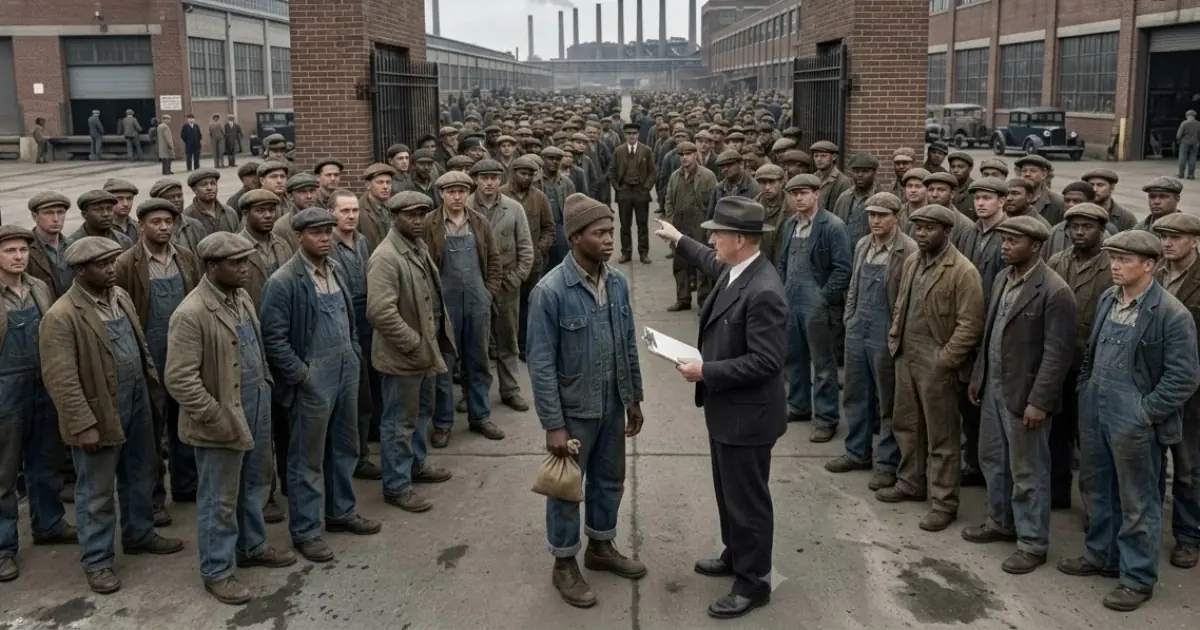
The promise that pulled the young man out of the South and into Detroit could be stated in a single number, $5 a day. In an age when a Black sharecropper in the South might work a whole year and end up owing money to the plantation, the idea of earning $5 for a single day of work was almost beyond belief. It was the sound of a different life. And it drew Black southerners to Detroit by the hundreds of thousands.
The movement was the Great Migration. It was a vast exodus that between roughly 1910 and 1920 saw nearly half a million Black southerners leave the farms and towns of the South for the industrial North, in what would become a 50-year migration of millions. They were fleeing the social and political oppression of the Jim Crow South, the peonage and the violence, and they were chasing the wages of the booming northern factories. Detroit, with its automobile industry and its war plants, was one of the great destinations.
But the auto industry did not welcome them at first. For all its hunger for labor, the industry largely refused to hire Black men. As late as 1920, only five of the 67 auto plants in the city of Detroit would hire Black workers at all. The doors of the great factories were, for the most part, closed to the very migrants who had come so far to reach them. One company was the exception, and it changed everything.
The Ford Motor Company, under its founder Henry Ford, opened its gates to Black workers when its competitors would not. Ford recruited Black men in part through his personal relationships with the leading Black ministers of Detroit, who sent their congregants to him. By 1920, Ford employed more than 1,600 Black workers, and it had become the largest employer of Black labor in the entire city. It held that distinction throughout the 1920s and '30s. The effect on Black Detroit was profound.
By 1920, around 80% of the city's Black working men were employed in the auto industry and related mechanical trades. The factory had become the foundation of Black life in Detroit, the engine that powered the churches, the businesses, and the neighborhoods of the migrant community. The $5 day and the work behind it was the reason the city's Black population was exploding. For the young man fresh from the South, getting hired at Ford was a triumph.
He had escaped the cotton field. He had a steady wage, paid in real money, for the first time in his life. He could send for his family, rent a room, walk into a store with cash in his pocket. After the powerlessness of the South, the simple dignity of a paycheck felt like freedom itself. But the promise had a catch, and he would discover it the moment he was told where in the great plant he would actually work.
The doors that Ford had opened led, for most Black men, to a single part of the factory. The hottest, most dangerous, and most punishing part of all. They led to the foundry.