On Monday, July 31, 2023, police officers and child-welfare workers gathered outside an ordinary rental home on Metro Court in Racine, Wisconsin. The call had begun with an unusual report from the landlord, who said she had gone into the property to replace carbon-monoxide detectors and discovered several young children in the basement. The basement door had appeared to be locked or jammed, and when she forced her way through, she said she found five or possibly six children inside with no adult immediately supervising them. Before anyone entered the home, the responding team had to decide whether the report justified forcing entry if the people inside refused to open the door.
One worker summarized what they had been told. The landlord had first visited the day before and noticed two young women, roughly nineteen or twenty years old, who were not on the lease. When she tried to reach the basement, one of the women reportedly told her that a family was living down there, which confused the landlord enough that she backed away and left. The next day, she returned with her son and the replacement detectors, found the basement door inaccessible again, and forced it open. Behind it, she said, were several children, including an infant, and none of the adults gave her a clear explanation before she left and called for help.
The officers immediately began discussing the legal problem in front of them. If no one answered the door, did the information they had justify a breach, or did they need the landlord physically present before taking that step? One officer said the locked basement and the report of multiple unsupervised children were serious enough that a supervisor needed to be contacted. Another pointed out that the young adults might already have taken the children and left, meaning officers could force a door only to discover an empty house. For the moment, they chose to slow down, verify who was supposed to live there, and wait for additional information.
The situation became more confusing as they checked names and vehicles connected to the property. One vehicle appeared to be associated with a person who was in jail, even though someone had apparently told officials that he was simply out of town. There were questions about whether he had a young daughter and whether she might also be living at the house. The lease information did not match the number of people reportedly staying there, and nobody yet knew which adults were responsible for the children in the basement. The more the team compared notes, the less the household made sense.
Then the landlord arrived and gave her account directly. She said she had already been to the house twice and had seen people living there who were not listed on the lease. During the second visit, she needed access to the basement to deal with the detectors and had to pry or force the door enough to get downstairs. She described finding only little children there, from very young babies to children she estimated were around seven or eight years old, with no adult in the basement at that moment. Two adults, she said, had been outside near a white vehicle.
That firsthand account changed the officers' posture. The landlord had a key, and the front door itself was not functioning normally, so there was no need for a dramatic forced entry. Officers announced themselves as police and said they were there to check the welfare of the children. A young woman appeared near the top of the stairs, and they asked her to put on a shirt and come down to speak with them. She seemed immediately confused about why the police were there.
An officer explained that they had received a report involving children in the basement and needed to make sure those children were safe. The woman initially tried to redirect the conversation, saying they should speak to the children's mother. When officers asked for her own name and identification first, she became defensive and insisted that the matter had nothing to do with her. The officers repeatedly told her that if the children were safe, the welfare check should be simple. They still needed to identify every adult inside the residence and understand who lived where.
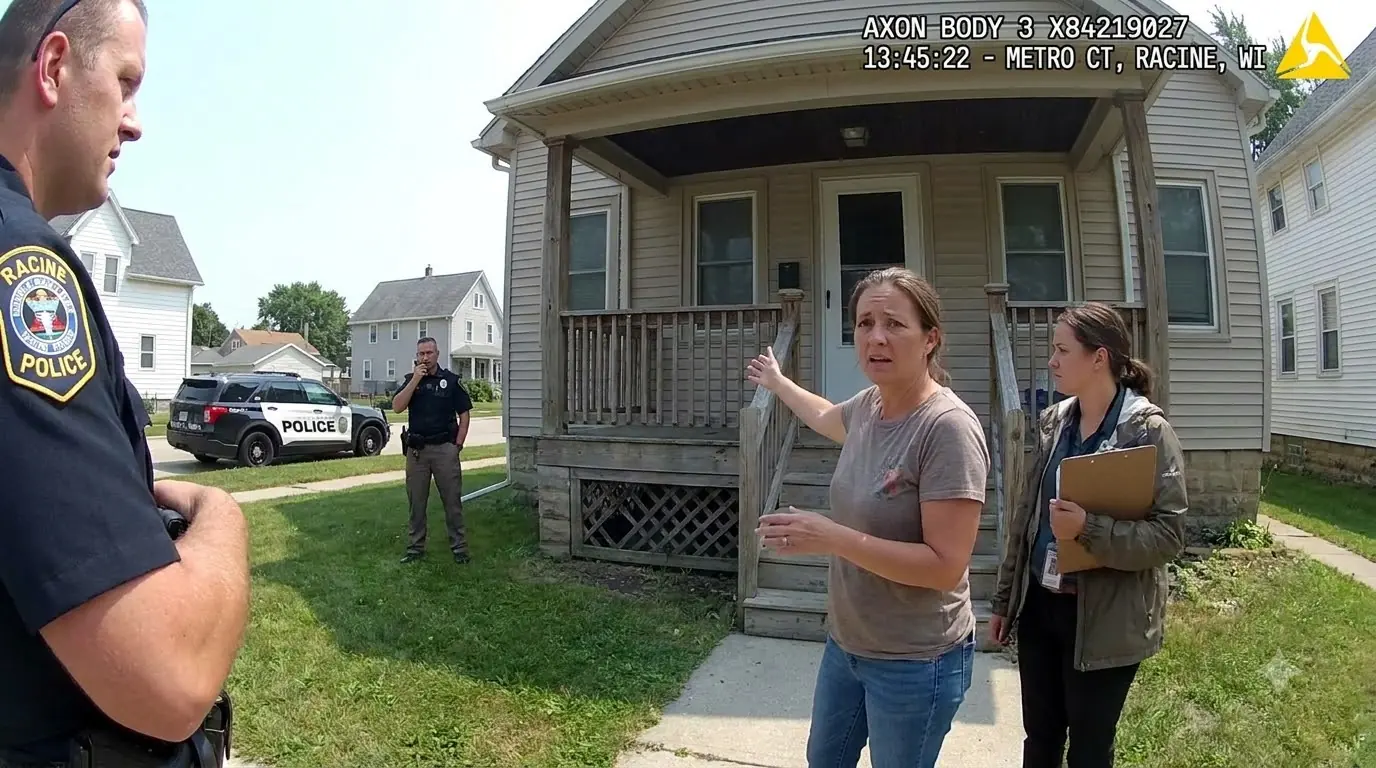
Another woman appeared, equally frustrated by the police presence. She said the adults were family members visiting because an uncle had died and accused the landlord of creating unnecessary problems. Officers again explained that they were not there because of a landlord dispute; they had been called about children reportedly confined or left unsupervised in a basement. The woman talked over them, saying the landlord was focusing on the wrong things and making a private family situation into something larger. The officers kept returning to the same point: they needed to see the children.
Eventually, the woman identified as the children's mother began speaking with police. She was identified as 34-year-old Turner. She said all of the children were hers and that she was only staying at the property temporarily. When asked for identification, she first said it was in a vehicle belonging to her boyfriend, then hesitated when asked what that vehicle looked like and where the boyfriend was. She eventually gave the boyfriend's name as Laquan Russell.
Turner said she had been at the house for only a short time, roughly fifteen days, and insisted that she was almost always with the children. She said they were not being left alone and suggested that whoever called authorities had misunderstood the situation. Officers explained that the concern was specific: the basement had reportedly been locked, children had been found there without an adult, and Human Services needed access to determine whether they were safe. Turner continued repeating that she was always there, as if the presence of a parent by itself should end the inquiry.
One officer tried to lower the temperature. He told Turner that, at that point, he did not know whether she was in any trouble at all. His role was to make sure the social workers could do their job and to document who he had spoken with. He was not yet accusing her of anything. That reassurance seemed to calm the conversation briefly, and Turner produced a card with her name after first saying she did not have identification available.
A Racine County child-protective-services worker then introduced herself and began asking basic questions about the family. Turner said she had five children. She described the oldest as approaching fifteen, two school-age children around seven and eight, and two much younger children, one around a year old and another around two. The worker asked to go from oldest to youngest and spell each child's first name so the agency could verify who was present.