The guilt Thomas felt about the circumstances of Henry's conception began to fade. Buried under the daily reality of raising a child who felt like his own, he taught Henry to ride, to recognize good horse flesh, to understand the basics of cotton cultivation. He read to him from agricultural journals and family histories, preparing him to eventually inherit Bellere and continue the Bowmont legacy. And if late at night Thomas sometimes remembered how Henry had actually come to exist, he pushed those thoughts away with practiced determination, focusing instead on the future he was building.
Eleanor watched Henry's relationship with Thomas with complex emotions. She was relieved that Thomas loved the boy, that her plan had secured not just an heir, but apparently a genuine family structure. But she also felt a strange possessiveness, a sense that Henry was hers in ways Thomas couldn't fully understand. She had conceived the plan, arranged every detail, ensured its success through willpower and calculated ruthlessness.
Henry's existence was her achievement. Her victory over the biological limitations that had threatened to destroy her position. Thomas might believe he was Henry's father, might play that role convincingly, but Eleanor knew the truth. Henry was the child of her determination, her willingness to do what others found unthinkable.
The enslaved community at Bellere watched Henry's childhood with carefully hidden knowledge. They knew what the white family refused to acknowledge. They recognized Marcus' features in the boy's face, saw the resemblance in his gestures and expressions. They understood that Henry was one of them, stolen and raised as white, taught to believe he was superior to the very people whose blood ran in his veins.
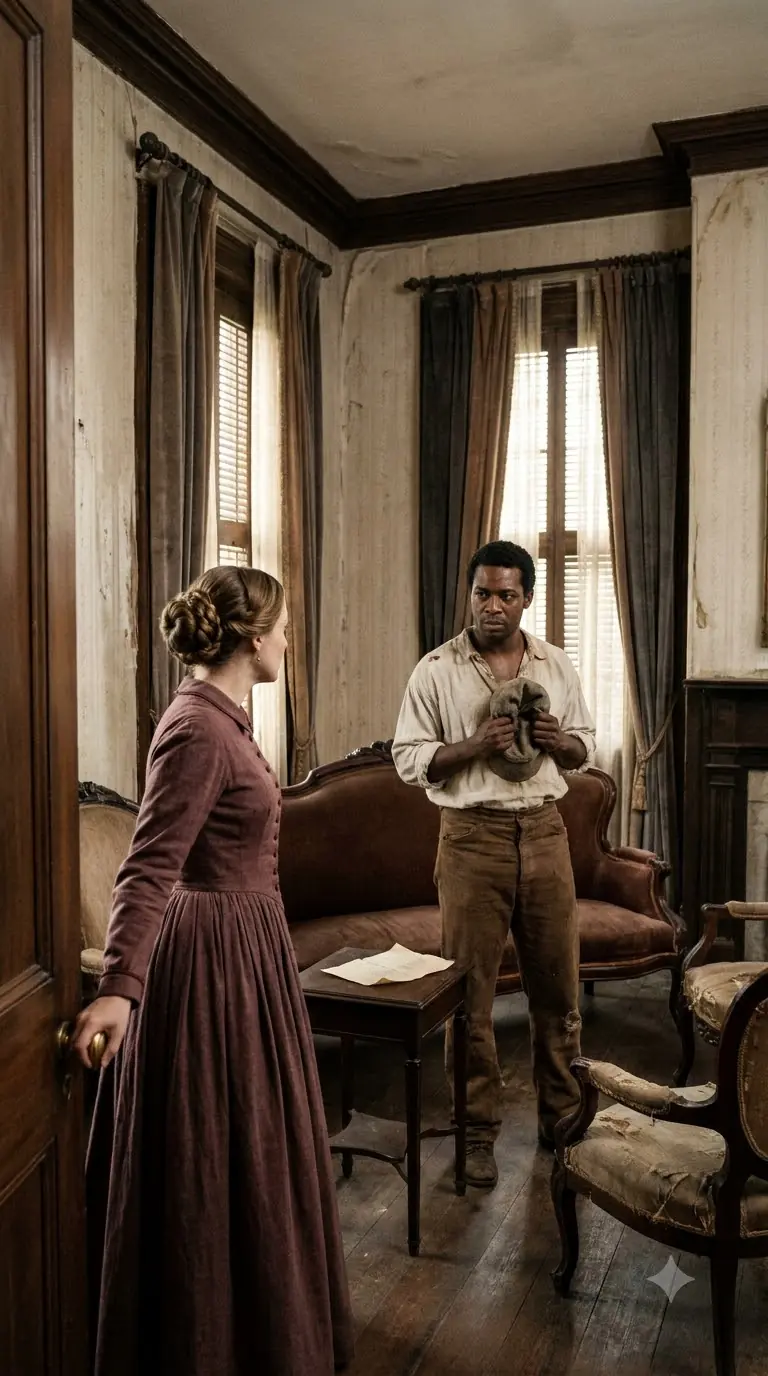
Some felt anger at the deception, at the cruelty of raising a black child to become a master of enslaved people. Others felt profound sadness for Marcus, forced to watch his son grow up, calling another man father. And many felt a complex mixture of both, recognizing the tragedy while understanding the impossibility of any different outcome. Marcus himself had aged years in the months following Henry's birth.
He worked with mechanical efficiency, fulfilling his duties, but showing none of the pride or engagement he'd once brought to his carpentry. His mother watched him with a breaking heart, seeing her son being consumed by grief and rage he couldn't express. She tried to talk to him to offer what comfort she could, but Marcus had retreated to a place beyond words. He had been violated, used, and then forced to witness the ongoing consequences of that violation as his child was raised to despise everything Marcus was.
There was no framework, no philosophy, no faith that could make such a situation bearable. He simply endured it because enslaved people had no choice but to endure. By the time Henry turned 12, he had grown into a boy who showed every sign of becoming exactly what Eleanor and Thomas had tried to create. A refined young gentleman prepared to inherit one of Louisiana's finest plantations.
He was tall for his age, athletic, and confident, educated by private tutors in Latin, mathematics, literature, and history. He could ride as well as any adult, shoot accurately, and discuss cotton prices and cultivation techniques with impressive sophistication. He moved through Bellere with the easy authority of someone who had never doubted his place in the world, never questioned his right to command, never imagined he might be anything other than what he appeared to be. But cracks were beginning to show in the elaborate fiction.
Eleanor noticed them first, small inconsistencies that most people would overlook, but that filled her with creeping dread. Henry's skin had darkened slightly as he spent more time outdoors, taking on a golden brown tone that was just ambiguous enough to be explained, but noticeable enough to occasionally prompt questions. His hair, which had seemed merely wavy as a child, had developed more pronounced curl as he aged, requiring pomade and careful grooming to maintain acceptable appearance. And his features, while still individually attributable to European ancestry, had collectively begun to suggest something more complex, a mixture that observant eyes might recognize if they looked too closely or questioned too seriously.
More concerning were Henry's emerging personality traits. He showed an uncomfortable empathy for the enslaved people at Bellere, asking questions about their lives and treatment that made both Eleanor and Thomas uneasy. He had befriended several of the enslaved children who worked around the main house, treating them with a familiarity that violated proper social boundaries. When Thomas punished slaves for infractions, Henry sometimes protested the severity, arguing for mercy in ways that seemed to Thomas dangerously soft.
Eleanor worried that these tendencies suggested something deeper, some instinctive recognition of kinship that Henry couldn't consciously articulate, but that manifested in his behavior. The real crisis began in the summer of 1863 when Henry was 15 years old and the war between the states had transformed everything about plantation life. Federal forces were advancing through Louisiana and Bellere existed in a state of anxious uncertainty. Thomas had aged badly over the previous year, the stress of protecting the plantation from both Union troops and Confederate requisitions weighing heavily on him.
His health was failing, his drinking had increased, and the careful control he'd once maintained over every aspect of Bellere was slipping. It was in this atmosphere of crisis and uncertainty that Henry stumbled across the first real evidence of his true origins. The discovery came not through any deliberate investigation, but through simple chance, the kind of accident that Eleanor had spent 15 years trying to prevent. Thomas had taken ill in late July, confined to bed with what the doctor called nervous exhaustion, but what everyone recognized as the combined effects of alcohol and overwhelming stress.
Eleanor spent most of her time nursing him, leaving Henry to manage much of the daily plantation operations under the overseer's guidance. One afternoon, searching Thomas's study for documents related to a cotton shipment, Henry found a locked drawer in his father's desk. The lock was old and poorly maintained, and Henry had watched Thomas open it enough times to understand the mechanism. He told himself he was looking for business papers, that he had legitimate reasons to access whatever his father kept secured. But even as he worked the lock open, he felt the guilty thrill of transgression, the sense that he was about to discover something he wasn't meant to know.
Inside the drawer were personal papers, letters, and documents that had nothing to do with plantation business. Henry almost closed it immediately, respecting his father's privacy. But one envelope caught his attention. It was addressed to Thomas in a woman's handwriting, postmarked from New Orleans, dated March 1848, just months before Henry's birth.
The letter inside was from the midwife Josephine, and its contents made Henry's hands begin to shake. The letter was carefully worded, oblique in its references, but its meaning was clear enough to someone reading with attention. Josephine acknowledged receipt of final payment for her services. She confirmed that she would maintain complete discretion regarding the unusual circumstances of the birth.
She noted that the arrangement had been successfully concluded and that all parties should feel secure that their privacy was protected. She included a reminder that certain aspects of the situation, if revealed, would be damaging to all involved and reassured Thomas that her financial interest in silence was permanent. Henry read the letter three times, his mind trying to construct innocent explanations for phrases that seemed to resist innocent interpretation. What unusual circumstances?