Some hills keep what walks into them. That is an old way of saying it, and it is the way the men who lived up in those hollows like to say it, because it did the work of a long sentence in six short words. It did not matter whether you believed in anything past the front porch, whether you were a man of the church or a man of the still, whether you carried a Winchester or a Ballard or nothing at all. If the hollow wanted you, the hollow took you, and it did not have to hurry about it. This one is from the Boston Mountains up in the Ozarks, western Arkansas.
The fall of 1932. Two men went up. Neither one of them came all the way back down the same. And the reason we still have any of it in any form is because on the third day before the third night, they came out onto a piece of land where nobody thought anybody still lived. And the men who lived there knew before either of them spoke a word exactly what had followed them out of the hollow.
The one you would call the older of the two was named Orin Thol. 42 years old that autumn, a timber cruiser out of a company town in Johnson County, Arkansas, which meant he walked the ridges for a living, marking hardwoods for the saw, tall, narrow in the shoulder, with a face that had been out in weather for so long it had gone the color of a good pipe. His hands were the hands of a man who had used an axe for 25 years, and a bolt action for near as long. He did not talk much when he was inside a house, and he talked a good deal when he was out of one. His people were from up in the mountains originally, French on one side, Cherokee on his mother's mother's side, and he had that older Ozark habit of listening before he answered, so that people who did not know him took him for slow.
He was not. The younger one was named Pel Ketaring, 36 that fall. He kept a small farm on Ketaring Ridge, land his family had held since the 1850s, which was long enough in that country to make you the oldest thing on a road. Broad through the chest, sandy-haired, missing the tip of his left index finger from a saw he should not have been standing that close to when he was younger. He was a good hunter, the kind who could read a track two days old and tell you the weight of the animal and whether it was hurt.
He and Orin had known each other going on 20 years, and they had gone up into the hills together every fall since Pel was old enough to marry, which was to say nine seasons running. They knew each other's silences. That is the important part. They knew what to say about each other's silences and what not to.
They set out on a Sunday, late October, late in the second week of the season, when the leaves had already turned and half fallen, so that the country you were looking at was less a woods than a floor. Their plan was six days in a place called Slate Fork Hollow up in Newton County on the western slope of Boston Mountain on a piece of ground that Orin had cruised for the company two summers earlier and had marked in his notebook as good deer country and no people. That last part mattered. There was a settlement road that ran up to within about four miles of the head of the hollow, and past that it was foot traffic and mule and nothing else. Pel had a mule for the packs.
Orin had a Winchester Model 1894 in .30-30 and a canvas cruiser bag and the kind of boots you bought once in your life. They took coffee, meal, salt, pork, matches in two tins in case one got wet, a lantern with a spare wick, a hatchet, a whetstone, 30 rounds of ammunition, and a small brown bottle of quinine bitters that Pel's wife had made him take because her father had died of malaria at Vicksburg, and she had never made her peace with anybody walking into low ground without something on his hip. That last detail is one Orin wrote down years later in a letter to a man trying to make sense of what happened. He said the bitters were the only thing he took out of that hollow that he could look at without his hand shaking and that he kept the empty bottle on a shelf until he died. They rode up the settlement road on the Sunday afternoon and made camp that evening at the foot of the hollow on a bench of ground above a fork of the creek where the water ran clean over slate.
That is how it got the name Slate Fork. The rock ran up out of the stream bed in flat blue gray pieces, some of them long as a barn door, so that in places the water did not sound like water. It sounded like a hand stroking dry leather. They ate salt pork and cornbread that Pel's wife had wrapped in a cloth, drank coffee out of tin cups, and Orin rolled a cigarette, and sat looking up the hollow while the light went. He said later he did not feel anything wrong that first night.
He said the woods looked right, the smell was right, the sound of the creek was right, the animals were where they ought to be. A raccoon came down to the water about an hour before full dark. An owl on the far ridge starting up as soon as the sun cleared the mountain. The only odd thing he said, and he only remembered it later, was that the mule would not stand facing up the hollow. The mule stood facing back down toward the road, and when Pel tried to turn her, she turned her head, but not her feet. Pel laughed about it and said the mule was tired and knew where the corn crib was.
And that was Sunday.
On Monday morning they went up. They went up the North Fork first, moving quiet, working the ridges Orin had marked, and they did not see a deer, not a track, not a rub, not a bed. They saw squirrels, but the squirrels were quiet in the tops of the trees and did not come down. They saw a hawk turn over the ridge once and then not again. About noon they came into a stand of white oak on a bench about a mile above the camp, and Pel knelt down to look at the mast, the acorns on the ground.
And he was still for a long time. And then he stood up and looked at Orin and said in the low voice men use when they do not want to be heard by anything, that there was not a mark on any of them. Not a squirrel bite, not a deer print in the leaves around them, not the little hollow chewed hulls that a wild turkey leaves, just acorns on the ground the way somebody had spilled them out of a sack. Everything that ate in that woods had walked past that stand of oak and left it alone. Orin said nothing to that.
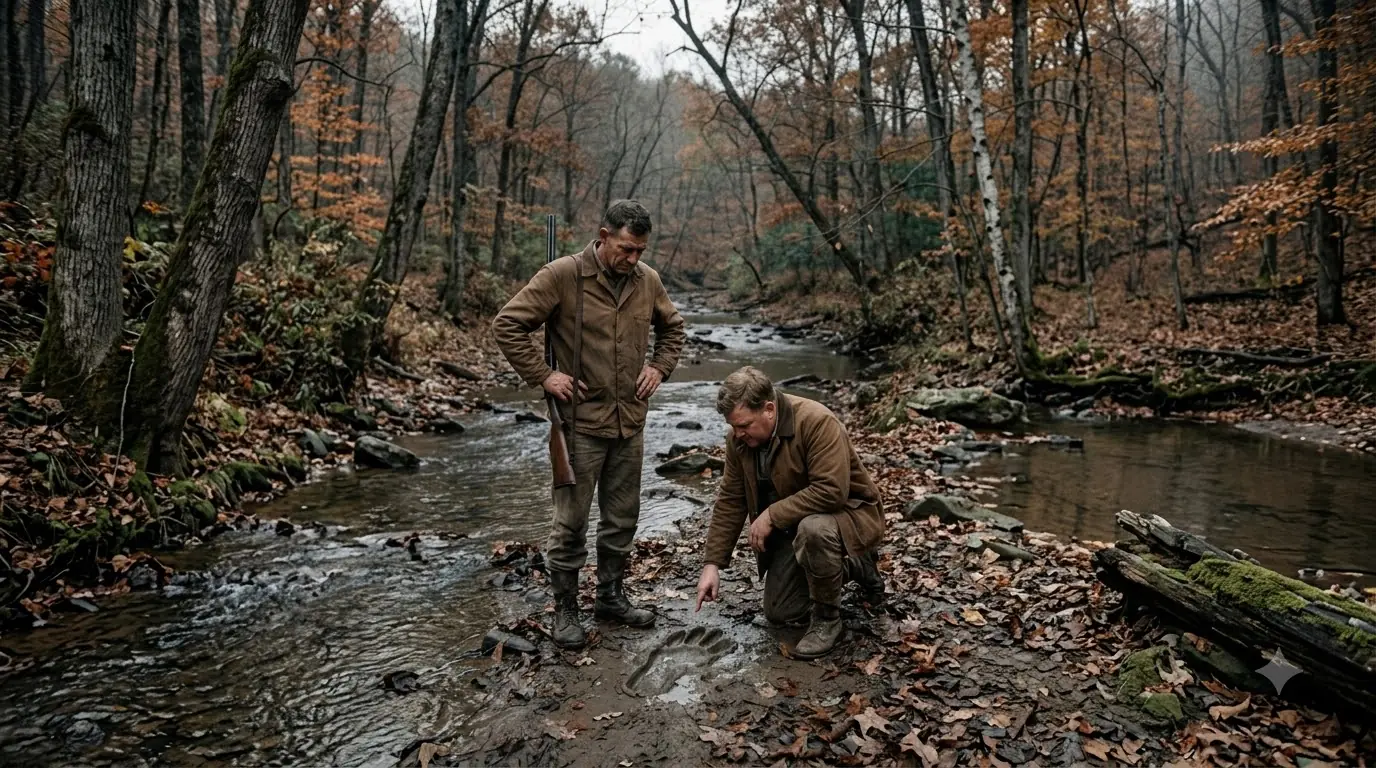
He looked at the ridge above them for a while. Then he said, "Quiet. Let us work back." They worked back down toward camp the long way along the east side of the hollow, and about an hour before dark, they came onto a track in a soft place near the creek. Pel knelt to it.
He was that kind of hunter. You could not walk him past a track without him kneeling. And after a minute, Orin, who had been watching the ridge, felt Pel go still in a way he knew, and turned. The track was a two-footed track, Pel said, meaning something on two feet. Not a bear standing up; a standing bear leaves a mark at the back of the pad where it sets its weight.
And this had no such mark, not a man in boots, no heel, no seam, not a man barefoot either, because it was too long, and the toes were wrong. Pel counted the toes twice. He said he counted them twice because the first time he thought he had miscounted. He said, and Orin wrote this down almost word for word later, that whatever had made that track had four toes on each foot, and the toes were long, and the print sank deeper at the ball than it did at the heel, so that whatever had made it walked forward on its weight in a way a man does not. Orin asked, "How old?"
Pel put the flat of his hand on the mud beside it. He said, "This morning, maybe before sunup." Orin stood there in the fading light and did the thing hunters do without knowing they are doing it, which is he counted his rounds by touch. And then he said out loud, "Let us not be out here after dark."