In the winter of 1897, a nun named Sister Agnes Morrow sat down in a candlelit room inside a convent in the Welsh countryside and began to write. She had been silent for more than a decade. More than a decade of nightmares. More than a decade of watching shadows move in corners that should have been empty. More than a decade of hearing a voice that did not belong to any living person she had ever met.
What she wrote over the following 6 weeks filled four leather-bound journals. 112 pages of testimony, observation, confession, and a detailed account of something that happened inside a place called Bleakwater Hospital for the incurably insane. A place that, by the time she sat down to write, had already been abandoned for 3 years. A place the local council had quietly purchased, boarded shut, and attempted to erase from public record. The journals were discovered in 1971 by a doctoral student named Callum Pritchard inside a trunk in the basement of a decommissioned convent outside Abergavenny.
Most of what Sister Agnes described was dismissed immediately. Hallucination, they said. Religious hysteria. The ravings of a woman who had spent too many years tending to the mad and had become one of them. But Pritchard didn't dismiss it.
He spent 7 years cross-referencing her account with municipal death records, coroner's reports, patient intake logs that had survived a fire in 1903, and the personal letters of two physicians who had worked at Bleakwater during the same period Sister Agnes described. What he found didn't explain everything, but it confirmed enough to make the rest of it terrifying. This is that story. Bleakwater was reached by a cart track that wound through a valley so narrow and overgrown that, according to one account from the 1880s, a man on horseback could not see the sky for the better part of an hour.
Construction began in 1861 under a physician named Dr. Harold Ness. He was not well known. He had published two papers on inherited madness, both ignored by the London establishment. But he had something better than reputation. He had money.
His wife Eleanor came from Welsh coal wealth. And when her father died in 1858, she inherited the equivalent of roughly 12 million pounds in today's currency. Dr. Ness used a significant portion of that inheritance to purchase 300 acres of land in one of the most remote and inaccessible parts of Southern Wales. The original plans show a facility designed for approximately 120 patients. But the design was unusual.
The wards were not arranged in the typical radial pattern favored by Victorian asylum architects. Instead, Ness designed the hospital as a series of concentric rings. The outermost ring contained the staff quarters, the kitchens, the chapel, and the administrative offices. The second ring contained the general wards. The third ring, which was smaller and accessible only through two locked iron doors, contained what the plans labeled the observation chambers.
And at the center of all three rings, like the pupil of an enormous stone eye, was a single corridor with six rooms on each side, 12 rooms in total. There were no windows. The walls were lined with a material the plans describe only as acoustic-dampening panels. The doors were made of oak reinforced with iron banding. Each room measured exactly 8 feet by 8 feet by 8 feet.
A perfect cube. This was the isolation wing. The official purpose of the isolation wing, according to the hospital's charter filed with the lunacy commission in 1862, was the temporary segregation of patients presenting behaviors dangerous to themselves or to others for a period not exceeding 72 hours. 72 hours, remember that number. Because when Sister Agnes arrived at Bleakwater in the autumn of 1883, there was a patient in the isolation wing who had been there for over 2 years.
He was 9 years old.
Bleakwater opened its doors in the spring of 1863 with 27 patients transferred from the county asylum at Abergavenny. Within 2 years, it was at capacity. Within 5 years, there was a waiting list. And within a decade, Dr. Harold Ness had established a reputation not among the academic elite, but among a very specific subset of wealthy families across England and Wales. Families who had a particular kind of problem, the kind of problem they did not want anyone to know about.
Because Bleakwater specialized in something that most Victorian asylums refused to touch. Children. Specifically, children of prominent families who exhibited behaviors that could not be explained, could not be controlled, and most importantly, could not be made public. The Victorians had a term for this. They called it moral insanity.
A child who appeared physically healthy, intellectually capable, and in full possession of their faculties, but who did things that defied every standard of civilized behavior. Violence without provocation. Speech that bordered on the obscene. An apparent absence of conscience, empathy, or fear. Children who hurt animals, children who set fires, children who said things that made grown adults leave the room.
These were the children who arrived at Bleakwater in covered carriages, often at night, accompanied by family solicitors who carried documents already signed. Those documents stipulated that no record of the child's existence would ever leave the institution. No letters, no visits, no inquiries. The child simply ceased to exist. By 1880, the patient population at Bleakwater had shifted dramatically from its original charter.
The adult patients, the ones who had been transferred from the county asylum, were still there. But they now occupied less than a third of the available beds. The rest were children, some as young as four, most between the ages of six and 14, and nearly all of them had arrived under the same conditions. Covered carriage, night arrival, signed documents, no return address. The Lunacy Commission visited exactly three times between 1863 and 1894.
Each visit was announced weeks in advance. Each lasted less than a single day. Each report described a clean, well-managed facility with patients in good health and reasonable spirits. What the commissioners never saw was the isolation wing.
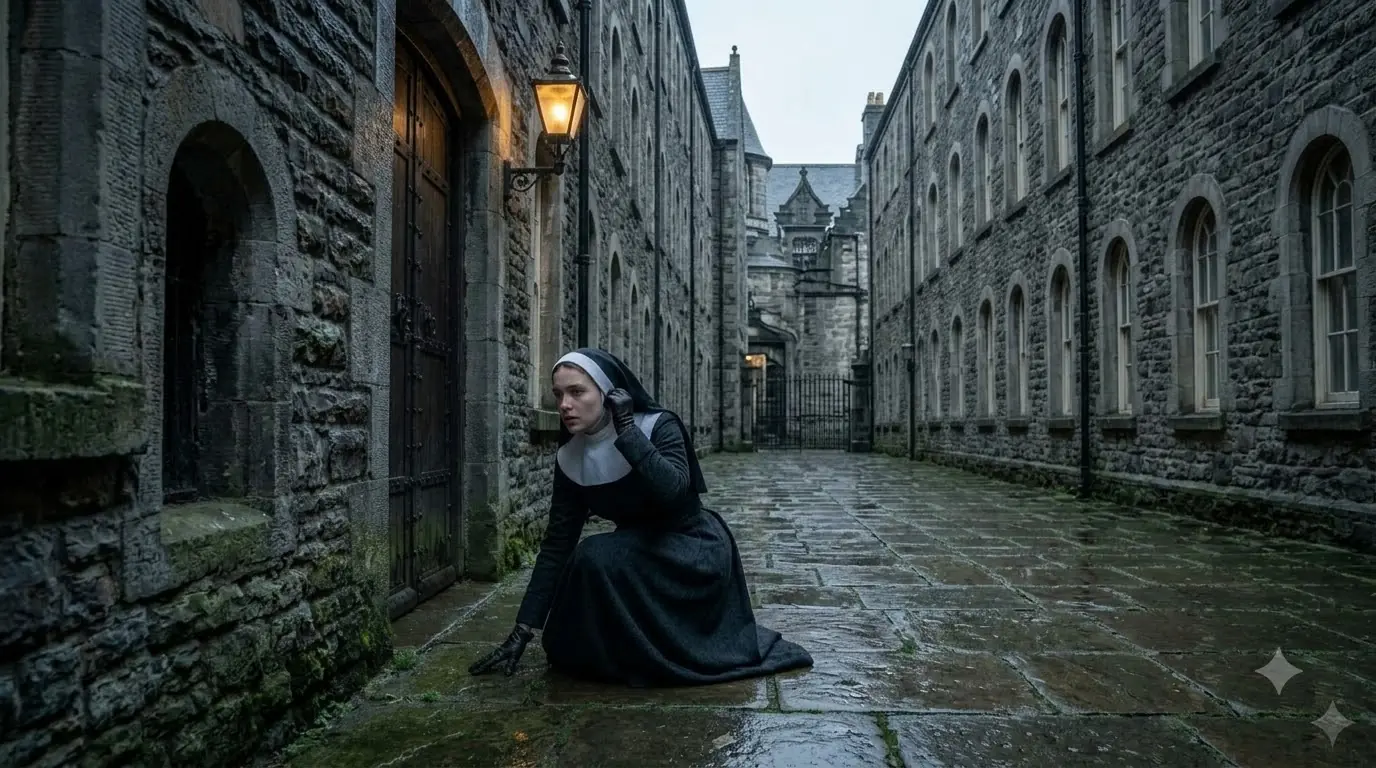
Sister Agnes Morrow was 26 years old when she arrived at Bleakwater in October of 1883. She belonged to a nursing order called the Sisters of Perpetual Mercy, a small congregation based in Hereford that supplied nurses to hospitals, workhouses, and asylums throughout Wales and the West Country. The order had a contract with Bleakwater dating back to 1867, and at any given time four to six sisters were stationed at the hospital. Agnes was the youngest of the group. She had taken her vows only 2 years earlier, and Bleakwater was her first long-term assignment.
In her journal, she describes the day she arrived with a kind of disbelief that even decades later had not entirely faded. She wrote that the cart ride from the nearest village took almost 3 hours. The driver, an old man who worked for the hospital, did not speak a single word the entire journey. When they finally emerged from the valley and the hospital came into view on the plateau above them, she felt, and these are her exact words, as though the ground itself was reluctant to carry us any closer. The building was enormous, gray stone quarried from the surrounding hillside, so it seemed to grow out of the landscape rather than sit upon it.
The windows were narrow and deep-set like the arrow slits of a medieval fortress. The roof was slate, black and wet, and the chimneys, she counted 14 of them, released thin threads of smoke that the wind scattered before they could rise more than a few feet. There were no gardens, no lawn, no trees within 100 yards of the outer wall, just raw rock and low scrub, and beyond the plateau's edge, the valley dropping away into mist. She was met by the hospital's matron, a woman she identifies only as Mrs. Crane, tall, thin, with the manner of someone who has already decided you are a disappointment. Crane showed her to a small room in the staff wing with a narrow bed, a wooden chair, and a window overlooking the inner courtyard, stone paved, completely enclosed by the hospital's walls.