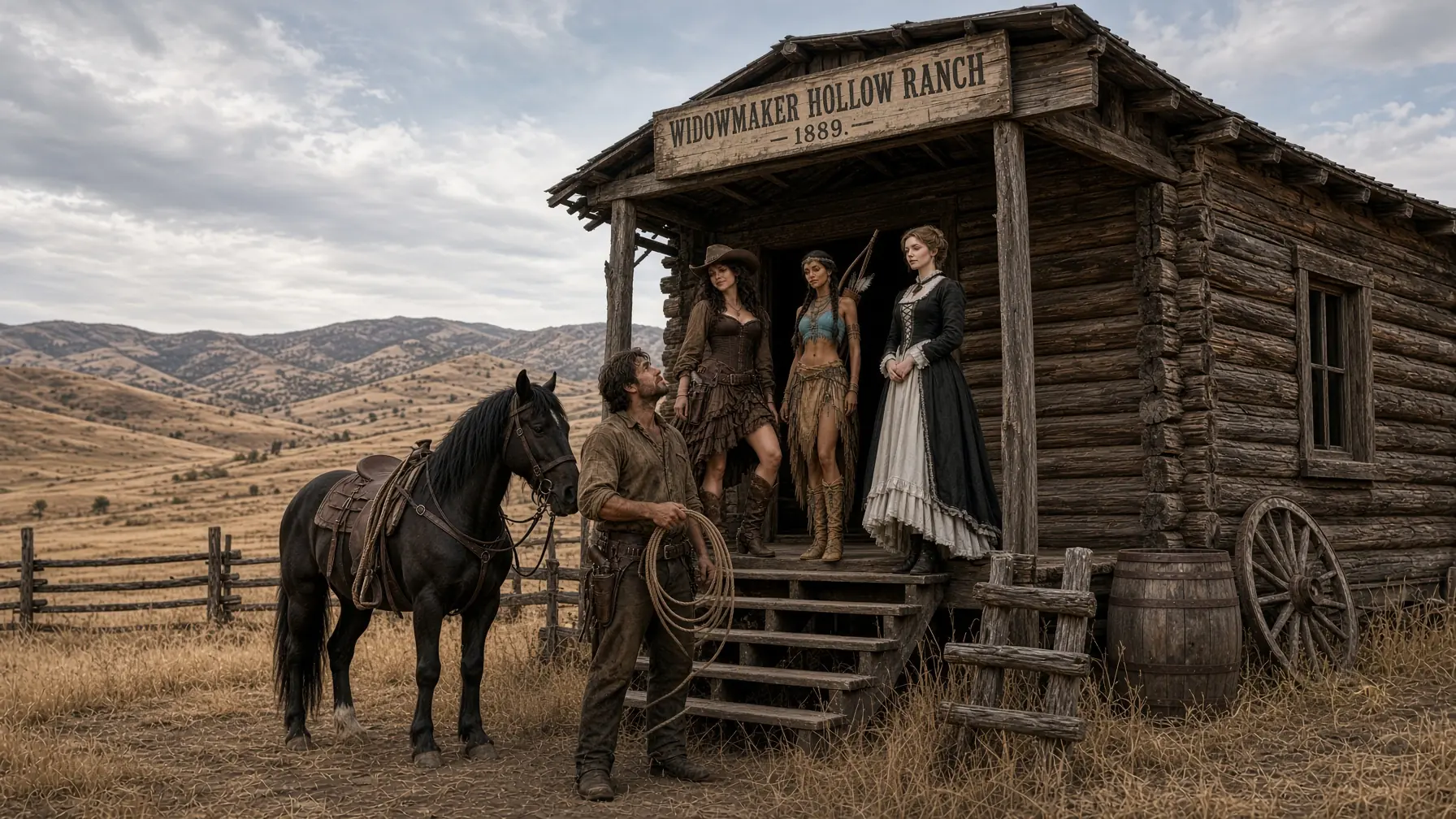
Wyoming Territory, 1889.
For sixteen years, Nathan Cole had measured his life in cattle trails, river crossings, broken wagon wheels, and the number of days between towns. He had slept beneath snow-heavy blankets, fought off thieves along the Platte, survived a stampede that buried four men beneath frightened cattle, and once spent three days trapped inside a line shack while a spring flood carried half the valley away. At thirty-nine, there was very little left in the West that frightened him.
Except the thought of growing old beside another campfire with nobody waiting for him when he came home.
Nathan had never planned on becoming a ranch owner. Cowboys like him usually talked about buying land the way thirsty men talked about oceans—something beautiful to imagine, but too far away to matter. Yet after his last cattle drive, he counted the money in his saddlebag and realized he had enough to stop moving if he was willing to live somewhere nobody else wanted. That was when he heard about Widowmaker Hollow.
The ranch sat in a remote valley west of the Wind River Range, nearly two days from the nearest proper town. It included a log house, barn, corrals, several hundred acres of grazing country, and water rights to a spring that apparently never froze completely, even in the worst winters. The asking price was so low Nathan assumed someone had made a mistake.
The banker in Laramie told him nobody had.
“You don't want that place,” Horace Bell said.
Nathan sat across from him in a cramped office smelling of tobacco and ink. “That usually means somebody else wants it cheaper.”
Horace did not smile.
“I mean exactly what I said.”
Nathan leaned back in the chair. “Bad soil?”
“No.”
“Water?”
“Plenty.”
“Indians?”
Horace shook his head.
“Then what's wrong with it?”
For a few seconds, the banker stared at the deed lying between them.
“People don't stay.”
Nathan waited.
Horace lowered his voice.
“They buy it, they settle in, and then they leave. Some leave in the middle of the night. Some never come back to town at all.”
Nathan almost laughed.
“Coyotes don't usually frighten grown men that badly.”
“I'm not talking about coyotes.”
Nathan smiled.
“Ghosts?”
Horace pushed the deed toward him.
“I stopped laughing about that valley twenty years ago.”
Nathan looked at the price again.
It was less than he had paid for forty-seven Texas steers the previous spring.
“I'll take it.”
Horace kept one hand on the paper.
“You sure?”
Nathan pulled the deed toward himself.
“No.”
The banker frowned.
Nathan tucked the document into his coat.
“But I'm tired enough of the road to find out.”
He reached Widowmaker Hollow six days later.
The valley opened unexpectedly between two towering walls of dark stone, broad enough for pastureland but narrow enough that the mountains seemed to lean over it. Pine forests climbed the northern slopes while the southern hills rolled into grassland pale from autumn frost. At the center stood the ranch house, larger than Nathan expected and built from thick lodgepole pine logs blackened by fifty years of weather.
The barn leaned slightly but looked salvageable.
The windmill had frozen in place.
Several corrals stood empty behind the house, their gates hanging crooked.
Nothing about it looked cursed.
It looked neglected.
Nathan preferred neglected things.
Neglect could be repaired.
He spent the afternoon carrying supplies inside, inspecting the roof, checking the barn floor, and turning his gelding, Whiskey, into a small paddock near the house. Someone had left old tools in the shed and several pieces of furniture inside the cabin. There was even a cast-iron stove that worked after Nathan cleared three dead birds from the chimney.
By sunset, he had beans cooking over the fire.
A lantern burned beside the window.
For the first time in years, Nathan ate supper inside a house he owned.
He sat at the rough kitchen table listening to the wind move through the valley and wondered why anyone would abandon the place.
At midnight, Whiskey screamed.
Nathan was awake before he understood what had pulled him from sleep.
The horse screamed again.
Not a whinny.
Not the sharp warning sound of a spooked animal.
It was a desperate, high, tearing sound Nathan had heard only when horses smelled something they believed could kill them.
He grabbed his rifle from beside the bed.
The lantern was still burning low.
Nathan stepped onto the porch barefoot, the cold hitting him hard enough to make his teeth clench.
“Easy, boy.”
Whiskey stood pressed against the far side of the paddock.
His eyes were wide.
Steam poured from his nostrils.
Nathan followed the horse's stare.
Three shadows stood beyond the fence.
At first he thought they were riders.
Then one moved forward.
Nathan stopped breathing.
She was a woman.
But she was unlike any woman Nathan had ever seen.
She stood close to eight feet tall, with shoulders wider than most cavalrymen and long black hair braided down her back. Heavy buckskin covered her body beneath a dark wool cloak decorated with faded beadwork. A necklace of carved bone and turquoise hung across her chest.
Two more women stood behind her.
One was slightly shorter and powerfully built, with two long braids and a scar running from beneath her left eye toward her jaw. The youngest appeared perhaps twenty-five, though Nathan had no idea whether ordinary age meant anything when looking at someone nearly seven and a half feet tall.
All three watched him calmly.
Nathan raised the rifle.
The tallest woman did not react.