No one was ever supposed to know this. Not really. The story was buried under a hundred years of silence, then another hundred of shame. It was hidden for over two centuries until now.
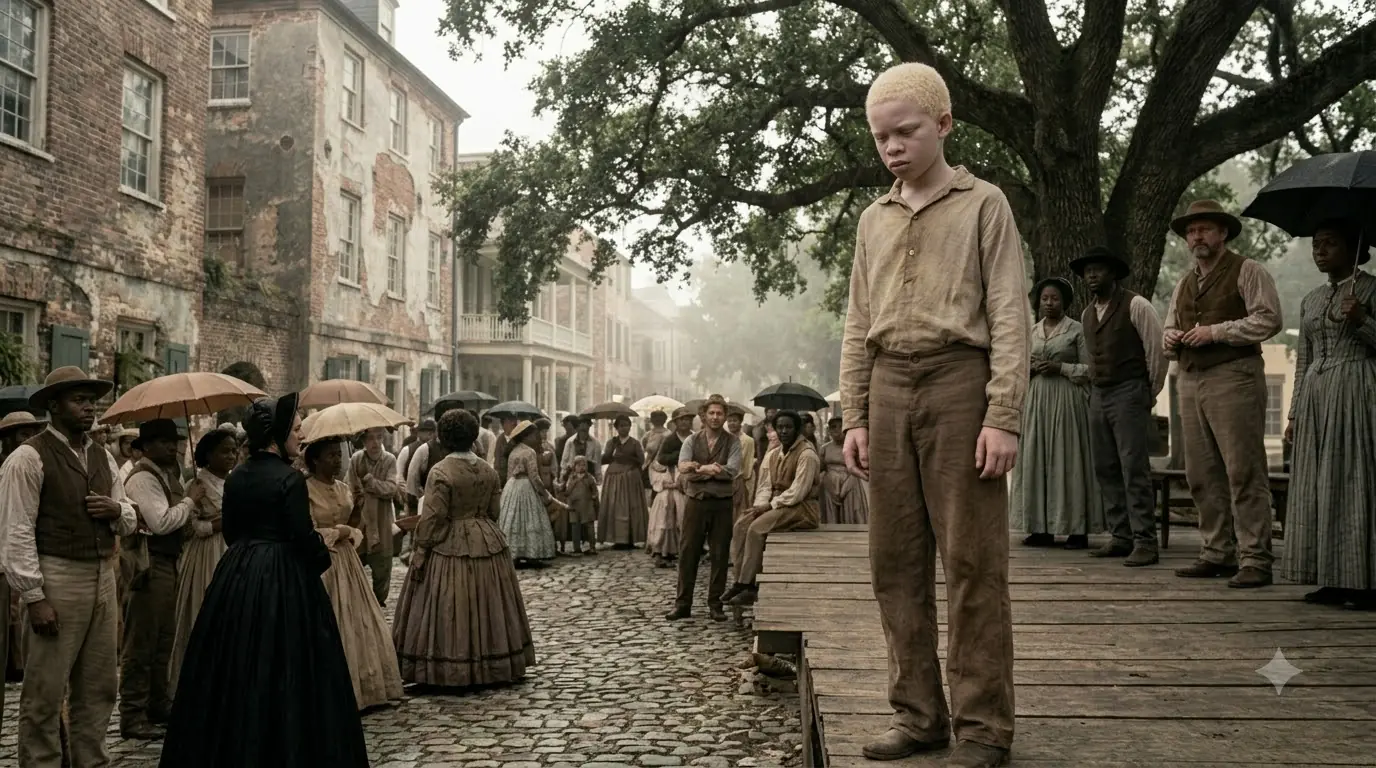
It begins not with a monster, but with a boy on an auction block in the suffocating heat of a Charleston summer, a boy no one wanted. He was soft and plump, an oddity in a world of sharp edges and hollowed-out hunger. His flesh, too pale, seemed to hold the light in a sickly way. And his eyes, they were the color of a washed-out sky, holding nothing and everything.
The auctioneer called him Samuel, but the name was a lie, a placeholder for property. He tried to start the bidding at $20. Silence. The humidity was a living thing, pressing down on the crowd, their sweat and their judgment mingling in the air. $15, nothing.
10. A nervous cough from the back. How did a story this grotesque, this deliberate, simply vanish from history? What were we never meant to know about the woman who finally raised her hand, not with a fan, but with a single gloved finger, and bought the boy for the price of a cheap bottle of wine?
She didn't see a curse or bad luck or a chubby useless child. She saw a key, a perfect untouched vessel for a truth so dark it threatened to bleed through the pages of history itself. She had been searching for him her entire life. And in that moment, under the brutal Carolina sun, she finally found him.
The crowd thought it was pity, a Christian kindness. They were so, so wrong. Her name was Saraphina Blackwood, and she was not in the business of saving souls. She was in the business of collecting them.
And the boy, the boy was to be her masterpiece. Saraphina's carriage was a black lacquered box sealed against the dust and the judgment of the outside world. Inside the air was still and smelled of old leather and dried lavender. Samuel, she would have to change that name, sat on the worn velvet seat opposite her, his small round body pressed into the corner as if trying to disappear.
He didn't cry. He didn't speak. He just watched her with those pale empty eyes. Saraphina ignored him.
She opened a small leather-bound journal and dipped a silver pen into an inkwell secured to the carriage wall. Her script was unnaturally precise. A series of sharp elegant symbols.
"Specimen acquired. Male, approximately 9 years of age. Unusual adiposity despite clear signs of malnutrition. Epidermis lacks significant pigmentation. Ocular structure appears receptive."
She paused looking up at him, her gaze as impersonal as a physician studying a disease. He flinched, a tiny, almost imperceptible tremor.
She made another note. "High reactivity to direct observation. Suggests a sensitive, pliable temperament. Excellent."
The word hung in the air between them, cold and sharp. She wasn't buying a laborer.
She wasn't buying a house servant. She was acquiring a component, a rare and necessary ingredient for an experiment that had begun generations before she was even born. The Blackwood family didn't measure their wealth in acres or in dollars. They measured it in bloodlines.
They were architects of the flesh, and their plantation, a sprawling empire of indigo and rice, known as a quiet hell to the enslaved, was merely the laboratory. Its true name, the one whispered only behind closed doors, was the Crucible. And Samuel, the chubby, unwanted boy, was about to be placed directly into the heart of its flame. He had no idea where he was going.
He only knew the silence in that carriage was louder and more terrifying than any scream he had ever heard. The flesh is a temporary garment. Saraphina's father used to whisper to her in the cavernous library of their ancestral home. His finger traced the gilded lines of a book bound in something that wasn't leather.
"Blood is a river of memory. Control the river and you control time itself." This was the foundational myth of the Blackwood dynasty, a whispered heresy passed down from father to daughter, mother to son. They were not merely plantation owners.
They saw themselves as custodians of a lost science, a form of biological alchemy that the modern world with its foolish notions of sentiment and morality had forgotten. They believed that through meticulous generational breeding of plants, of animals, and of people, they could isolate not just physical traits, but something far more esoteric. They sought to cultivate a perfect vessel, a human body so pure, so receptive that it could become a conduit for something else. An intelligence, a memory, a power that existed before humanity and would exist long after.
It was a madness born of immense wealth, absolute power, and profound isolation. Saraphina had inherited this mission like a genetic disease. Her husband's death, a sudden and convenient fever, had left her in sole command of the plantation and its dark hidden work. For years, she had followed the old family ledgers, arranging pairings, documenting births, and disposing of failures with chilling efficiency.
But the ledgers all spoke of a final necessary component, a blank slate, a subject with no strong ancestral traits, a body that was unwritten. This was why she had scoured the auctions for years, searching for the anomaly, the outcast. An albino child was a genetic whisper, a recessive trait that signified a dilution of dominant blood. But a plump one, that was the true prize.
In her twisted philosophy, his excess flesh was a sign of receptivity, a physical manifestation of a spirit that did not resist, that did not burn away its own substance with will or defiance. It was a body designed to store, to hold, to become.
The main house at Blackwood Manor was a grand Gothic illusion designed to impress visitors and distract from the estate's true purpose. The real work happened a mile deep in the cypress swamp, accessible only by a single unmarked road that was swallowed by the trees. Here, a collection of stark windowless buildings stood in a perfect geometric arrangement. Their whitewashed walls looked strangely clean against the backdrop of rot and decay.