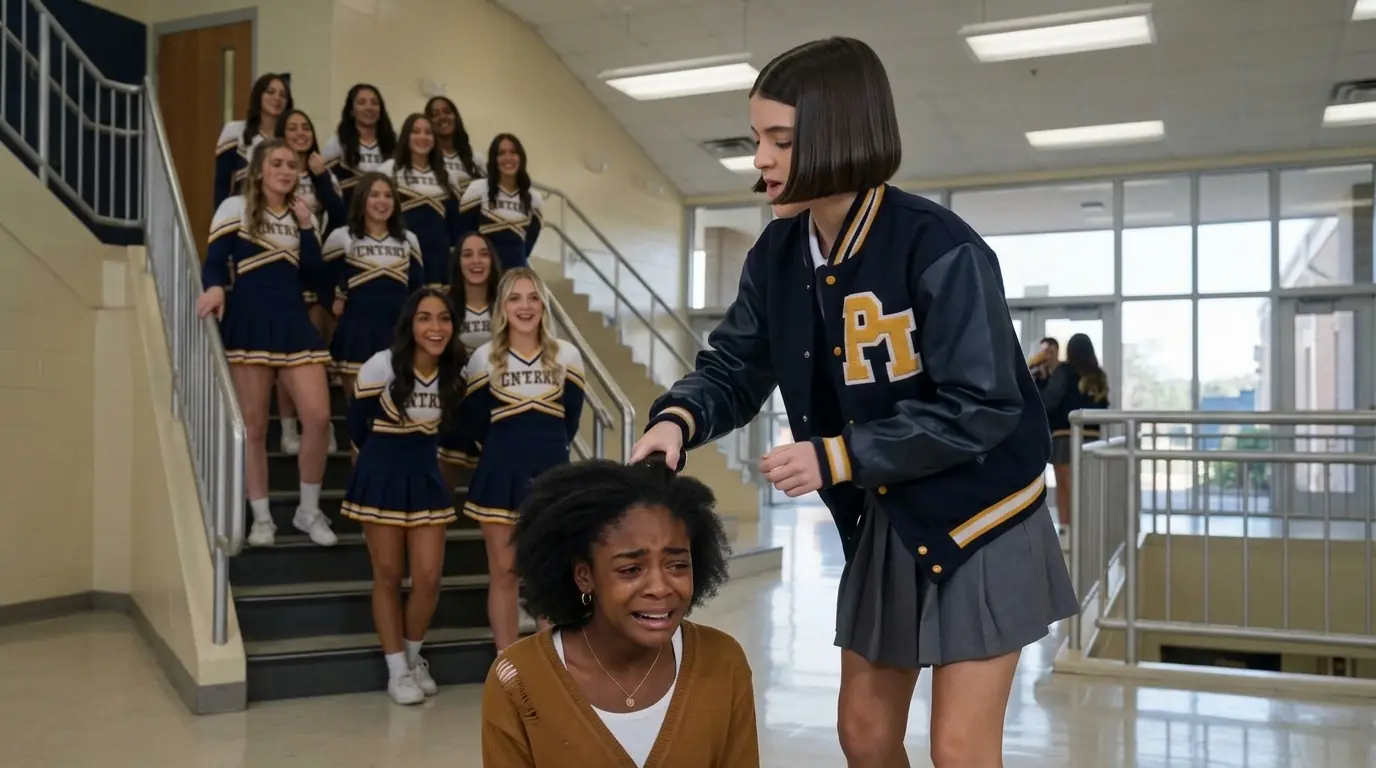
The electric clippers were still buzzing in Sloane Mercer’s hand when three black SUVs turned through the iron gates of Aldencrest Academy. The first vehicle stopped beside the fountain, the second pulled in behind it, and a dark sedan settled near the administration entrance while afternoon pickup traffic slowed around them. Nobody on the wide marble staircase knew who had arrived, but the students who had been laughing suddenly became much quieter. Sixteen-year-old Amara Whitfield remained on both knees between the brass railings, one loafer missing, while black curls covered the stone beside the left side of her head.
Sloane glanced toward the tall glass doors and forced another laugh. “What, somebody called Homeland Security because she got a haircut?” she said, looking at the cheerleaders behind her as if the right reaction might make the whole scene funny again. Nobody answered because the men getting out of the SUVs did not look like police officers, and they did not rush toward the school like frightened parents either. They moved deliberately, opening doors, checking the entrance, and carrying slim folders and radios while an older Black man in a charcoal overcoat stepped from the center vehicle.
Amara saw him before anyone else did. Her mouth opened, but embarrassment and shock had tightened her throat so completely that no sound came at first. The older man looked through the glass, saw her kneeling on the stairs, and stopped so abruptly that the woman walking beside him nearly collided with his shoulder. “Grandpa,” Amara finally whispered.
Sloane’s smile vanished. Even students who knew little about business recognized Everett Whitfield because his face appeared regularly in newspapers beside new bus factories, public-transit contracts, and charitable grants. He was the founder of Whitfield Transit Industries, one of the largest privately held transportation manufacturers in the Southeast, supplying municipal buses, school transportation, utility fleets, and commercial vehicles across seven states. Everett noticed none of the staring because every part of his attention had narrowed to his granddaughter.
He crossed the lobby and climbed the marble stairs without looking at Sloane. When he reached Amara, he removed his coat and placed it around her shoulders before lowering himself carefully onto one knee. A shallow cut behind her left ear had begun to bead with blood where the clippers caught skin, but Everett did not touch the damaged section of hair. “Who put their hands on you?” he asked.
Amara looked toward Sloane. The cheer captain glanced down, realized she was still holding the clippers, and dropped them so quickly that they struck the stair and skittered beneath the railing. “This is not what it looks like,” Sloane said, stepping forward with her palms raised. Everett stood.
“A misunderstanding is when two people remember the same moment differently,” he said. His voice was quiet, which somehow made the students around them become even quieter. “I see school cameras, at least thirty witnesses, and enough phones pointed at these stairs to cover a basketball tournament.” He looked around the landing and added, “So memory probably isn’t going to be our problem.”
Several students lowered their phones. Others kept recording because they understood the story in front of them had just changed direction, even if they did not yet understand why. A junior named Tyler Brennan started sliding his phone into his blazer pocket, but the woman who arrived with Everett stepped forward and politely asked everyone to preserve whatever they had recorded. Sloane turned toward her and demanded, “Who are you supposed to be?”
The woman opened a black leather folder. “Rachel Whitmore, general counsel for the Whitfield Family Foundation and Whitfield Transit Industries.” Sloane blinked, then looked at Amara with a kind of disbelief that was almost more insulting than the cruelty from minutes earlier. Until that afternoon, Amara had simply been the scholarship girl who took the city bus, worked two afternoons a week in the school library, and packed lunches from home.
Amara had never lied about Everett. She simply did not introduce herself through somebody else’s bank account. Her father died when she was eight, her mother worked as an emergency-room nurse, and Everett had helped raise her without moving her into the world his money could easily provide. He loved his granddaughter too much to let wealth become the explanation for everything she earned.
When Amara first applied to Aldencrest, Everett told his daughter Renee that the admissions office would receive no call from him. “If they admit her because of my name, she’ll spend four years wondering whether every teacher and student knows it,” he said. Renee agreed, and Amara earned one of the academy’s full academic scholarships on her own grades, debate record, recommendation letters, and entrance exam. The Whitfield Foundation had supported Aldencrest programs for years, but the admissions committee did not know one of its new scholarship students was Everett’s granddaughter.
Amara preferred it that way. She wanted the ninety-six she earned in calculus to belong to her, not her grandfather’s company. She wanted her debate trophies, architecture sketches, volunteer hours, and late-night study sessions to be evidence that she deserved her place. What she did not understand yet was that independence could slowly become the belief that asking for help somehow weakened everything she had earned.
Sloane Mercer understood the same privacy through a completely different lens. Her father, Conrad Mercer, owned Mercer Signature Events, a regional hospitality and event-production company that handled corporate launches, stadium hospitality, fundraising galas, and luxury conferences. Her mother, Vivian Mercer, chaired Aldencrest’s athletic-development committee and was on campus so often that new teachers sometimes mistook her for an administrator. Sloane had grown up in a world where adults checked who her parents were before deciding how firmly to correct her.
She was captain of the varsity cheer squad even though two girls on the team were stronger tumblers. She hosted birthday parties in hotel ballrooms, wore shoes classmates recognized from designer websites, and had once joked during lunch that detention at Aldencrest was “more of a suggestion if your parents know the right board members.” Several students laughed because the joke was funny enough to hide how accurate it felt. Amara did not.
The trouble began during the second week of sophomore year. Sloane reached across the chemistry table and touched one of Amara’s braids without asking, then said she had always wondered whether “that kind of hair” felt real. Amara pulled away and said, “Please don’t touch my hair.” Sloane smiled as though Amara had embarrassed herself and answered, “Relax, it was a compliment.”
A few days later, Sloane asked whether scholarship students received a clothing allowance or had to return their uniforms after graduation. Two girls sitting nearby laughed. Amara told her she bought the same blazer everyone else wore and went back to studying. Sloane watched her with the expression of someone whose joke had been ruined by the target refusing to participate.
The comments did not become extreme immediately. That was what made them difficult to explain. Sloane called Amara “Aldencrest’s investment” and joked that donor brochures needed somebody photogenic enough to prove scholarship money worked. When a teacher entered the room, Sloane became charming again.
She asked whether Renee cried when the tuition invoice disappeared. She wondered aloud whether Amara’s bus pass counted as part of financial aid. Once, while Amara was filling a water bottle, Sloane told another cheerleader that “some people get everything free and still walk around acting offended.” Amara heard the sentence and kept walking.
The first formal complaint did not come from Amara. English teacher Mrs. Helen Avery saw Sloane and two cheerleaders block Amara beside a locker while another student filmed. Amara asked them twice to move, and Mrs. Avery intervened before anything physical happened. She submitted an incident report that afternoon.
Principal Douglas Harlan classified it as a peer conflict. Sloane said the girls were making a social-media clip and Amara misunderstood the joke. Harlan told Mrs. Avery he did not want to criminalize normal teenage behavior and suggested everyone needed perspective. Amara was advised to use the north hallway during the busiest passing period so there would be less opportunity for friction.
Renee never heard about that recommendation. She worked twelve-hour emergency-room shifts and already rearranged enough of her life around transportation, groceries, medical appointments, and Amara’s academic schedule. Amara had started measuring problems by how many hours of sleep telling her mother might cost. Sloane had never needed to think that way about any adult in her life.
By winter, the bullying had developed a rhythm. Sloane knew exactly how far to go before another student could describe the behavior as obviously cruel. She would touch a braid and call it curiosity, make a comment about money and call it humor, block a doorway and call it playing around. Every individual moment looked smaller once separated from the others.
A private group chat called Aldencrest After Dark made everything worse. Students posted photographs of classmates with sarcastic captions and reacted with laughing emojis. A picture of Amara studying alone in the cafeteria appeared beneath the words When The Tuition Is Free But The Lunch Isn’t, while another showed her waiting at the public bus stop under Private Academy, Public Transportation. Amara did not learn about either post until much later.
Some students participated enthusiastically. Others read the messages without reacting. A few disliked what was happening but convinced themselves staying silent meant they were not involved. Nobody understood how useful silence was to the person doing the humiliating.
One of Sloane’s closest friends, Harper Dean, occasionally told her she was going too far. Harper was also on the cheer squad, attended the same parties, and liked belonging to the social circle around Sloane. Saying “that’s mean” was easy when the comment remained inside a locker room. Risking the friendship was harder.
The staircase incident happened on a Thursday afternoon before Aldencrest’s annual Benefactors’ Gala. Scholarship students were invited because the event celebrated academic programs funded by alumni and community donors. Amara had spent nearly seven weeks setting aside library wages and birthday money for a dark green dress she found at a consignment store. She had repaired a loose seam herself and kept the dress inside a garment bag in her locker.
Sloane saw the garment bag during lunch. “You’re going tonight?” she asked. Amara shut the locker and said yes. Sloane smiled and said, “Makes sense. They need scholarship students in the room so donors can see what they purchased.”
Amara usually walked away. That afternoon she stopped. “Do you ever get tired of needing everyone to know you’re the loudest person in the room?”
Sloane’s smile disappeared. Harper, Brooke Landry, and Kelsey Moore stood nearby. Football player Tyler Brennan was leaning against the opposite locker scrolling through his phone.
Sloane stepped closer. “Come upstairs.”
“No.”
“We need to fix that attitude before you embarrass yourself tonight.”
Amara walked toward the west staircase instead. Sloane followed with Brooke and Kelsey, while Harper came behind saying they should leave it alone. Tyler followed because conflict at Aldencrest attracted phones before it attracted adults. By the time Amara reached the landing, he had already opened his camera.
Sloane stepped in front of her. “You want help with your hair for tonight?”
“No.”
“I think you do.”
Amara tried to move around her. Sloane reached toward one braid.
Amara slapped the hand away. Not hard enough to injure her, just fast enough to stop the touch. Everyone froze because Amara had spent months refusing to give Sloane a dramatic reaction.
Sloane looked down at her own hand. Then her expression changed. “Hold her.”
Harper immediately said, “Sloane, stop.”
Brooke laughed because she still believed the moment was performance. Kelsey grabbed Amara’s left wrist.
Amara pulled away. Kelsey tightened her grip, Brooke caught her other arm, and Tyler began recording because he expected whatever happened next would be something students talked about for a day and forgot. Harper moved toward Sloane and saw battery-powered clippers in her hand.
The clippers belonged to Harper. She kept them in her cheer bag because the squad occasionally used them for costume tape, adhesive strips, and loose synthetic extensions during competition weekends. Sloane had taken them without asking. Harper reached toward her and said, “Give those back.”
Sloane pushed her aside. Brooke pulled Amara backward, and one of Amara’s loafers came off as she lost balance. She fell hard onto both knees between the stair railings. Tyler laughed.