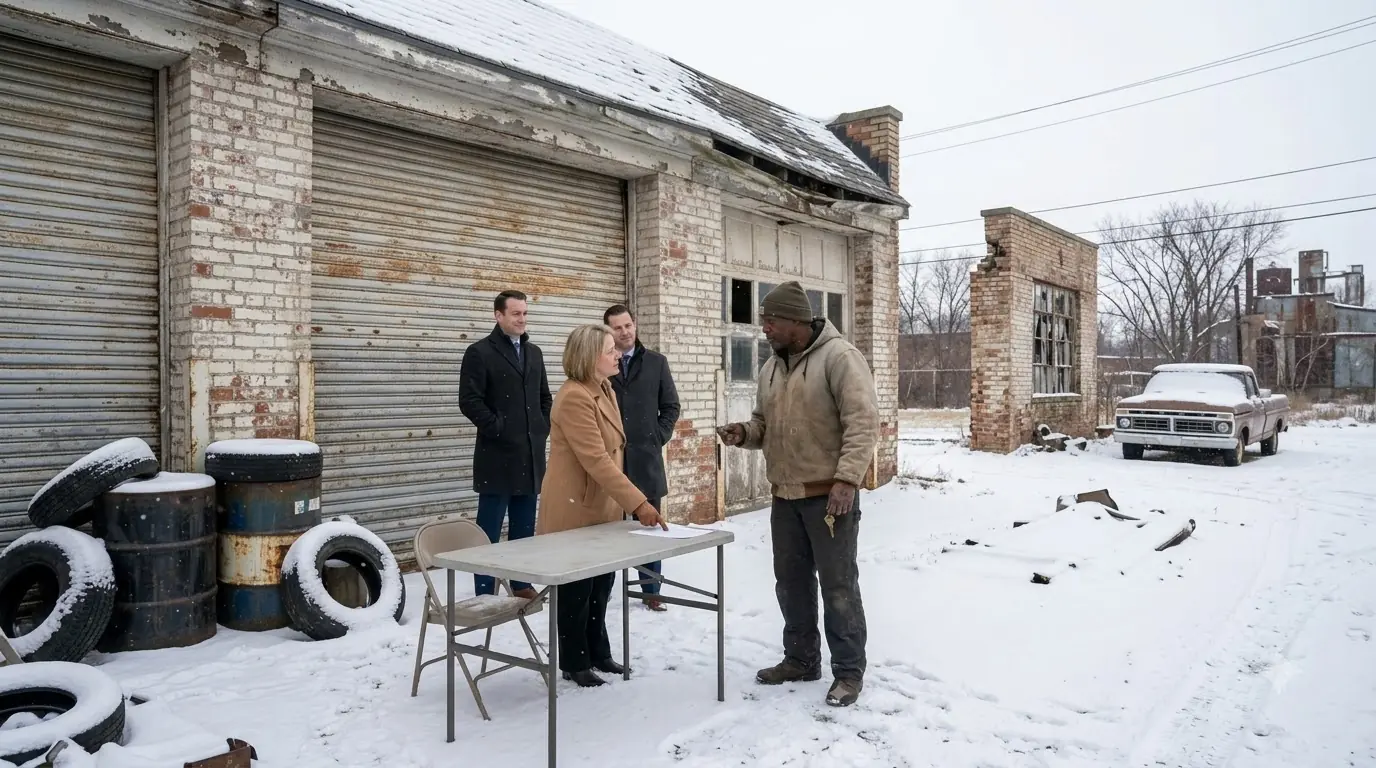
$800. That was the price a millionaire developer put on a crumbling Detroit garage she called a tetanus risk with a roof. She signed the contract on a frozen January morning, slid it across a folding table without looking up and laughed with her associates while the man across from her took the key and walked out into the snow without a single word. He wore a worn work coat and carried grease under his nails that no soap had ever scrubbed all the way out.
And she'd decided in about three seconds that he was nobody. She was wrong in a way that would cost her everything because behind a door her own team had inspected and dismissed under 11 gray tarps that nobody had bothered to lift sat something worth nearly a million dollars. And one quiet line she had signed in her own hand was about to become the paper trail that ended her career. Six months later, his name was on the front page of every business page in the state.
And she was standing on a cold sidewalk, locked out of a building that used to be hers, staring at a future she had personally signed away. His name was Elijah Reed. He grew up in a flat on Kuster Street on the east side of Detroit in rooms that smelled of motor oil, cornbread, and the particular sharpness of brake cleaner that gets into the curtains and never fully leaves. His father, Solomon Reed, had come up from Alabama in the second wave, worked the line at the Dodge main plant in Hamtramck until his shoulder gave out, then took his severance and his savings and opened a one-bay garage on the corner of Mack and Bewick in 1979.
He ran it for 31 years. Solomon Reed could not have told you the market value of a 1970 Chevelle in any language a banker would recognize, but he could lay his palm flat on a fender and tell you where the body had been hit, how long ago, and whether the man who fixed it had loved the car or only been paid to touch it. He believed in three things in this order. The Lord, his family, and the truth that lives inside a thing, whether or not anybody bothers to look for it.
He kept all three in a green spiral notebook in the breast pocket of his coveralls where he wrote down torque specs, prices, and once in a while a sentence that had nothing to do with cars at all. Elijah spent every Saturday of his boyhood in that garage. Not watching television, not running the block, learning. He learned to listen to an engine the way the deacons at Greater Bethel leaned in for the part of the sermon that mattered.
He learned to read the stress lines in a frame the way his mother read the worn pages in her hymnal, knowing which ones had been turned the most. By 16, he could name a knock by ear. By 19, he was rebuilding transmissions on the bench his father had welded out of old bed rails. By 23, he had a mechanical engineering degree from Lawrence Tech, earned on night shifts and a job at Meridian Restoration Group out in Warren, doing concours work for clients who flew in from both coasts.
He was not the loudest voice in any meeting, he was usually the most correct one. The owners trusted his appraisals. The clients asked for him by name. He was the man you called when the thing on the lift was supposed to be impossible to save.
But here is something I have learned and maybe you have learned it too. The places that depend on you the most are very often the places that will let you go without a phone call. 20 months before this story really begins, Meridian got bought by a holding company that ran the numbers and decided hand-built restoration did not scale. 11 people lost their jobs on a Friday.
The notices sent by email at 6:42 in the evening. Elijah read the message standing at the counter of a rented duplex off McNichols, still in his work clothes, the smell of the shop still on him. He did not answer it. He set the phone face down.
He sat in the dark a while and then he prayed, the short, rough kind of prayer his father taught him, the kind that is mostly listening. The next morning, he got up and made a list. He spent the better part of a year doing what a man does. He pulled engines at a salvage yard on Dequindre for cash.
He took side jobs. He paid his tithe at Greater Bethel, even the months it hurt, because his mother had taught him, “You do not start trusting God only when the account is full.” He kept his head down and his eyes open the way his father taught him to look at a wreck methodically, quietly, without expecting the answer to announce itself. He was 3four years old.
He had no real debt and he had $11,400 saved in a credit union account which was not enough to open anything but might be enough to start something if the right something ever came along. Caroline Sterling had never repaired a single object with her own two hands in her entire life. And she would have told you so without a flicker of shame. She had a different kind of intelligence and it was real.
She read land. She read leverage. At 41, she ran Sterling Meridian Group, a development firm she had built over a decade, buying tired industrial land cheap, walking a rezoning through the city, and flipping the assembled parcel to a national developer at a multiple that made her investors very happy and very quiet. Her fund had outside money in it.
Set that detail somewhere you can find it again, because it is going to matter. She had been called a visionary by the Chamber of Commerce and a bulldozer by every man who ever sat across a table from her, and both were true. She was not cruel the way people who enjoy cruelty are cruel. She was indifferent, which is colder, and harder to argue with because indifference does not deny the evidence.
It simply never lets the evidence in the door. In December, Sterling Meridian closed on a four-acre parcel in Milwaukee Junction, the old manufacturing belt on the lower edge of the North End, the very ground where this city taught the world how to build an automobile a hundred years ago. The plan was clean on paper.
Hold the land, push a mixed-use rezoning through planning and development, assemble the corridor, and flip the whole thing inside two years. There was one complication. At the back corner stood a garage, maybe a 900-square-foot cinder-block building from the 1960s with a rusted roof, a rollup door that had not opened in years and an electrical panel a sterling tech summed up in a single word on his report. Dead.
The estimate to demolish and clear it ran $14,000 to $16,000. Caroline had no interest in spending $16,000 to remove a liability when she could be paid a token to make it somebody else's problem. Listed as is, she told her acquisitions lead in a meeting that lasted 90 seconds, “Get a number on it. Move it off the books.”
Her team valued that building by walking through it once with a clipboard and a flashlight and writing down everything that was broken. Not one of them lifted a tarp. Remember that Reggie Vaughn heard about the garage from a tow driver who hauled scrap off that block. Reggie and Elijah had turned wrenches side by side at Meridian for four years and stayed close after the layoffs, the way men do when they have both bled into the same engine bay.
Reggie was freelancing now, welding, fabrication, whatever paid, and he called Elijah on a Tuesday night, more out of instinct than anything else. He said the little he knew. Old block garage off Riopel, bad shape. Some development outfit wants it gone.
Might let it go for almost nothing. Elijah said very little. The next morning he drove out and parked across the street with the heat off to save gas and the windows fogging from his breath. And he looked at that building the better part of 20 minutes without moving.
From the outside it was objectively a wreck. The rollup was buckled. Two of the four sidewall windows were boarded with plywood gone soft and green at the edges. The roof sagged at the northeast corner like a tired man's shoulder.
But Elijah was not looking at what was broken. He was reading the footprint, the foundation, the way the slab sat true on the lot despite everything. And he was reading the corner itself, the on-ramp to I-94 a quarter mile north, the streetcar extension study he had seen mentioned in the free press a year and a half back, the scaffolding filling up the north end, the particular kind of quiet that comes right before money arrives. He had grown up nine blocks from here.
He knew this corner the way you know a relative's face, and he had a suspicion, precise and unhurried, about what was coming to this ground inside the next year and a half. There was an old man clearing snow off the sidewalk with a flat shovel, working slow, and even the way a man works when the work is the only thing he has left of a place. Elijah crossed the street and said, “Good morning.” And the old man looked at him a long moment and decided he was all right.
His name was Earl Dawson. He was 72. He had been the caretaker of that property for more than 30 years. Hired back when it belonged to a man named Augustus Caldwell, a Black collector who had run a body shop two doors down in the 60s and 70s and had quietly over decades brought home cars nobody else wanted and put them away under tarps the way other men put away money.