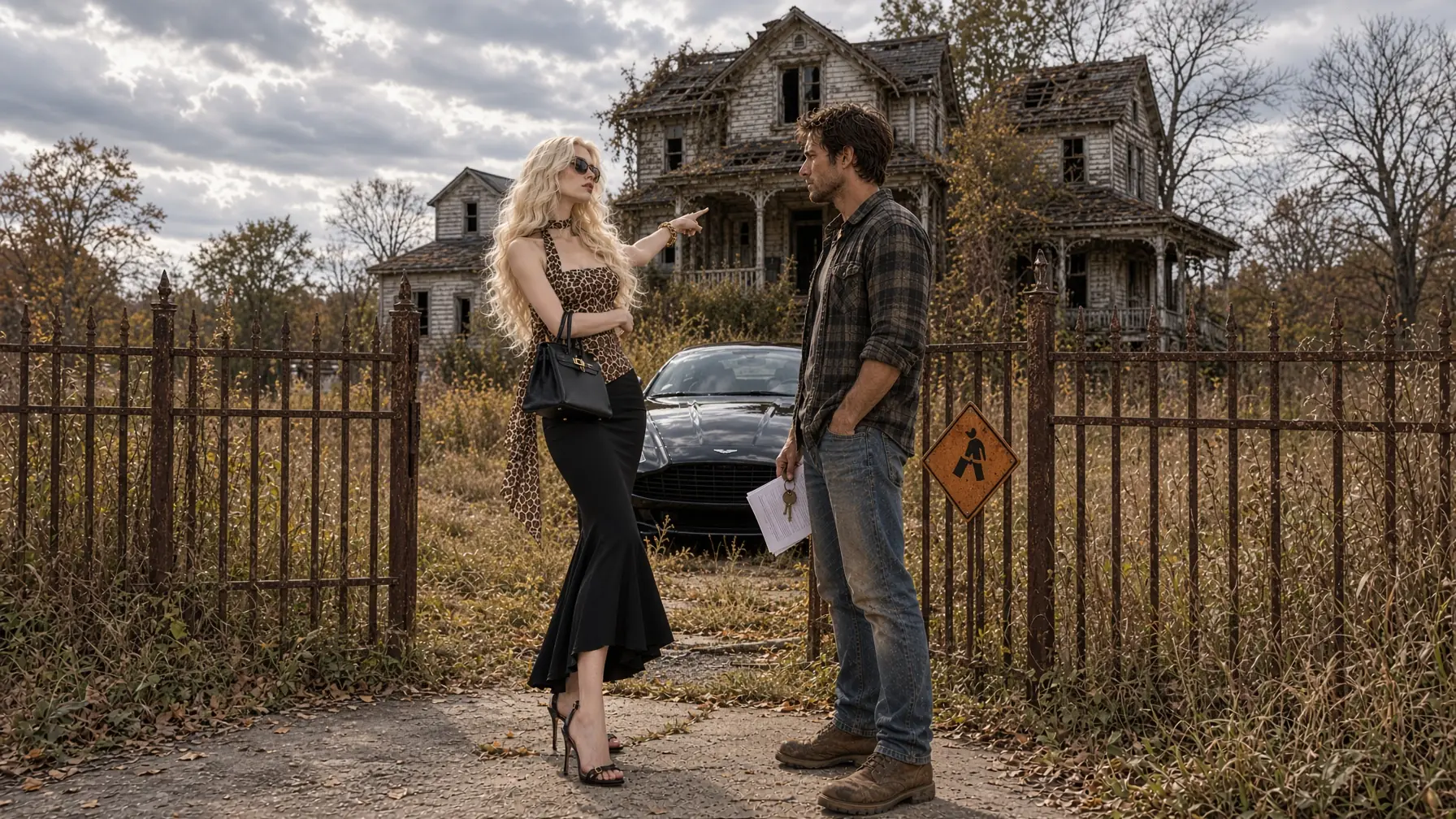
Celeste Mercer laughed the moment the gavel came down at $99. Standing before her was a rotting wood frame house on Hollow Creek Lane. Sagging roof, shattered windows, weeds thick as a man's fist climbing past the porch railings, and a bright orange unsafe structure sign hanging crooked at the gate. The man who had just bought it was Sawyer Langley, a single father in a faded flannel shirt, sawdust still caught in the creases of his hands. Celeste looked at him the way someone looks at a punchline they have already heard, with the flat amusement of a person who has never needed to rethink a first impression.
"You just paid $99 for a pile of garbage," she said. And Sawyer picked up the old key and said nothing at all. 3 months later, she came back. And the garbage was worth millions. The auction on that Tuesday morning was not the kind that drew crowds or television cameras, but a county tax lien sale.
The kind where the government disposes of properties that have owed back taxes long enough that no one alive still cares about them. And the city of Nashville had listed 11 parcels on Hollow Creek Lane, a crumbling stretch of old neighborhood on the outer edge of the metro where the sidewalks had buckled and the streetlights had been dark for longer than anyone could remember. Most of the lots were straightforward, empty land easily scraped, easier still to flip it into something profitable. And the attendees knew this and came prepared with paddles, lawyers, and spreadsheets full of acquisition targets ranked by demolition cost. Celeste Mercer had arrived with two men who carried themselves like people used to winning rooms before they spoke.
Vaughn Mercer, her uncle and senior partner at Mercer Development Group, a heavy-set man in his late 50s whose practiced calm other people mistook for patience, but was actually the composure of someone who had already decided the outcome. And Garrett Holloway, their attorney and site planner, lean and efficient with a leather portfolio he never set down. Together they had come to finalize the last few properties needed for the land assembly behind Mercer Hollow Creek Resort, a destination development that represented the largest single project in the company's history, a $140 million gamble on the idea that wealthy visitors wanted a curated experience outside Nashville's downtown core. The lot they cared least about was the one they ended up watching most closely. Parcel 11 at the end of the lane, a two-story wood-frame house abandoned for nearly two decades, unnecessary to their project footprint but flagged by Garrett as a potential nuisance, the kind of property best acquired cheaply before it ended up in the wrong hands.
The auctioneer opened parcel 11 at $200 and no one moved. He dropped to 150 and still nothing stirred. At $99, a hand went up near the back of the crowd and belonged to Sawyer Langley, 39 years old, in a flannel shirt washed so many times the pattern had faded to suggestion, carrying a manila folder that had been bent and re-straightened enough times to have permanent creases across the middle. He was a craftsman and a restorer by trade, the kind of man who took work that other people considered beneath them, stripping old floors and repairing timber frames and replacing porch posts on houses that developers had written off. And he was also a single father raising his daughter Piper alone.
And the combination of those two facts had made him exactly the sort of person that someone like Celeste Mercer looked at and immediately categorized as background. She watched him sign the purchase agreement with faint amusement she didn't bother to conceal. And Vaughn said something to her low enough that only she could hear it. And she smiled. And when Sawyer stepped back from the clerk's table she met his eyes without apology and told him he had just paid $99 for a pile of garbage.
Sawyer didn't flinch. He looked at the house at its broken windows and the half-collapsed portion of the roof and the wall of weeds between the fence and the porch. And then looked back at her with an expression neither angry nor embarrassed but something quieter and more difficult to name and said that some things are only cheap because the person doing the pricing doesn't know what they're looking at. Celeste assumed it was the kind of thing people say to themselves when they know they've made a mistake but can't afford to admit it. Turned back to Vaughn and Garrett and moved on to the next parcel without another thought for the man now standing at the rusted gate of a house no one else had wanted turning an old key slowly in the lock.
Sawyer brought his daughter Piper to see the house the following morning before he began any real assessment of the damage. And she stood at the edge of the overgrown yard with her head tilted slightly the way she looked at broken things she was trying to decide whether to fix or leave alone. and asked why the house was so sad, and he told her it probably wasn't sad, just that nobody had listened to it long enough to find out. The structure was genuinely dangerous in several places. The staircase had three rotted treads.
One section of the upper floor had given way over a weakened ceiling joist, and the roof was sound only across the rear 2/3. While the interior walls were covered in black mold, and the window frames had swollen shut against their casings. He set up safety barriers, hauled out the worst of the debris, and spent the first full week walking the structure with a flashlight and a notepad, tapping walls, testing joists, crouching under the crawl space to check the foundation, building the kind of picture that only comes from patience and from knowing what you're looking for. Beneath the decay, the bones of the house were extraordinary. The mortise and tenon joints at the primary load-bearing frame had been cut with a precision he associated with craftsmen trained before power tools made careful hand-fitting optional.
The newel post at the base of the staircase was carved with a shallow original spiral no catalog had ever stocked, and the fireplace surround was made of hand-thrown brick in a size that hadn't been standard since before the Second World War. A neighbor pausing at the fence told him he was taking a considerable risk on a property nobody had held on to longer than a season. That there had been some kind of dispute attached to the deed years back. Something involving the original owner that no one in the neighborhood had ever gotten a straight answer about. And Sawyer thanked him and kept working because he was not a man who needed a straight answer to start.