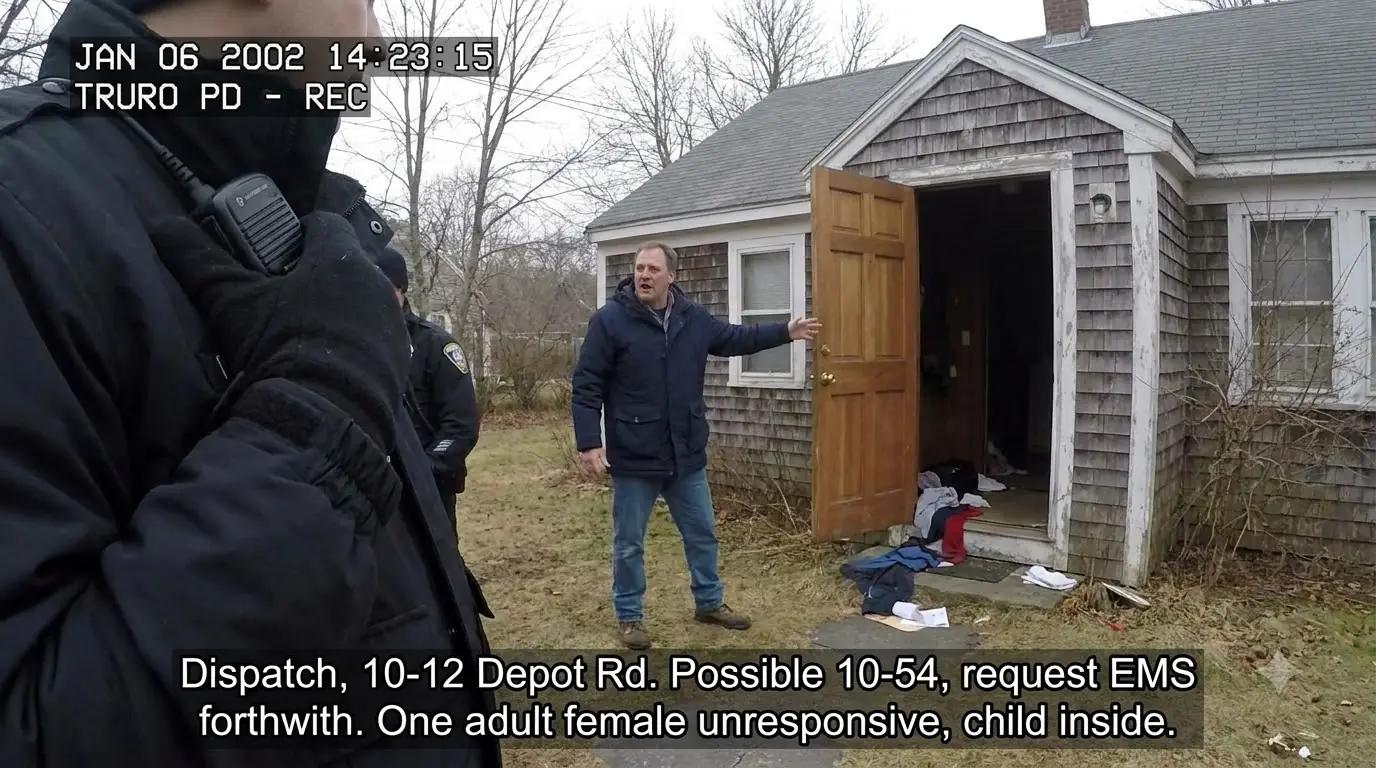
Christa Worthington was found dead at her home at 50 Depot Road in Truro, Massachusetts, on the afternoon of January 6, 2002. Her former boyfriend Tim Arnold did not arrive alone; according to the Massachusetts Supreme Judicial Court record and later reporting, Arnold went to the property with his father, Robert, while returning a flashlight. Worthington's two-year-old daughter, Ava, was found alive beside her mother and had apparently been alone in the house for at least a day.
The transcript contains several details that require qualification. Christa was born in December 1956 and was 45 when she died, although some contemporary reports rounded her age differently. Tony Jackett, the married shellfish constable who fathered Ava, was investigated for years but was never charged, and later reporting states that he was ultimately cleared as a suspect. Tim Arnold was also investigated and cleared. Claims about other people in Christa's private life should be understood as investigative leads or media-reported suspicions, not proof that they were involved in her death.
The timeline surrounding Christopher McCowen also needs correction. Police first interviewed McCowen in April 2002 because his garbage route included Worthington's home. He voluntarily provided a DNA sample in March 2004; the sample was sent to the state crime laboratory in July 2004, and investigators received a written report on April 13, 2005 linking him to DNA recovered from Worthington's body. McCowen was arrested on April 14, 2005, not April 15 as some retellings state.
There is another important correction concerning McCowen's six-hour police interview. The interview was not recorded, but the Massachusetts Supreme Judicial Court later found that officers offered to record it and McCowen declined, signing a written form documenting that decision. The court also upheld the trial judge's finding that McCowen knowingly and voluntarily waived his rights and made his statements voluntarily. McCowen has nevertheless maintained for years that he did not kill Worthington and has continued challenging his conviction.
In November 2006, a Barnstable Superior Court jury convicted McCowen of first-degree murder, aggravated rape and aggravated burglary. He received three life sentences, with the murder conviction carrying no possibility of parole. In 2010, the Massachusetts Supreme Judicial Court affirmed the convictions and rejected his request for a new trial. Later efforts to overturn the verdict have also failed, although court-authorized forensic testing of previously missing evidence was approved in 2024. No reliable public result of that testing was located in the sources reviewed for this account, so it should not be described as having cleared or further implicated anyone.
A Fashion Writer Returns to Cape Cod
Christa Worthington grew up connected to Cape Cod through a family whose roots in the area stretched back generations. Her father, Christopher "Toppy" Worthington, was a Harvard-educated lawyer who had worked in public service, and the Worthington family name carried a degree of familiarity in the region. Christa's own ambitions, however, took her far beyond the Cape.
She attended Vassar College and built a successful career as a fashion journalist. Over the years she wrote for major publications including Women's Wear Daily, Elle, Harper's Bazaar and The New York Times, while spending time in New York and Paris covering an industry built around designers, editors, seasonal collections and constant movement. Friends and colleagues later remembered her as intelligent, funny and direct, with a sharp personality that fit the competitive world in which she worked.
By the late 1990s, Christa had grown tired of that pace. She wanted more control over her time and reportedly talked about writing a play and building a quieter life. In 1997 she left New York and settled full-time in Truro, the Outer Cape community where her family had long spent summers.
Truro was the opposite of the professional world Christa had left behind. Its year-round population was small, its winters were quiet, and its social world was close enough that private matters rarely stayed private for long. Christa began freelancing on her own terms and settling into the routines of local life from her house on Depot Road.
Her move seemed, at first, to offer exactly the change she had wanted. She was no longer chasing runway schedules or magazine deadlines in the same way, and she had space to think about writing outside fashion. Yet the privacy she sought in a small Cape Cod town would eventually prove more complicated than the anonymity she had left behind in New York.
Tony Jackett and the Birth of Ava
One of the people Christa came to know in Truro was Tony Jackett, the shellfish constable for Provincetown and Truro. Jackett came from a local fishing family and was well known in the community. He was also married and had a large family of his own.
Christa and Jackett began an affair. What may have started as casual conversation developed into a relationship that Christa described privately with considerable emotion. In 1999, she gave birth to a daughter, Ava, and Jackett was the father.
The existence of the child placed enormous pressure on everyone involved. Jackett eventually told his wife, Susan, about both the affair and Ava. Later interviews with the Jacketts described a complicated but surprisingly cooperative arrangement in which Susan eventually accepted Ava into the broader family circle and the adults attempted to make the situation work.
That matters because later retellings of the murder sometimes present the affair as an obvious motive for Jackett to kill Christa. Investigators certainly examined him closely, but the family situation by the time of the murder was more complicated than a simple secret affair on the verge of exposure. Jackett had already acknowledged paternity, his wife knew about Ava, and the Jacketts said they were developing an ongoing relationship with the child.
For Christa, motherhood became central to her life. Friends described her as deeply involved with Ava and willing to reshape her work around raising her daughter. Whatever turbulence had marked Christa's romantic life, there is little indication that she expected the domestic life she was building to end suddenly.
The Last Days Before the Murder
The evidence later presented in court allowed jurors to conclude that Christa was killed sometime after 8:00 p.m. on Friday, January 4, 2002, when she spoke by telephone with a babysitter, and before noon on Saturday, January 5, when she failed to appear for a hair appointment. Both the Saturday and Sunday newspapers remained uncollected at the bottom of her driveway. No one who knew her yet understood what had happened inside the house.
By Sunday afternoon, January 6, Tim Arnold was on his way to Christa's property with his father, Robert. Arnold was a former boyfriend who had remained part of Christa and Ava's lives after their romantic relationship ended. The purpose of the visit was ordinary: he was returning a flashlight he had borrowed.
When the two men reached the property, they noticed things that were wrong. Christa's car was still there, the newspapers had not been picked up, and the exterior door leading from the driveway toward the kitchen area was partly open and showed damage consistent with forced entry. Arnold went inside.
He found Christa on the floor in the passageway near the kitchen. She had suffered blunt-force injuries and a fatal stab wound to the chest. Beside her was Ava, alive and physically unharmed.
The child had apparently been alone in the house for many hours. Contemporary reports described cereal scattered nearby and evidence that Ava had tried to feed herself while waiting for an adult to come. The image of the toddler beside her mother's body became the detail that would define public memory of the case.
A Crime Scene in a Town Unused to Murder
Truro had not experienced a homicide in more than 30 years, and first responders were suddenly dealing with a crime scene unlike anything the town had seen in decades. In the first moments, the natural priority was the living child and the obvious victim. That urgency meant some actions taken by responders later became part of arguments about scene contamination and evidence handling.
Investigators documented damage to the exterior door and evidence suggesting that a struggle had taken place outside the house. Worthington's glasses, a barrette, socks and keys were found outside between the house and her vehicle. The dirt driveway contained long disturbed tracks that investigators later recreated by dragging a person across the ground.
Inside, forensic evidence became the center of the investigation. Semen and other biological material were recovered from Worthington's body, giving police a male DNA profile that would eventually become the most important evidence in the case. Other trace evidence, including material under her fingernails, was also collected.
The scene raised immediate questions about motive. Although the door had been forced, the circumstances did not fit neatly into a simple burglary. Christa's private relationships, the lack of an obvious random intruder, and the nature of the attack pushed investigators toward the possibility that she knew the person who killed her.
As news spread across the Cape, the case became national. A former fashion writer who had left New York for a quiet seaside town had been killed in her home, while her toddler survived beside her. Reporters arrived quickly, and the private details of Christa's life became part of the public investigation.
The Suspect List Expands
Tim Arnold was an obvious early focus because he had found the body and had previously dated Christa. Police examined his relationship with her, his movements and his statements. He was interviewed repeatedly, but no evidence established that he had killed her, and he was eventually cleared.
Tony Jackett also came under intense scrutiny. The affair, Ava's paternity and the damage that disclosure had caused to his marriage offered investigators a possible motive on paper. His family life was exposed publicly while police examined his movements and relationships, but he was never charged and was ultimately cleared as well.
Investigators also examined tensions involving Christa's father, Toppy Worthington, and his much younger girlfriend, Elizabeth Porter. Christa reportedly disapproved of the relationship and was concerned about her father's involvement with Porter and the people around her. Those circumstances generated another line of inquiry, but they did not produce evidence sufficient to charge anyone connected to that relationship with Christa's murder.
Other acquaintances, former romantic partners, visitors, workers and people who had simply been near the property at different times were pulled into the investigation. The growing list illustrated one of the central problems detectives faced: Christa had lived a full adult life, and many people had some connection to her, but suspicion was not evidence.
The longer the investigation continued, the more Christa's personal life became a public spectacle. Media coverage often framed the case around romance, class and scandal. Some commentary reduced a murdered woman to the affairs and relationships she had had, while the actual question of who attacked her remained unanswered.
A Town Asked for DNA
The biological evidence offered investigators one clear strategy. If they could find the man whose DNA matched the material recovered from Christa, they would have a crucial lead. Police began requesting voluntary samples from men connected to her and to the property.
The effort eventually became one of the most controversial features of the case. Authorities asked a broad group of local men to provide DNA, including people with only routine reasons to have been near Christa's home. Between 150 and 200 men ultimately provided voluntary samples according to later Massachusetts appellate litigation involving the retention of those samples.
In a community as small as Truro, the effect was significant. Men who had known one another for years were suddenly being asked to prove they were not the source of DNA recovered from a murder victim. Some cooperated immediately. Others were uncomfortable with the scope of the request and what would happen to their genetic information after the investigation.
The mass collection did not quickly solve the case. Sample after sample came back without identifying the unknown male. By 2004, more than two years after Christa's death, national attention had faded and the investigation appeared to many outsiders to be drifting toward cold-case status.
Yet detectives continued looking at people whose jobs gave them ordinary access to the property. Contractors, repair workers, delivery workers and sanitation employees became part of the expanding comparison pool. One of those men was Christopher McCowen.
Christopher McCowen Enters the Investigation
McCowen worked for a private disposal company and collected trash from Christa's residence as part of his route. He had not been one of the romantic partners whose names dominated early coverage. His connection to the property was mundane: he came there because it was his job.
State Troopers Christopher Mason and William Burke first interviewed McCowen on April 3, 2002. According to the later Supreme Judicial Court opinion, McCowen said he did not know Christa, had never spoken with her and had no contact beyond an occasional wave while collecting garbage from a wooden bin on the property. He also said he would have no problem providing fingerprints or DNA if investigators requested them later.
That request came in March 2004. By then, the state crime laboratory had developed a useful DNA profile from samples recovered from Christa's body. McCowen again said he did not know her and voluntarily provided a cheek swab.
His sample was sent to the crime laboratory in July 2004 along with a group of other samples. The delay that followed became one of the frustrating features of the case. Investigators did not receive the critical written report until April 13, 2005.
The report said McCowen matched the major DNA profile from a mixture recovered from Christa's right breast and could not be excluded as a contributor to the male DNA from the vaginal sample. At trial, the Commonwealth's DNA expert testified to extremely low probabilities that an unrelated person would randomly produce the relevant profiles. After more than three years of searching, police finally had the type of match they had been waiting for.
The Arrest and the Six-Hour Interview
Police arrested McCowen at his Hyannis residence shortly after 7:00 p.m. on April 14, 2005. He was taken to the South Yarmouth State Police barracks. The interrogation that followed would become almost as controversial as the DNA evidence itself.
McCowen was advised of his Miranda rights in the police vehicle and again at the barracks. According to the Supreme Judicial Court, he waived those rights. Officers also asked whether he would consent to having the interview recorded.
McCowen declined. He signed a form documenting that he did not want the interview recorded, so the six-hour questioning session survives principally through police reports and later testimony rather than an audio or video record. That distinction is important because critics often describe the absence of a recording without noting that the appellate court found the recording had been offered.
At first, McCowen repeated the same denial he had given in earlier interviews. He said he did not know Christa and had never been inside her home. When investigators showed him the laboratory report linking his DNA to biological evidence from her body, his story changed.
According to Trooper Mason's account, McCowen said, "It could have been me." He then described drinking heavily on the night of January 4 and initially claimed not to remember having sex with Christa. As the interview continued, he said the two had had consensual sex and that his friend Jeremy Frazier had been with him.
The Statements About Jeremy Frazier
McCowen's account changed several times during the interview. In one version, he said Christa became angry after seeing Frazier going through her belongings. He said Frazier struck her and later forced his way back into the house while McCowen remained outside.
As questioning continued, McCowen acknowledged a greater role. According to the police account accepted into evidence at trial, he said he struck Christa after Frazier attacked her and that the two men kicked her while she was on the ground. He said they dragged her inside and that Frazier stabbed her.
The most damaging statements attributed to McCowen included his acknowledgment that he had sex with Christa and had participated in beating her while insisting Frazier delivered the fatal stab wound. He also reportedly told detectives that he never meant for her to be killed and that he thought about what happened constantly. When investigators asked what it would mean if Frazier could be shown to have been somewhere else, McCowen reportedly answered that it would then be "all on" him.
Frazier denied being at Christa's home. At trial he said he had spent part of the evening with McCowen but later went to a house party and eventually spent the night at another man's home. Another witness supported Frazier's account of where he spent the night.
McCowen later rejected the prosecution's interpretation of the interview. He has maintained that he had consensual sex with Christa but did not kill her. His defense has argued that the shifting, unrecorded statements should not have been trusted as proof of murder.
The Defense Challenges the Interview
Before trial, McCowen's lawyers moved to suppress his statements. They argued that he had cognitive limitations and questioned whether the interview had been truly voluntary. The trial judge heard evidence about McCowen's condition and the way the questioning was conducted.
The judge rejected the defense argument. He found that McCowen had been properly advised of his rights, that he understood them and that he chose to speak. The judge also found that the interview was not coercive and that McCowen gave responsive, coherent answers.
In 2010, the Massachusetts Supreme Judicial Court upheld those findings. The court specifically noted that McCowen had declined recording when officers offered it and had demonstrated the ability to refuse police requests. It also concluded that the length of the interview did not, by itself, make his statements involuntary.
That ruling does not eliminate the broader debate over the reliability of unrecorded interrogations. It does, however, mean that the legal record does not support the simplified claim that police secretly chose not to record McCowen or that a court found him incapable of understanding the interrogation. The highest court in Massachusetts reached the opposite conclusion on those legal questions.
With the suppression challenge unsuccessful, prosecutors entered trial with two major pillars: McCowen's DNA on Christa's body and the statements police said he made after being confronted with the match.
The 2006 Trial
McCowen's trial began in Barnstable Superior Court in the fall of 2006. Prosecutors charged him with first-degree murder, aggravated rape and aggravated burglary. Their theory was that McCowen went to Christa's home, sexually assaulted her and killed her when events turned violent.
The DNA evidence was central. A state analyst testified that McCowen matched the major profile from one sample recovered from Christa and was included as a potential contributor to other biological mixtures. The statistical probabilities offered to the jury made the genetic evidence extremely difficult for the defense to dismiss as a random coincidence.
The defense did not dispute that McCowen's DNA had been found on Christa. Instead, it argued that sexual contact had been consensual and may have occurred before the murder. If that was true, the DNA would prove contact but not necessarily homicide.
McCowen's lawyers also attacked the police interview. With no recording, jurors had to rely heavily on the troopers' reconstruction of what McCowen had said. The defense emphasized that his accounts shifted under hours of questioning and argued that the statements were unreliable.
Alternative-suspect evidence also became important. Jeremy Frazier, whom McCowen had accused in the police interview, testified for the prosecution and denied involvement. The state presented witnesses supporting his claim that he had spent the relevant night elsewhere.
The Jury Deliberations and Verdict
Deliberations became unusually difficult. The jury reported problems reaching agreement, and one juror was eventually removed after the judge learned of a conflict involving a person close to her who was facing prosecution by the same district attorney's office. The reconstituted jury was instructed to begin deliberations again.
On November 16, 2006, the jury returned guilty verdicts. McCowen was convicted of first-degree murder, aggravated rape and aggravated burglary. He continued to insist he was innocent.
The court imposed three life sentences. The first-degree murder conviction meant McCowen would not be eligible for parole. Later reporting has described the life terms as concurrent.
For many people on Cape Cod, the verdict appeared to close a case that had haunted the region for nearly five years. The unknown DNA had a name, a jury had heard weeks of evidence, and the man linked biologically to Christa had been convicted. But the legal fight was only beginning.
Questions About Race and the Jury
After the verdict, allegations emerged that racially offensive comments had been made during jury deliberations. McCowen is Black, Christa was white, and the case had already generated discussion about race, class and whether investigators or jurors would view the possibility of a consensual relationship between the two through prejudiced assumptions.
The allegations were serious enough that the trial judge held a post-verdict evidentiary hearing and questioned jurors and other witnesses. The defense argued that racial bias had denied McCowen an impartial jury. Some jurors publicly described disturbing experiences during deliberations.
The judge ultimately found that the factual basis necessary to overturn the verdict had not been established. McCowen challenged that ruling on appeal, but the Massachusetts Supreme Judicial Court upheld it in 2010. The court concluded that the trial judge's detailed factual findings were supported by the record and did not justify a new trial.
That legal outcome is important to state precisely. It is accurate to say that jurors raised allegations of racially charged comments and that those allegations became part of post-trial litigation. It is not accurate to say that a court found the verdict was the product of racism. The courts ultimately refused to overturn the convictions on that ground.
The controversy nevertheless remained part of the public debate surrounding the case. To supporters of McCowen, the allegations reinforced doubts about whether he received a fair trial. To prosecutors and the courts, the evidence was not enough to invalidate the jury's verdict.
The 2010 Supreme Judicial Court Decision
McCowen's direct appeal raised a long list of arguments. He challenged the voluntariness of his police statements, the grand jury process, venue, evidentiary rulings, the removal of the juror during deliberations, alleged nondisclosure by prosecutors and the racial-bias claim.
On December 10, 2010, the Massachusetts Supreme Judicial Court affirmed his convictions. The court also reviewed the case under the special authority Massachusetts gives its highest court in first-degree murder cases and found no basis to reduce the degree of guilt or order a new trial.
The decision provides one of the most reliable sources for reconstructing the prosecution evidence because it carefully summarizes what the jury was entitled to find. It confirms the timeline of the DNA sample, the changing statements during interrogation, Frazier's testimony and the forensic evidence used at trial.
It also makes clear that the case was not built on DNA alone. The prosecution relied on McCowen's biological link to Christa, his opportunity to know the property through his work and the series of statements attributed to him after the DNA result was disclosed. The defense, in turn, attacked the meaning of the DNA and the reliability of those statements.
The appellate court's decision left the verdict intact. Later motions for a new trial were also denied, but McCowen did not stop asserting his innocence.
The Case Reopens in the Public Eye
Years after the conviction, documentary projects and investigative reporting returned to the Worthington case. ABC's "A Killing on the Cape" gave McCowen an opportunity to speak publicly and revisited weaknesses that his defense believed had never received enough attention.
McCowen said that he knew Christa through his trash route and maintained that they had consensual sex. He denied killing her. His attorneys pointed to the absence of his fingerprints at the scene and argued that the DNA evidence proved sexual contact rather than the timing or circumstances of the homicide.
Prosecutors remained equally firm. They maintained that the DNA, McCowen's statements and the surrounding evidence overwhelmingly supported the verdict. The Commonwealth never adopted McCowen's claim that Jeremy Frazier killed Christa, and Frazier was never charged in connection with the murder.
This is where the case becomes difficult to discuss responsibly. A jury convicted McCowen beyond a reasonable doubt, and Massachusetts' highest court affirmed that judgment. At the same time, McCowen has a legal right to maintain his innocence and pursue new forensic testing, and questions raised by his defense should not be rewritten as proven exonerating facts before testing or a court establishes them.
The distinction matters even more because a new dispute over physical evidence emerged more than two decades after Christa's death.
The Missing Sweater and New Testing
Jeremy Frazier had turned over a blue-and-white sweater to authorities in 2005. McCowen's defense later argued that fibers recovered from Christa's body should be compared with that sweater because a match could support McCowen's claim that Frazier had been present.
For years, the sweater could not be located in the expected evidence collection. According to 2024 reporting, it was eventually found in Massachusetts State Police custody after a defense request prompted a renewed search. Its reappearance led attorney Gary Pelletier to seek funds for modern DNA and fiber testing.
In May 2024, a Barnstable Superior Court judge approved funding and an order allowing forensic analysis. The plan included DNA testing at a private laboratory and fiber comparison work involving blue-and-white fibers recovered from Worthington and the sweater attributed to Frazier.
The defense described a potential fiber match as highly significant. But potential significance is not the same as a result. As of the latest reliable public reporting located for this account, the court-authorized testing had been ordered, but no definitive published result was found establishing that the sweater matched the fibers from Christa or that it excluded McCowen.
Accordingly, the legal status remains unchanged unless and until a court says otherwise. McCowen's convictions stand. The sweater is an active point of post-conviction interest, not a proven exoneration.
What Happened to Ava
At the center of every stage of this case is a child who had no role in any of the adult conflicts surrounding her. Ava was two and a half years old when she was found alive beside her mother's body. She was too young to tell investigators what she had seen or experienced.
After Christa's death, Ava was raised by guardians and relatives and was largely shielded from the media. Tony and Susan Jackett remained connected to her life, according to later interviews. As she grew older, the people around her tried to protect her from a story the public had known since before she could form memories of it herself.
Her presence at the scene became one of the most repeated details in coverage of the murder. Yet reducing Ava to the image of a toddler beside a body risks forgetting that she grew into a person entitled to privacy. Public reporting about her adult life has remained limited, and there is no reason to fill that silence with speculation.
The same principle applies to Christa. Her affairs, disagreements and personality became investigative material because police had to understand her relationships. But those facts were not a moral explanation for her death.
Christa Worthington was a writer, daughter, friend and mother whose life contained far more than the romantic history that dominated tabloid coverage after she was killed.
The Case Today
Christopher McCowen remains convicted of Christa Worthington's murder, aggravated rape and aggravated burglary. The Massachusetts Supreme Judicial Court affirmed the convictions in 2010, and subsequent attempts to obtain a new trial have not overturned them. He has continued to maintain his innocence.
Recent post-conviction attention has focused on forensic testing of the recovered sweater associated with Jeremy Frazier and comparison of fibers linked to the crime scene. That testing was authorized in 2024. No reliable public source located for this account established that the results had produced a new trial, vacated McCowen's conviction or led to charges against another person.
For that reason, two facts must be held at the same time. Legally, McCowen is the man convicted of killing Christa Worthington, and that judgment remains valid. Publicly, he and his attorneys continue to challenge the verdict and seek evidence they believe could support another explanation.
Those are not contradictory statements. One describes the current judgment of the courts; the other describes an ongoing post-conviction claim. Treating either side's allegation as established fact would distort the record.
More than two decades later, the murder still carries an unusual hold over Cape Cod because the investigation touched so many people. For years, lovers, relatives, workers and ordinary residents lived under some degree of suspicion before the DNA match finally focused the case on McCowen.
Conclusion
Christa Worthington left the fashion worlds of New York and Paris because she wanted a quieter life. She moved to a small Cape Cod town, became a mother and tried to build a future on the same coastline her family had known for generations. In January 2002, that future ended inside her home on Depot Road.
Her daughter Ava survived beside her long enough for Tim Arnold and his father to arrive on January 6. The physical evidence revealed a violent struggle, forced entry and male DNA that investigators spent years trying to identify. The search turned Truro into a community of suspects and exposed nearly every private relationship Christa had ever had.
Tony Jackett, Tim Arnold and other people close to Christa were examined and eventually left behind as investigators continued widening the DNA search. Christopher McCowen, a sanitation worker whose route included her house, had been interviewed as early as 2002 but did not provide the sample that eventually identified him until 2004. A laboratory report in April 2005 linked him to DNA recovered from Christa's body.
After his arrest, McCowen changed his account during a six-hour interview. He ultimately admitted sexual contact and, according to police testimony, admitted participating in an assault while blaming Jeremy Frazier for the fatal stabbing. Frazier denied involvement, and witnesses supported his alibi.
In 2006, a jury convicted McCowen of first-degree murder, aggravated rape and aggravated burglary. The Massachusetts Supreme Judicial Court upheld those convictions in 2010, including the rulings that McCowen's statements were voluntary and that post-verdict allegations of racial bias did not justify a new trial.
McCowen has never stopped saying he is innocent. His defense has continued pursuing forensic questions, most recently through court-approved testing of a blue-and-white sweater once provided by Frazier and later rediscovered after years of being missing from the expected evidence location. As of the latest public information reviewed here, that effort has not changed the conviction.
The case therefore ends in an unusual place. In legal terms, there is a convicted murderer serving life sentences. In human terms, there remains a daughter who lost her mother before she was old enough to understand death, a family that endured years of public scrutiny, and a community permanently changed by a killing that shattered its sense of safety.
Whatever future forensic testing may or may not show, the central fact does not change: Christa Worthington was killed in the home where she had gone looking for peace, and her child was left alone beside her until help finally came.