"Was it like full kicks, or was he stomping?" the officer asked.
"Stomping," Kirsten answered. "He was stomping on him."
When a teenage caretaker was accused of seriously assaulting a disabled man in his care, he initially insisted the situation had been misunderstood. Investigators, however, knew there were cameras throughout the facility, and they soon made that fact clear. "You do know there are cameras in that facility, right?" the detective asked. Dante Garriot answered yes. The detective followed with the question that would hang over the rest of the interview: "What do you think those cameras are going to show?"
On February 5, 2024, police in Billings Heights, Montana, received a report from Adult Protective Services alleging significant abuse. The person at the center of the report was 37-year-old Allan Edward Wright, who had already been taken to the hospital with several serious injuries. Allan lived in a group care home for vulnerable adults, and because of his intellectual disabilities, staff described him as functioning cognitively at the level of a very young child. He was mostly nonverbal, nearly blind, weighed only a little more than 100 pounds, and depended heavily on other people for his daily care.
The manager, Debran, explained that Allan had lived at the home for a long time and could be difficult to manage. She told the officer that he sometimes bit or injured his own arms, struck himself, fought with peers, and occasionally became physical with staff. She said he had even given himself black eyes before, which was why the facility performed body checks every day and documented as many visible marks as possible. Debran described him as frequently angry and "cantankerous," language that initially suggested staff were accustomed to seeing bruises and behavioral incidents around him. That history mattered because it offered a possible explanation for ordinary injuries, but what doctors found this time was on an entirely different scale.
At the hospital, Debran told the officer that Allan had multiple broken ribs, an injury to his liver, a brain bleed, and a very large bruise along the left side of his body. She explained that the previous evening had seemed relatively normal until a staff member noticed Allan was having trouble breathing. When Debran reached the emergency room and helped change him, she saw the large bruise herself. The officer repeated back the list of injuries as if trying to make sure he had heard correctly. By then, the possibility that this was simply Allan's usual pattern of self-injury was becoming much harder to accept, and investigators had to determine what had happened during the final hours of the shift.
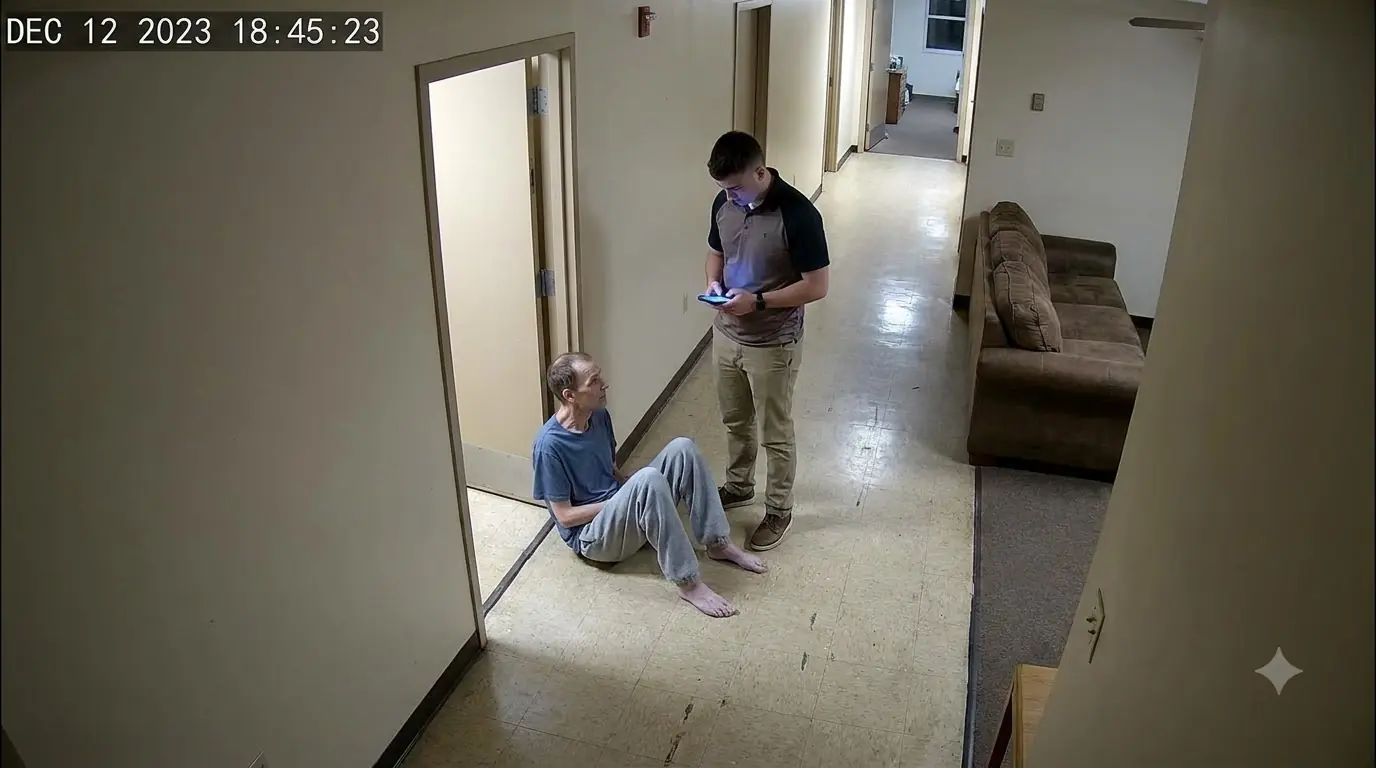
Because the group home had cameras that recorded both video and audio, investigators hoped they could independently test what Kirsten had reported. While Allan remained in critical condition, Dante was brought in for questioning. He told the detective he had worked at River Support Services for only about a month or two. Before that, he said, he had worked at Pizza Ranch.
Debran later explained that Dante was her neighbor and that she personally knew his aunt. She had told him about the opening at the group home and served as the only reference on his application. Dante had no previous caregiving experience, but Debran did not believe his age alone should have disqualified him because, as she told the officer, the facility had other employees who were 18 or 19 and were "phenomenal." Dante told detectives he had been at River Support Services only about a month or two and had previously worked at Pizza Ranch. His short time in direct care would become important as investigators examined what training he had actually completed.
According to Debran, Dante missed several required training sessions, including instruction related to de-escalation techniques, CPR, and medication administration. The source also indicates that despite those gaps, she still permitted him to give medication to residents, including Allan. That raised an obvious question about supervision inside a home serving people who could not always protect or advocate for themselves. Investigators were not yet building a case against the facility itself, but the employment history helped explain why a 19-year-old with little experience had been placed in a position requiring judgment, restraint, and specialized caregiving skills. For the immediate investigation, however, detectives remained focused on what had happened between Dante and Allan during the previous shift.
After Dante was advised of his rights, the detective confronted him directly. "Another one of your coworkers said they saw you kicking him when he was on the ground," the investigator said.
Dante initially sounded surprised. He then tried to explain that when Allan was on the floor, he sometimes did not know how to move him, so he would use his feet to maneuver him. The detective pushed back, telling him the witness had described stomping, not simply guiding someone across the floor. The investigator also reminded Dante that injuries like Allan's did not come from casual contact.
Then came the cameras. "You do know there are cameras in that facility, right?" the detective asked.
"Yes," Dante answered.
"What do you think those cameras are going to show?"
Investigators reviewed the footage from the group home. Early in the recording, Kirsten could be heard calling Allan over to check his weight. Afterward, Dante escorted him toward his bedroom. Allan fell to the floor, and Dante appeared to use his feet to move him forward. Dante later attempted to describe that part of the encounter as a practical response to Allan sprawling out when he went down.
The detective then showed Dante a photograph of Allan's body. The image revealed a large, dark bruise extending along much of one side of him, from his upper back toward his lower body. "Who's that?" the detective asked.
"That's Allan," Dante said.
The detective asked whether the injury looked like something caused by a harmless nudge. Dante admitted it did not. He said he was nervous and did not like seeing the photograph. The investigator left the image where Dante could continue looking at it, making clear that Allan could not explain for himself what had happened and that the physical evidence had to speak for him.
The video provided more context. After the first hallway encounter, Dante returned to the couch and appeared to start playing a game on his phone. Allan later came back out of his bedroom and lingered nearby. Dante appeared agitated by his presence, got up, and took Allan back toward the room. Once the two moved beyond the camera's direct view, the microphones captured several loud thuds from off screen. A command to get out of the area could also be heard before Dante came back into view.
Dante then returned to the couch and to his phone. Kirsten, who had passed him and Allan while moving through the hallway, did not simply ignore what she had seen. She went quickly into the office and alerted Debran. Debran remembered Kirsten coming through the door shortly after 7 p.m., speaking urgently, and telling her there was something she needed to know about Dante and Allan. Debran immediately wanted to confront him, while Kirsten initially urged her to wait.
When Dante was eventually called into the office, Debran asked whether he had kicked Allan. The conversation captured on the facility system was less decisive than what investigators would later hear in the interview room. Staff told Dante that the way he had moved Allan with his leg looked bad on camera and reminded him that employees were not supposed to put hands on clients. There was discussion suggesting other staff had sometimes used their feet to create space or guide a resident, which blurred the seriousness of what had just been reported. Most importantly, Dante was told he was not in trouble and was essentially warned to be more careful before a higher-level supervisor saw the footage.
That reassurance mattered. Instead of being immediately separated from Allan, Dante returned to the resident's area. In hindsight, investigators were now looking at a moment when a witness had raised an alarm, a manager had asked a direct question, and yet the accused caretaker remained in contact with an exceptionally vulnerable man who would soon deteriorate medically. The footage preserved not just the alleged assault, but the facility's immediate reaction to the warning.
Not long afterward, Dante reported that Allan was struggling to breathe. Kirsten returned to assess him and immediately noticed a dramatic change. She later described him as ashen in color, breathing strangely, barely responsive, and no longer acting like the man she knew. Within roughly 45 seconds of evaluating him, she said she looked at Dante and ordered him to call 911 because "something is wrong with my guy."
During the emergency call, Dante struggled to describe what he was seeing. He told the dispatcher that one of the clients had become pale, was not walking around, was barely moving, and was breathing heavily. When asked whether Allan was fully alert, he answered that he was not. The call itself did not explain how Allan had reached that condition, but it established how abruptly the situation had become a medical emergency.
Kirsten later emphasized how unusual Allan's lack of resistance was. She had seen him fight hard against being taken to the hospital before, to the point that paramedics sometimes had difficulty getting him onto a stretcher. Even when he was in pain, he hated leaving the home for medical treatment. This time, she said, she picked him up and he barely moved. That single change in behavior told her more than words could have.
Paramedics arrived, and another resident became worried as emergency workers moved through the home. Kirsten, visibly shaken, went into the office while Allan was being treated. At that point, the situation was no longer a vague staff concern. A medically fragile, largely nonverbal man had suffered severe injuries during a shift in which another employee had been seen using force against him.
Back in the interrogation room, the detective pressed Dante again. He described the broken ribs and Allan's difficulty breathing, then reminded Dante that Allan could not simply sit across from investigators and tell them what happened. A witness could describe part of it, and the camera could capture part of it, but the detective wanted Dante to explain the rest. Dante said he did not know what to say.
The investigator left him alone with the photographs for a time. While alone, Dante took a quick picture of the images and sent it to his aunt. When the detective returned with another officer, the pressure increased. This time, Dante's story began to change.
He admitted that Allan would not get up and that he became frustrated. "He wouldn't get up, so I kicked him," Dante said.
The investigators asked Dante to demonstrate how he had kicked Allan and pressed him on the force. He acknowledged that the kicks had been "pretty hard." They deliberately gave him a wide number, asking whether they were talking about 100 kicks. Dante denied anything close to that. When they narrowed the question and asked whether it had been more than 10, he settled around that range, again acknowledging the force had been substantial rather than a gentle attempt to move someone.
That still was not the end of the admission. Investigators had noticed a point in the footage when Dante appeared to react as though one of his hands hurt. They asked whether he had also punched Allan. Dante admitted striking Allan's body and then acknowledged punches to his face, including around the mouth and jaw. The detective asked him to show how his hand had been positioned, continuing to test his account against the injuries and the video. By this stage, the original explanation that he had merely maneuvered Allan with his feet had collapsed into an admission of repeated intentional force.
When investigators once again left him alone, Dante quietly said, "I'm sorry."
Following the interview, Dante was arrested for aggravated assault. At that stage, Allan was still alive, and the case centered on the severe injuries he had sustained. But only days later, investigators learned that Allan's medical situation was even more fragile than they had first understood.
Police records described a long-standing blood disorder that had progressed to the point that open-heart surgery represented Allan's only treatment option. Doctors did not believe he was strong enough to survive the procedure. Instead, he was returned to the group home under hospice care, where staff attempted to keep him comfortable while his condition deteriorated. The timing complicated the legal picture because investigators now had to distinguish between the role of Allan's pre-existing disease and the consequences of the trauma documented after Dante's shift.
Twelve days after the assault, 37-year-old Allan Edward Wright died. Debran later described him as probably the most fragile person in the facility. She said the bruising was extensive when he returned from the hospital and that he could no longer move normally. The source includes graphic descriptions of the discoloration across his body, but the central point was that staff were seeing consequences far beyond the ordinary bruising they had once associated with Allan's self-injury. Because he was nonverbal, staff often had to interpret his pain through changes in his breathing, shaking, sweating, wakefulness, and physical distress rather than through words.
Debran recalled staff calling her because they could tell Allan was suffering despite efforts to manage his pain. She described the final days as extremely difficult and said Allan remained awake for long stretches before he died. Her account was emotional and angry, particularly because Dante had already been released on bond by the time she was later interviewed about what had happened.
A subsequent autopsy documented seven fractured ribs and internal injuries that remained visible. The medical examiner determined that Allan's cause of death was blunt-force trauma, with a pre-existing medical condition listed as a contributing factor. The manner of death was ruled a homicide. That finding fundamentally changed the stakes of the case against Dante.
Debran also expressed frustration at people who, in her view, minimized what had happened because Dante was young or had no previous record. She had heard people describe him as a good kid who deserved only probation or characterize the incident as a single moment in which he had snapped. Her response was simple: Allan was dead, and whatever people believed about Dante's life before the incident could not erase that fact.
At the time Debran spoke with investigators, Dante was 19 and out on bond. Although he had apologized during questioning, she said it was difficult for her to watch him continue ordinary daily life while Allan was gone. She described seeing him around the neighborhood, dressed casually, smoking, getting into his truck, and carrying on. To her, the contrast was unbearable.
The criminal case continued. According to the court records described in the source, Dante Garriot eventually entered a guilty plea in June 2025 to mitigated deliberate homicide. He was sentenced to 35 years in prison, with 10 years suspended. The sentence meant that the case that began as an Adult Protective Services report about unexplained injuries had ultimately become a homicide prosecution centered on a vulnerable man who could not speak for himself.
The consequences extended beyond Dante's sentence. River Support Services, the group home where Allan had lived, permanently closed after his homicide. The closure did not erase what had happened, but it marked a recognition that the case had exposed failures larger than a single confrontation. Questions remained about why an inexperienced teenager had been hired on one reference, why required training had been missed, why he was still administering medication, and why a witness report of physical force did not immediately remove him from contact with Allan.
Allan's name also became connected to a change in Montana law. In May 2025, Montana's governor signed what became known as Allan's Law, legislation intended to strengthen protections for vulnerable people in caregiving settings. The measure increases penalties for employees and volunteers at caregiving facilities who commit certain offenses against vulnerable people entrusted to their care. Under the law as described in the source, courts may add an additional one to 10 years of imprisonment on top of the sentence for the underlying offense.
The timing of the law was notable because it was signed before Dante entered his June 2025 plea. Its purpose went beyond one prosecution. Allan's case had become an example of how difficult it can be to uncover abuse when the victim is largely nonverbal, medically fragile, visually impaired, and dependent on the very people responsible for documenting his daily condition. The law carrying his name was framed as an effort to recognize that imbalance of power and increase the consequences when caregivers exploit it.
The case began with a witness trying to explain the difference between moving someone with a foot and stomping on them. It ended with surveillance footage, physical evidence, a changing interrogation story, a homicide ruling, a guilty plea, a prison sentence, the closure of the care home, and a law carrying Allan Wright's name. What made the investigation possible was that Allan did not have to rely on his own voice alone. Kirsten spoke up, the cameras preserved what happened around him, and the injuries documented at the hospital forced investigators to keep asking the question Dante could no longer answer with a misunderstanding: what really happened to Allan that night?