The Apache woman was terrified and ashamed, but the rancher's daughter asked, "Is she my new mama?" The desert shimmered like hammered brass beneath the noon sun. Dust rose from the road in trembling waves, curling around the feet of a young Apache woman walking alone. Her name was Yanni, though no one had spoken it kindly for a long time. Sweat streaked the dirt on her face. The air burned her lungs until every breath tasted of metal.
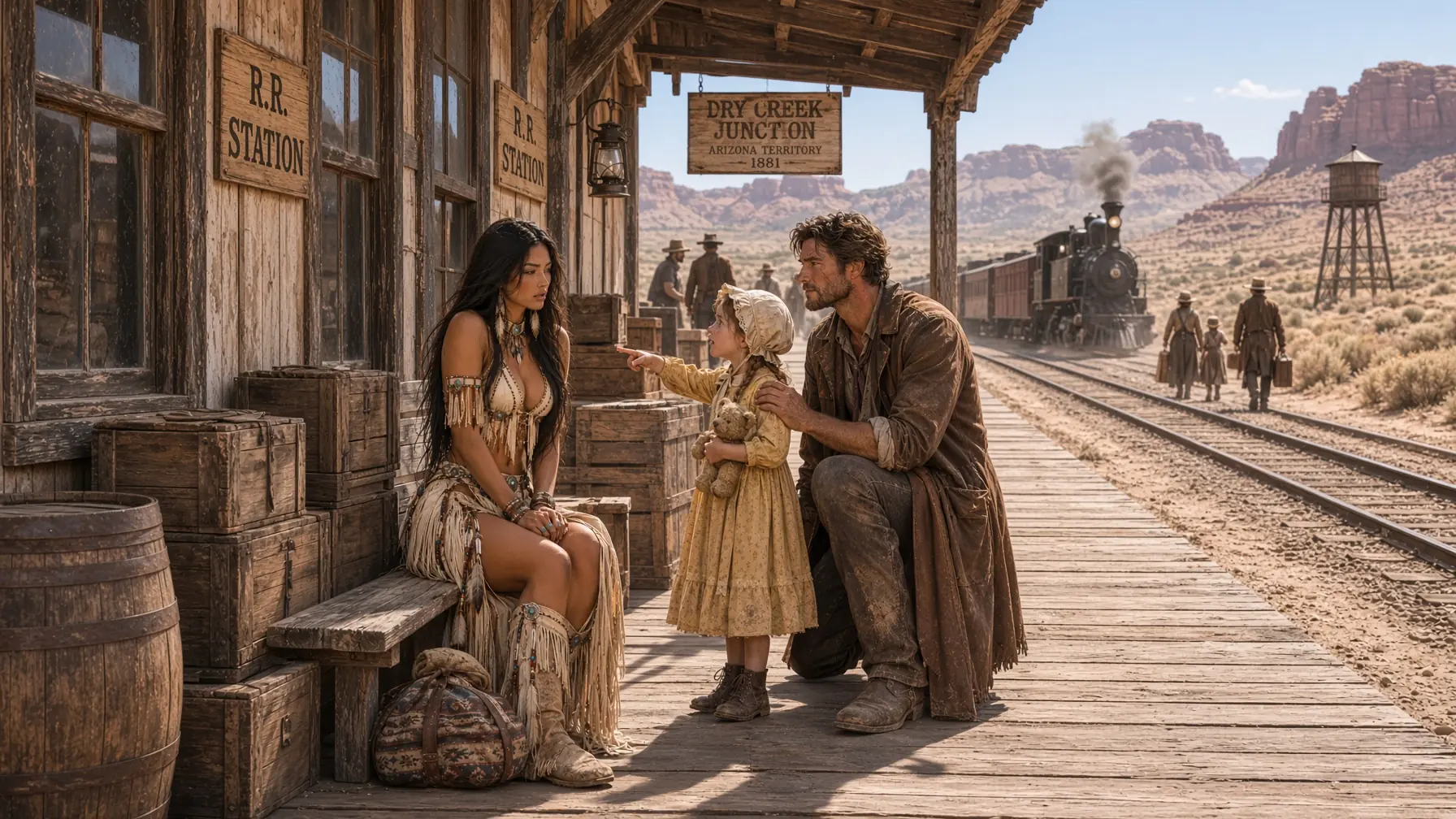
Behind her lay the Holloway Ranch, a place that had called her servant, then witch, then worse. They said she'd bewitched a white man. They never said he'd been drunk. The coins they threw still clinked in the small cloth bag at her side, each one cutting deeper than a lash. Ahead.
The land was empty but for a station sign half-buried in dust: Dry Creek Junction. She didn't know where the next train would take her, only that it would carry her farther from shame and closer to silence. By the summer of 1881, the Arizona territory lay scorched beneath a pitiless sky. The drought had lasted so long that even the coyotes stopped howling at night. Their voices cracked into silence.
Yucca blades stood brittle as bone, and every hoofstep on the dry ground echoed like a hammer striking stone. The air itself carried a strange metallic scent as if the desert were smoldering from within. At the edge of this forsaken valley, a small railway station leaned beneath its own dust. Dry Creek Junction, no creek left, only thirst. Freight wagons creaked nearby, and the few travelers who waited for the afternoon train kept to the shade, glancing often at the sky, as though rain might remember them.
Yanni sat apart from them all, on a bench sun-bleached to the color of bone. Her dress, once pale blue, had turned the gray of ash. A small bundle lay by her feet, a folded blanket, a comb carved from mesquite, and a string of worn beads she had not dared to sell. Her hair, long and dark as a raven's wing, was braided loosely over one shoulder. Her skin glowed warm against the dust, but her eyes dark still and wary told of someone who had learned not to expect kindness.
She did not flinch when she heard the hiss of the arriving train. Steam burst into the air like a sudden storm, doors opened, passengers stepped down, and the quiet station came to life for a moment. Among them was a tall man carrying a child on his hip. He moved with the weary steadiness of someone used to hard work and long silences. Alden Ror wore the sun on his skin and the desert in his eyes, a gray that caught the light like weathered steel.
His shirt sleeves were rolled to the elbow, revealing scars faded to pale lines. A man who had seen more battles than he cared to name, and survived only by learning when to speak and when to keep still. The little girl in his arms, June, no more than five, squirmed until he set her down. She smoothed her faded yellow dress and looked around with the innocent curiosity that only children carried. Her gaze landed on Yanni.
"Is she my new mama?" The words fell into the stillness like a stone into water. The chatter stopped. Someone coughed. Yanni's heart stuttered, not from shame this time, but shock. Alden knelt beside his daughter, resting a hand on her small shoulder.
His voice was low, even. "Don't speak out of turn, June Bug." Then he turned to Yanni. For a moment, he simply studied her the way she sat straight despite exhaustion. The defiant set of her jaw, the quiet tremor in her hands. There was something in her that reminded him of the land itself.
Proud, scarred, still standing. I'm looking for help at my ranch, he said finally. It's ten miles west. Works honest. I don't ask questions you don't want to answer.
Yanni hesitated, her throat tight. She saw no mockery in his face. No pity either, only a plain truth. She nodded once. Alden tipped his hat in silent agreement, then lifted June back into his arms and walked toward the wagon, waiting beyond the fence.
Yanni gathered her bundle and followed behind them. The station faded into the shimmer of heat ahead. The long red road stretched toward the Chiricahua Mountains, where a place called Coyote Bend Ranch waited beneath the weight of sun and silence. and where for the first time in months someone had spoken to her without the word Apache wrapped in contempt. The road to Coyote Bend Ranch wound through miles of cracked earth and msquet thorns. By the time the wagon reached the valley, the sun had turned the world to brass.
Ahead the ranch appeared like a mirage low fences, a windmill creaking above an empty water trough and a house built of weathered pine leaning into the wind. A banner of smoke curled from its chimney, fragile against the white-blue sky. When Yanni stepped down from the wagon, the heat pressed against her skin like a hand. She stood still, unsure whether to move until a soft gravelly voice broke the silence. "New face," said an old man, leaning on the corral rail.
His skin was the color of sun-worn cedar, and his hair hung in two silver braids. "Kai Nantan," the others called him, Apache, like her, though older by decades. His eyes met hers briefly, and in them she saw the rarest thing. No suspicion, only quiet recognition. From the cookhouse door emerged May Booker, full-bodied and brisk, apron flapping in the wind.
"Mr. Ror, is that the help you finally found?" Well, she's half the size of Eli, so I expect she'll work twice as smart. A deep laugh came from behind her. Eli Booker, May's husband, a mountain of a man whose skin gleamed like polished walnut. He carried a bucket in each hand as if they weighed nothing. "Welcome, miss," he said warmly.
"Don't mind my wife. She scares rattlesnakes for breakfast." May swatted at him, chuckling, and turned to Yanni. "Come along, child. Let's get you some water before you melt." As Yanni followed, she caught sight of another figure lounging near the barn. A young man in a wide hat, plucking lazy notes from a battered guitar. Tomas Rivera, she later learned, a Mexican drifter who sang more than he spoke.
He raised his hand in greeting, the melody twining with the hum of the windmill. Inside the house smelled of flour, wood smoke, and coffee gone cold. The scent alone felt like a kind of peace. May poured her a tin cup of water. "You can call me May.
We keep our own rhythm here. You'll find it soon enough." Yanni nodded, murmuring, "Thanks." Her voice came out hoarse from days of silence. That night, she lay on a narrow cot in the small room off the kitchen. Through the window, she saw the vast sky spread like black velvet, stars sharp as needles. She thought of the townspeople's laughter, of the cruel words that had followed her all the way to Dry Creek, and how Alden Ror hadn't asked a single one.
The next morning began before sunrise. Roosters crowed, hooves stamped the dry ground. Yanni joined May at the stove. Her movements quick and precise. No one told her what to do.