No one at Copper Creek believed Emmett Knox had a chance. The gray stallion had already thrown good riders into the dirt, snapped ropes, and scared half the trading post away from the corral. Then Nollie, a young Apache woman with a sharp eye and an even sharper tongue, laughed and made a promise she never expected to keep. Tame that horse, cowboy, and I'll marry you. The joke died the moment Emmett climbed the fence without a rope, a whip, or a gun.
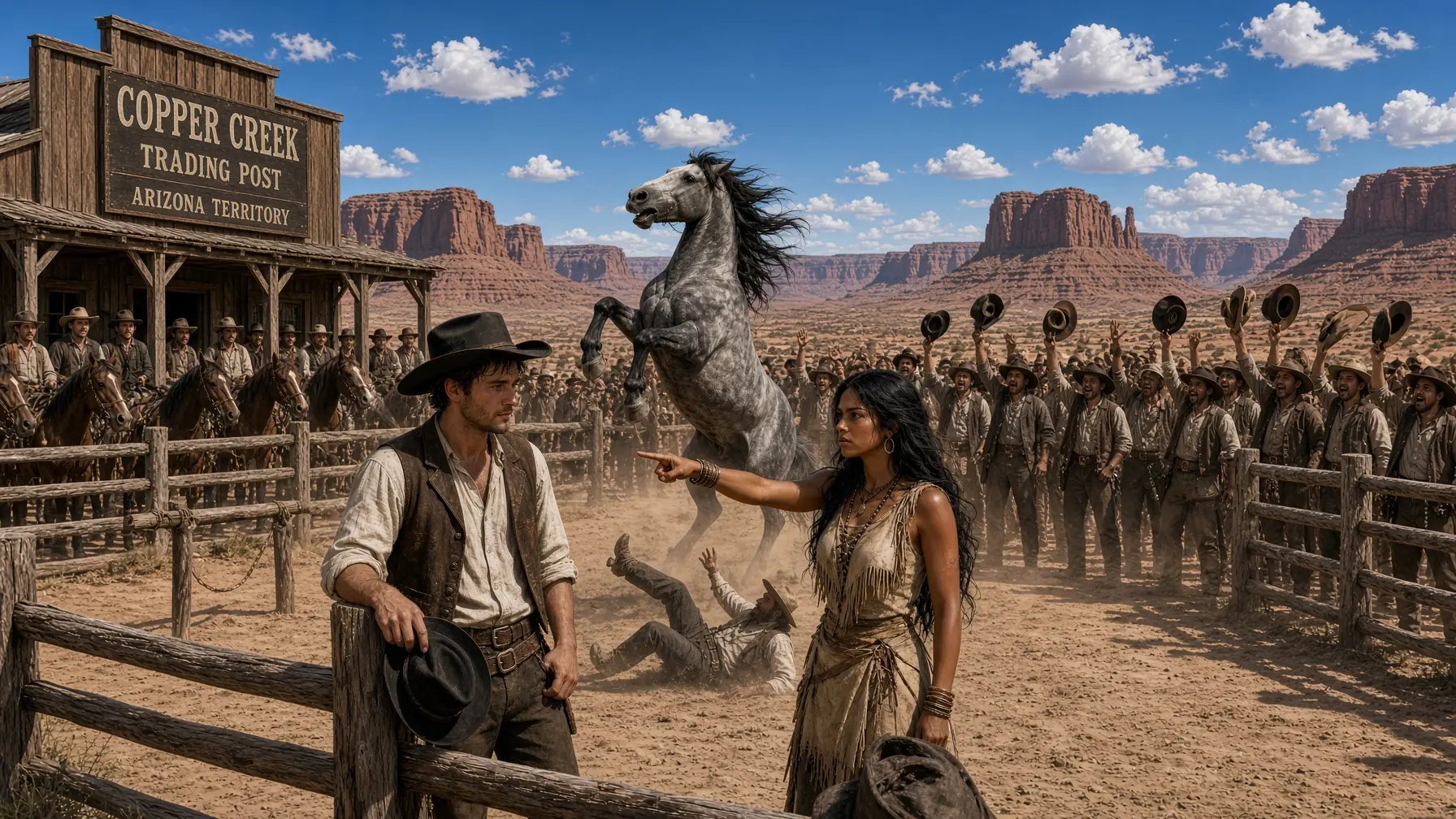
There was no turning back now. One wrong move could leave him broken under pounding hooves. But Emmett had already chosen his price. He would risk his body before he used fear to win. And before you judge Nollie for laughing, remember she had watched every man before him try strength first.
By sundown, neither of them would see courage, trust, or each other the same way again. In the spring of 1876, Copper Creek sat under an Arizona sky so wide a man could feel small just looking up at it. Red mesas burned in the distance. Mesquite twisted out of hard ground, and every rancher in the country watched the creeks as closely as he watched his cattle. Water decided who stayed, who moved, and who survived another season.
Emmett Knox knew that country well. At 29, he had already spent 11 years pushing cattle, mending fence, sleeping beneath open stars, and taking work wherever a steady hand was needed. He was not famous for drawing fast, or talking loud. Most men who knew his name knew it because of horses. Animals other cowboys called spoiled, mean, or ruined tended to settle around Emmett.
His father, Abner Knox, had taught him why. When Emmett was still a boy, Abner once spent nearly 2 hours standing inside a barn with a frightened mare that had been beaten by a previous owner. He never cornered her, never raised his voice. He simply waited until the mare stopped seeing him as another threat. Later, Abner told his son, "Fear can make a horse obey you.
Trust is what makes him stay." Emmett carried those words long after fever took Abner when Emmett was 17. That spring morning, Emmett had just finished helping move a small herd nearly 40 miles from his own modest place. With the job done and several hours of daylight left, he turned Scout, his dependable gelding, toward Copper Creek Trading Post for flour, coffee, and a few other supplies. He expected a quiet stop.
Instead, he heard shouting before he reached the Cottonwoods. Copper Creek was busier than usual. Wagons crowded the open ground. Horses stood tied shoulder to shoulder along the hitching rails. Ranch hands, traders, hunters, and Apache families had gathered in a tight circle near a wooden corral behind Gus Marorrow's store.
Emmett swung down from scout and tied him beside a freight wagon." What happened? " he asked Gus. The trading post owner jerked his chin toward the corral." That happened. Inside stood the biggest gray stallion Emmett had seen in years.
The horse was dust-colored from shoulder to flank with a black mane tangled against a powerful neck. Sweat darkened his chest. His nostrils flared. One broken rope lay near the fence. Another farther out in the dirt.
He's been running wild up north, Gus said. Caught him two days ago. Men been trying him since sunrise. And he stayed on? Gus gave a dry laugh.
Long enough to regret climbing aboard. A cheer suddenly went up as another cowboy approached the gate, but the stallion slammed both front hooves against the dirt and lunged toward the fence. The cowboy stopped. So did the cheering. Emmett said nothing.
He watched the horse's ears, the tight jaw, the whites showing around his eyes, the way his body kept searching for an opening that was not there. Around him. Men called the stallion vicious, crazy, unbreakable. Emmett saw none of those things. He saw an animal that had been free 3 days earlier and now had nowhere left to run.