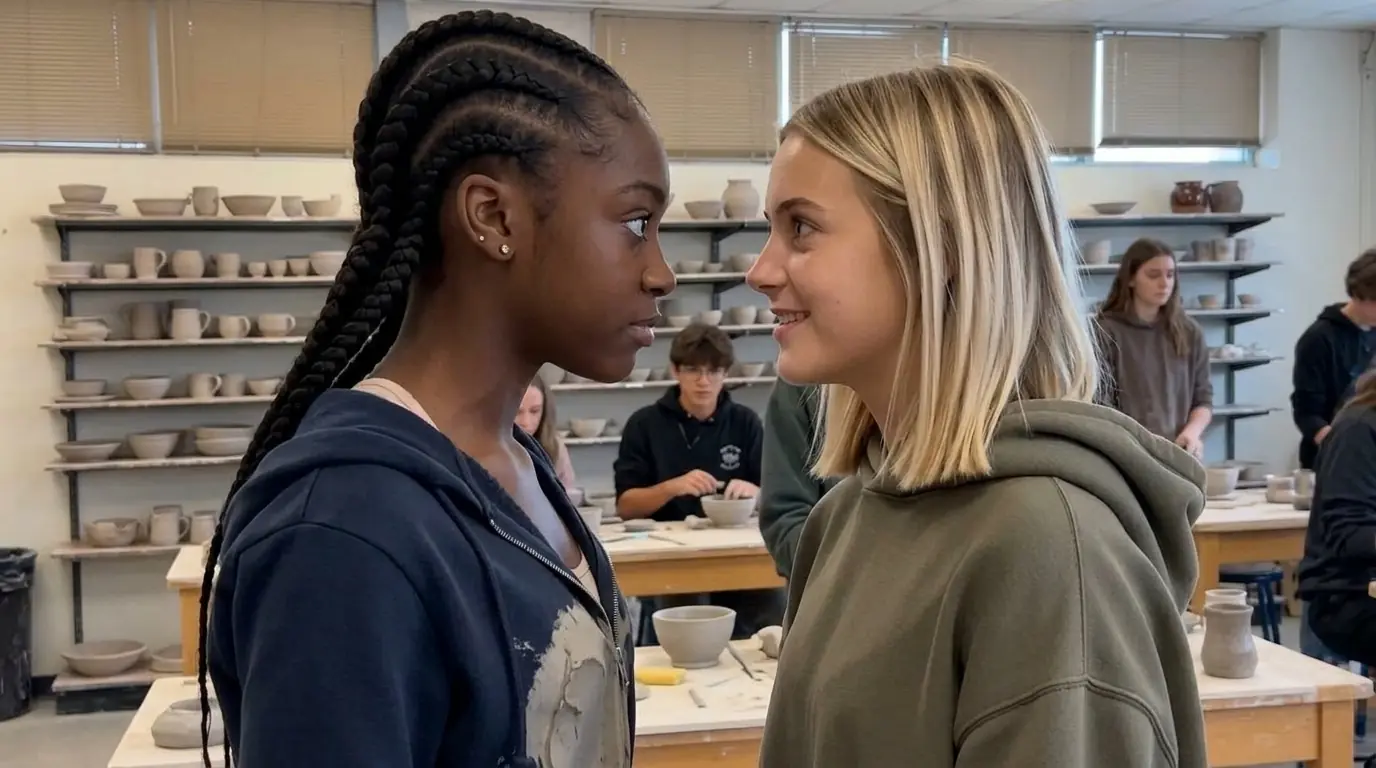
The first piece of pottery Sanaa Jefferson ever sold went for forty-two dollars to a woman whose name she never learned. It happened on a Sunday evening in late August at the Franklin County Community Arts Center, where folding tables had been arranged beneath strings of patio lights and local students were allowed to donate one piece each to raise money for free children’s art classes. Sanaa had almost kept her bowl home because the rim leaned slightly to one side, the glaze pooled darker near the bottom, and one thumbprint remained visible beneath the blue-gray finish. Her ceramics teacher, Dana Mercer, told her those were exactly the reasons somebody might want it.
The woman who bought it was probably in her sixties, wearing a yellow raincoat even though the sky had been clear all afternoon. She picked up the bowl, turned it slowly in both hands, and traced the raised leaf pattern Sanaa had carved around one side. “This feels like something somebody actually made,” she said, which Sanaa found funny because every piece on the table had been made by somebody. The woman paid forty-two dollars, carried the bowl away in a newspaper-lined box, and never asked Sanaa where she went to school, what her grades were, what neighborhood she lived in, or why a Black girl had chosen ceramics.
That became important later.
At seventeen, Sanaa had grown used to people wanting explanations for things she considered ordinary. Why ceramics instead of track? Why did she speak “so formally” in presentations? Was her hair difficult to maintain? Had she always lived in Briarwood, Ohio, or had her family moved there through some special housing program?
Usually she answered once and moved on. Her mother, Vanessa Jefferson, called it the tax people charged when curiosity and assumptions wore the same coat. Her father, Derrick Jefferson, preferred a simpler strategy: make people finish their own questions until they heard how strange they sounded. Sanaa used both methods depending on how tired she was.
The Jefferson family lived in a brick split-level house about twelve minutes from Hawthorne Ridge High School, where Sanaa would begin senior year the following morning. Vanessa managed outpatient scheduling for a regional hospital network, while Derrick inspected commercial electrical systems for the county. They were neither the wealthiest family in Hawthorne Ridge nor remotely close to the poorest, though Sanaa would spend much of senior year listening to other people invent a financial biography for them. Her younger sister Naomi mostly cared whether college would leave Sanaa’s bedroom available for takeover.
Sanaa had discovered ceramics sophomore year after choosing the class only because digital photography was full. She expected to spend one semester making ugly mugs and switched electives; instead, she liked the physical stubbornness of clay. A piece could collapse because she rushed, crack because she dried it incorrectly, warp because the kiln behaved differently than expected, or become beautiful for reasons she had not planned. Clay did not care whether she was impressive.
By junior year, Ms. Mercer had given her independent shelf space near the kiln room. Sanaa made bowls, cups, narrow-necked vases, sculptural hands, and a series of vessels covered in repeating carved lines inspired partly by basket patterns her grandmother kept around the house. She never described the work as an exploration of Black identity because most of the time she was thinking about balance, shape, texture, and whether the glaze would crawl during firing. Other people became much more interested in defining what the work represented than Sanaa ever was.
The first of those people was Mackenzie Holt.
Mackenzie was seventeen, white, blonde, broad-shouldered from years of volleyball, and socially comfortable in the effortless way that usually came from knowing a place belonged to you. She wore oversized hoodies, leggings, expensive sneakers made to look ordinary, and a rotating collection of silver rings that she removed before touching clay. Her mother served on the county arts foundation board, and her father owned two dental practices outside Columbus.
Mackenzie was genuinely talented. That mattered to Sanaa later because jealousy was easier to understand when nobody had to pretend one girl possessed skill and the other did not. Mackenzie threw beautifully balanced forms on the wheel, understood glazes better than most students in Advanced Ceramics, and could produce sets of nearly identical cups with a consistency Sanaa envied.
They had been friendly during junior year. Not close enough to text each other about personal problems, but close enough to borrow tools, compare firing schedules, and complain about Mercer requiring sketches before anyone touched clay. Once, when Sanaa ruined three bowls in a row, Mackenzie stayed after class to help her diagnose the problem.
Nothing dramatic happened between them then.
Senior year changed after Hawthorne Ridge submitted student work to the Ohio Young Artists Fellowship, a statewide competition offering twelve high-school seniors six thousand dollars each toward college or approved art training. Schools could submit up to eight portfolios. Every portfolio was digitally anonymized before the first two rounds of judging, with names, schools, photographs of students, and biographical statements removed.
Ms. Mercer nominated Sanaa, Mackenzie, and three other Hawthorne Ridge students.
Mackenzie had been planning for the fellowship since sophomore year. Her mother knew several people in the regional arts community and had encouraged her to develop a cohesive portfolio early. Sanaa had barely known the fellowship existed until Mercer placed an application packet beside her wheel.
“You need ten finished pieces,” Mercer said. Sanaa looked toward the shelf where three of hers currently had cracks and replied, “Then I need a miracle.” Mercer told her she needed November, which was usually cheaper.
For two months, Advanced Ceramics became an unofficial fellowship workshop. Students arrived before school, stayed during lunch, and kept Mercer in the building until custodians began turning lights off around them. Sanaa developed a series of bowls and vessels built around repaired surfaces—intentional seams, overlapping slabs, fingerprints left visible, and textured patches added rather than sanded away.
She called the series Evidence of Hands.
Mackenzie’s collection was completely different. She created elegant porcelain vessels decorated with delicate red geometric lines, each piece almost impossibly smooth. Even Sanaa believed Mackenzie had an excellent chance of winning.
That was why the first comment surprised her.
One afternoon in October, Mercer announced that a local museum educator would review portfolios before submission. Mackenzie looked across the worktable toward Sanaa’s pieces and said, “They’re probably going to love yours because it has such a strong cultural angle.”
Sanaa looked up. “What cultural angle?”
Mackenzie gestured toward the carved patterns.
“You know, the woven-looking stuff.”
“They’re just patterns.”
“I thought they were African.”
Sanaa laughed. “My grandmother bought the basket I copied from Target.”
Two students nearby laughed too.
Mackenzie did not.
“Oh.”
Sanaa expected that to end the conversation. Instead Mackenzie said, “Well, it still reads that way.”
“Reads what way?”
“Cultural.”
Sanaa stared at her.
Mackenzie immediately raised both hands. “That’s not an insult.”
“I didn’t say it was.”
“You looked offended.”
“I looked confused.”
Mercer called the class together before either could continue.
The moment seemed too small to remember. Sanaa probably would have forgotten it if another comment had not arrived the next week. During critique, Mercer praised the visible fingerprints on one of Sanaa’s bowls because they gave the surface movement.
Mackenzie said, “Raw authenticity is definitely having a moment.”
Nobody responded.
Sanaa looked toward her.
“What?”
“Nothing.”
“What does raw authenticity mean?”
Mackenzie pointed toward the bowl.
“Exactly what Mercer said.”
Mercer had not used either word.
Sanaa noticed but decided not to argue.
Her best friend Tessa Nguyen, who took photography next door and usually met Sanaa after class, heard about the comments while they walked toward the buses. Tessa said Mackenzie was trying very hard to describe Sanaa’s work without simply calling it good. Sanaa defended her.
“She likes clean work.”
“So?”
“So maybe she genuinely doesn’t like mine.”
Tessa nodded. “Not liking it is normal.”
She waited.
“Explaining why everyone else will like it is different.”
Sanaa hated when Tessa made good points in calm voices.
She ignored the issue anyway.
In November, fellowship portfolios were submitted.
The judges would not announce semifinalists until January.
Senior life moved elsewhere.
College applications arrived.
Basketball season started.
The theater department discovered water damage inside its costume closet.
Naomi stole one of Sanaa’s hoodies and denied it while wearing it.
For nearly two months, Mackenzie and Sanaa were normal classmates again.
Then the semifinalist email arrived during fifth period.
Two Hawthorne Ridge students advanced.
Sanaa Jefferson.
Mackenzie Holt.
Mercer announced it at the end of class and the entire room applauded.
Mackenzie walked directly to Sanaa and hugged her.
For that afternoon, competition felt healthy.
The second judging round was also blind.
Semifinalists submitted three additional photographs and a short artist statement stripped of identifying personal details before being sent to judges.
The final twelve were announced in February.
Sanaa won a fellowship.